László Krasznahorkai, Nobel Prize laureate in Literature: ‘My Hungary is that of language, not of hussars’
The author of ‘Satantango’ speaks in Barcelona about his country, the Shoah, his favorite authors and the filmmaker Béla Tarr: ‘I don’t offer hope, although I don’t take it away either’
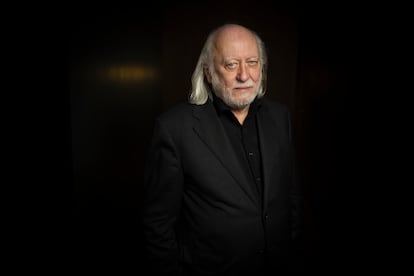

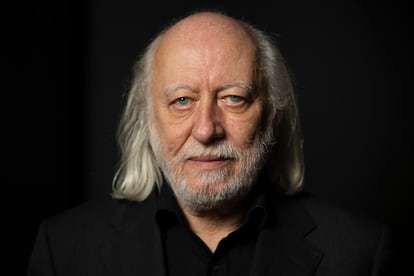
Haloed by the Nobel Prize in Literature and by the wisps of white hair that — along with his gray beard and piercing blue eyes — give him the air of an apostle or prophet, the Hungarian writer László Krasznahorkai,72, greets us in the bar of the Alma Hotel after having indulged the day before — in an unusual public appearance for an author as refined and demanding as he is — at the Center for Contemporary Culture in Barcelona (CCCB).
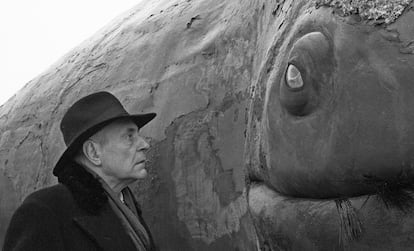
The author of Satantango and The Melancholy of Resistance is dressed entirely in black and looks surprisingly tanned; he is also in excellent spirits and appears approachable and affable, though his mood darkens when he speaks about the political situation in his country. Placing a copy of his book Spadework for a Palace, featuring a bookseller with the same name as Herman Melville, on the table serves to kick off the conversation by recalling a discussion we held in 2024 in Marrakech at the Formentor Literary Conversations about the meaning of the whale that appears in The Melancholy of Resistance.
Question. You denied back then, up to three times, that the whale was a symbol of anything, not of Moby Dick, not of Stalinism, not of greed, not of chaos…
Answer. And I maintain that nothing in my work is symbolic; I don’t like symbols in literature, nor parables, although I have a soft spot for French Symbolist poetry. I hold that book, Spadework, in high regard because it features Melville, Malcolm Lowry, who is one of my favorite authors, and the innovative and visionary American experimental architect Lebbeus Woods. Lebbeus is a biblical name, by the way.
Q. So then, asking you if literature is a tango with the devil…
A. It is for the characters in Satantango. There are happier dances like flamenco, even though it also deals with passion and the devil is also present; you can feel the devil’s influence in flamenco. But in my novel, tango is simply the dance they do there while they wait for a miracle. It’s that and nothing more.
Q. Is it then just realism?
A. Realism is a word associated with a certain era; it’s not what I do. What is realism? The truth is, there isn’t exactly such a thing. If you think about it, even with something as objective as a car accident, witnesses will give different accounts. When you talk about sentimental or emotional relationships, as I do, you can’t say what’s real and what isn’t. You can’t present a situation from a single, correct point of view: what would it be? In fact, it’s a radical shift in the concept of reality, or rather, the disappearance of reality itself.
Q. What are you trying to tell the reader? Some people are left somewhat bewildered by your books.
A. First, I try to convince people not to read me, and I mean it, honestly. I don’t offer hope, although I don’t take it away either. Mine aren’t cookbooks, obviously. You can’t cook a good meal with them. They’re like a paella I made once. It turned out badly; I had all the ingredients for paella, but the combination just didn’t work, and it even made me feel sick.
But if someone, despite everything, decides to read my books, I advise them not to believe anything that’s been said about them. The bit about them being difficult to read. It’s true that I use unusually long sentences [in fact, he uses only one in 400 pages in Herscht 07769, about a character who wants to warn Angela Merkel about the end of the world while working as a graffiti cleaner for an amateur neo-Nazi orchestra conductor].
It’s like when you keep a secret for a long time and suddenly blurt it out: “How I love you, Lucía, and I’ll always love you,” and the whole avalanche that follows; you can’t say it in short sentences. The fact that I usually write from that passion for storytelling makes it impossible to use a period. Anyway, it just occurred to me: does anyone care about all this? Who cares how a book is made? We’d be surprised if Samuel Beckett explained how Waiting for Godot came about. I don’t think he had an idea; it just came out that way. Honestly, I can’t say more. I have something in my head, I put it together, and I write it. And if the reader is having a bad day, they buy the book.
Q. If you put it that way…
A. The important thing is for the reader to recognize themselves. How fragile their own dignity is. To realize that this dignity is the last thing that can be taken from them, but that it can be taken. That’s where my friend Béla Tarr and I differed. He believed that a person could not be stripped of their dignity.
Q. Do you feel an affinity with the Hungarian world?
A. Hungarianness… I was born Hungarian, my mother tongue is Hungarian. Hungarianness, I fight against it as much as possible. Why exchange being a citizen of the world for being only Hungarian? My relationship with being Hungarian is like the one you have with a stone on the riverbank. We don’t know why it’s like that. Why wasn’t I born Albanian or Slovak? Far be it from me to ideologize the fact of being from any nation, from Hungary specifically. There are always surges of populism, people who are proud of being Hungarian, of the homeland. Am I proud of the chair I’m sitting in? It’s very damaging how people talk about the homeland in relation to reality. Origin doesn’t have much to do with anything. Certainly, those who speak like me are hated. I like the Hungarian language; I feel very fortunate that my mother tongue is capable of expressing such subtle nuances. But I respect other languages equally and understand that they are cared for, like the Catalan language, in which I have an editor.
Q. I’m getting a sense that you are not really into hussars, Esterházys, Abadys, sabers…
A. [Laughs heartily] You can only laugh at all that. That is, until their supporters catch you in the street and beat you to a pulp. You ask me about the hussars, the homeland, and I keep talking about language. It’s not a coincidence. My Hungary is the Hungary of language, not the Hungary of the hussars. I’ve become so detached from the Hungarian world, from that concept of Hungarianness infected with stupidity. Horrible things happen in all states that are exposed to populism, but nothing equals, in intensity and brutality, what is happening in Hungary. That capacity for manipulation, a source of infection. Hungary is no longer a country; it’s a madhouse from which the doctors have already departed, and where the patients play at being doctors on Mondays, Wednesdays, and Fridays.
Q. History tells us that Hungary always seems to make mistakes at crucial moments. The Treaty of Trianon has weighed heavily.
A. It always makes mistakes at historical crossroads, it always chooses the wrong path. When I said in an interview that I didn’t understand why Hungarians are always so proud of their battles, which they always lose, I was attacked by the far right. There’s no point in arguing. Even people who seem very intelligent are prisoners of ideology. All of this takes us back to the animal world, when what we should really want is to elevate ourselves as human beings. It’s not about accepting or rejecting traditions; few people are more conservative than I am in accepting them from an intellectual standpoint. But, as a Hungarian saying goes, we grind in two very different mills, and bread will never come from their flour. And that has built a sick society, these psychological wounds that could be healed in a different way.
Q. Despite having Jewish roots, the Shoah, the Holocaust, does not appear in your literature.
A. It’s present. Anti-Semitism, racism, criminal stupidity... They’re in my books, in The Melancholy of Resistance, in Satantango... Petty-bourgeois Nazism...
Q. But not explicitly.
A. I haven’t written specifically about the Shoah because Imre Kertész [his Hungarian predecessor in the Nobel Prize for Literature, in 2002], who was a very good friend of mine, already did that. I couldn’t write about it any better. And it’s very dangerous to do so; there are so many kitsch works about the Shoah…
Q. How was it to win the Nobel Prize?
A. Very unexpected for me. I don’t belong to the group of people who sit in front of the screen on the first Thursday of October, watching a closed door and waiting for it to open and a name to be announced. It was very difficult to accept being placed alongside so many names I admire—Faulkner! I still don’t know what to do with the Nobel Prize. It’s something that lifts you to a height where there’s no oxygen, and my lungs need it; it’s a great honor for me. It was courageous of them to choose me, because I’ve always told a story of failures in my books.
Q. Has Béla Tarr’s cinema influenced the reading of your work? Has it somehow stolen your thunder?
A. No, no, Béla never took anything from me, I gave him everything. Look, a book is a book, a novel is a novel, Béla and I worked together, we decided everything together. I helped him with everything he needed. I even convinced him to use things he didn’t want to use. But on a ship there’s a captain and then there’s everyone else. Many writers don’t tolerate that well, so they shouldn’t go into filmmaking. Film has very cruel rules, and they’re necessary.
Q. Kafka and Malcolm Lowry are special to you.
A. There are many writers I admire; these aren’t the only ones by any means, but it’s true that without Kafka, without The Castle, I wouldn’t be a writer. And I owe a great deal to Lowry as well. It’s not a matter of choosing. I encourage everyone to open themselves up and read more authors. If we continue like this, we’re heading toward a world where individual survival strategies will play a decisive role.
Q. In a way, you are also one of the big K writers.
A. Hahaha, an L.K.
Q. Allow me a frivolous question, are you familiar with that other Lászlo, Almásy, the real Hungarian explorer and the one from the novel and the film?
A. Yes, although he’s better known outside of Hungary. A very special and colorful fellow. It would be worthwhile for Hungarians to get to know him better, but I’m afraid it wouldn’t help either.
Sign up for our weekly newsletter to get more English-language news coverage from EL PAÍS USA Edition
Tu suscripción se está usando en otro dispositivo
¿Quieres añadir otro usuario a tu suscripción?
Si continúas leyendo en este dispositivo, no se podrá leer en el otro.
FlechaTu suscripción se está usando en otro dispositivo y solo puedes acceder a EL PAÍS desde un dispositivo a la vez.
Si quieres compartir tu cuenta, cambia tu suscripción a la modalidad Premium, así podrás añadir otro usuario. Cada uno accederá con su propia cuenta de email, lo que os permitirá personalizar vuestra experiencia en EL PAÍS.
¿Tienes una suscripción de empresa? Accede aquí para contratar más cuentas.
En el caso de no saber quién está usando tu cuenta, te recomendamos cambiar tu contraseña aquí.
Si decides continuar compartiendo tu cuenta, este mensaje se mostrará en tu dispositivo y en el de la otra persona que está usando tu cuenta de forma indefinida, afectando a tu experiencia de lectura. Puedes consultar aquí los términos y condiciones de la suscripción digital.