‘Boycott! We don’t buy where we’re not respected!’: Target, the new focus of protests against ICE
The Minnesota-based retail giant has changed CEOs amid strong pressure across the country to take a stand against immigration raids
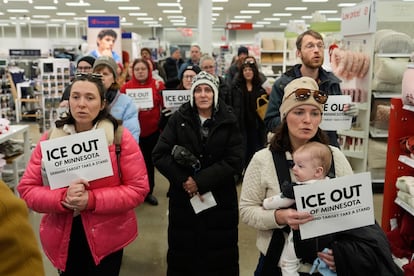
It’s eleven in the morning, and if it weren’t for the snow drifts accumulating on the sidewalks, it wouldn’t seem like it’s 18ºF (-8ºC). Despite the cold, dozens of people are doing something resembling a conga line. Outside the Target department store in Columbia Heights, Washington, protesters carry banners, use megaphones, play drums, sing, and dance as they march in a line, one behind the other, in an endless circle that fills the entire sidewalk.
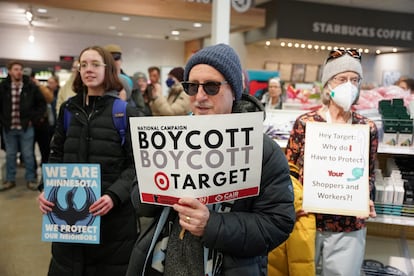
“Say it loud, say it clear, immigrants are welcome here!” They chant. “Say it once, say it twice, we will not tolerate ICE!” they sing while holding up signs with phrases like “Boycott Target” and “ICE out.” This time, the protest against Immigration and Customs Enforcement is taking place outside the store, but last week it was inside. The same group went about buying and returning, one by one, packages of salt. Because salt melts ice, and because ICE is the agency that is detaining migrants across the country and arrested two employees inside a Target store in Minnesota.
Target, one of the largest retail chains in the United States with nearly 2,000 stores and more than 400,000 employees, has been facing a nationwide boycott campaign for a year for “capitulating to Trump and the MAGA movement,” in the words of its organizers. The initiative has led to a drop in sales and prompted the resignation of its CEO in August. But in recent weeks, the movement has gained new momentum after viral videos of what happened at a store in St. Paul. Minnesota is the state where the retail giant originated.
The footage shows Border Patrol agents detaining two Target employees in the store lobby after an argument with one of them. They are forced to the ground, arrested, and placed in an SUV while one of them repeatedly shouts, “I’m an American citizen!” All in the presence of former Border Patrol Chief Gregory Bovino. After verifying their citizenship, they were released. Other videos show at least one of them being released in a parking lot away from the store, where he can be heard sobbing and saying he is bleeding. “They slammed me on the fucking ground,” he says through tears.
Following the incident, the Department of Homeland Security posted a video on X and stated that the employee was arrested “for assaulting federal law enforcement officers” and for “impeding federal agents.” However, it did not explain why he was later released.
“The Trump administration is carrying out a revenge campaign in Minnesota; they’re getting back at its residents because they lost the 2020 election. Black people have been dealing with this for a long time,” says Dante O’Hara, one of the leaders of the Boycott Target coalition in Washington. O’Hara explains that this is precisely why the campaign against Target began a year ago. In January 2025, the company announced it was rolling back its diversity, equity, and inclusion (DEI) policies to try to “be more in tune with the changing external landscape.”
The main element that had changed in that “landscape” was the president of the United States. Donald Trump was sworn in for the second time a few days before Target’s announcement and he signed a series of executive orders to roll back the government’s diversity and inclusion programs. Dozens of other companies followed Target’s lead, from Walmart to Amazon, McDonald’s, Meta, Google and Ford.
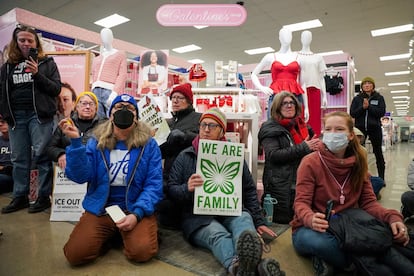
However, the Target case particularly upset many because it happens to be one of the companies that has most proudly touted its progressive values in recent years. The company promised to support Black and minority-owned businesses (a program it also discontinued a year ago), celebrated LGBTQ Pride Month, and was one of the first companies to support same-sex marriage before it was even legalized in the U.S. It was also one of the first big box stores to announce that it would allow transgender employees and customers to choose which restroom to use according to their gender identity.
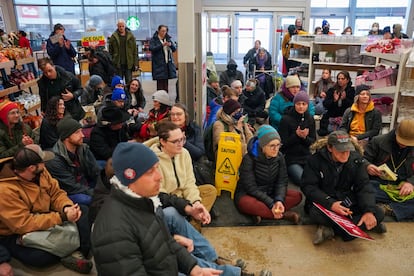
The protests have produced images that have gone viral across the country. Jamal Bryant, an African American Baptist pastor from Georgia, gathered dozens of worshippers outside a Target store and called for a 40-day “Target fast” coinciding with Lent. Bryant appeared on television and radio, arguing that the African American community spends $12 million a day at Target and that “diversity is as threatened as democracy.” In Minneapolis and St. Paul, Minnesota’s Twin Cities and the current epicenter of Trump’s anti-immigrant offensive, dozens of people staged sit-ins inside stores and sang protest songs, some dressed in frog costumes.
“We want them to recommit to the Black community, to commit to doing business with more Black entrepreneurs, and we want their CEO to publicly state that ICE needs to leave not just Minnesota, but everywhere,” emphasized the leader of the protests in the capital. The company’s new CEO, Michael Fiddelke, took office last Monday, just after another weekend of demonstrations outside Target stores in major cities such as Atlanta, New York City, Seattle, Philadelphia, and Chicago, among others. The protesters are threatening to keep going until the company reconsiders its position, hoping to achieve this through the impact on its bottom line.
According to a poll published last year, a quarter of Americans have stopped shopping at their favorite stores for political reasons. Other surveys have found that the typical Target customer is predominantly progressive, in contrast to Walmart’s more conservative consumers.
Target has already acknowledged that the boycott is impacting its sales, which fell more than expected during the first three quarters of 2025. Full-year results won’t be available until March, but its stock has fallen 17% in the last year. Target typically generates around $100 billion in revenue annually (reaching $106.6 billion in 2024), and expects its new figures to be affected by inflation, tariffs, and the federal government shutdown last November—the longest in the country’s history—which delayed paychecks for hundreds of thousands of government employees and food stamps for the most vulnerable.
“There’s no doubt that Target has many problems. These weaknesses have contributed to the decline in sales and market share,” says retail analyst Neil Saunders, who believes the company “didn’t handle communication and crisis management well” when it eliminated its diversity policies. In an attempt to calm the waters, Target’s new CEO joined 60 other CEOs of major Minnesota-based companies last week in an open letter calling for “an immediate de-escalation of tensions.” For many, this came as a surprise because most of these companies have tried to avoid taking a stand on any political issue since Trump returned to power—a silence that contrasted sharply with their strong response to the 2020 killing of George Floyd, an African American man, which triggered a wave of corporate actions against racism.
However, for the protesters, this isn’t enough, and they plan to continue urging people to boycott Target until the changes are much more explicit and the company reinstates all its policies related to minorities and immigrants. “They can’t just break their promises to the Black community like nothing happened,” shouted a spokesperson for the organizations calling for the boycott in Washington. The crowd echoed her: “We don’t shop where we aren’t respected. No diversity? No equity or inclusion? Well, then no dollars either!”
Sign up for our weekly newsletter to get more English-language news coverage from EL PAÍS USA Edition
Tu suscripción se está usando en otro dispositivo
¿Quieres añadir otro usuario a tu suscripción?
Si continúas leyendo en este dispositivo, no se podrá leer en el otro.
FlechaTu suscripción se está usando en otro dispositivo y solo puedes acceder a EL PAÍS desde un dispositivo a la vez.
Si quieres compartir tu cuenta, cambia tu suscripción a la modalidad Premium, así podrás añadir otro usuario. Cada uno accederá con su propia cuenta de email, lo que os permitirá personalizar vuestra experiencia en EL PAÍS.
¿Tienes una suscripción de empresa? Accede aquí para contratar más cuentas.
En el caso de no saber quién está usando tu cuenta, te recomendamos cambiar tu contraseña aquí.
Si decides continuar compartiendo tu cuenta, este mensaje se mostrará en tu dispositivo y en el de la otra persona que está usando tu cuenta de forma indefinida, afectando a tu experiencia de lectura. Puedes consultar aquí los términos y condiciones de la suscripción digital.