Van Gogh’s yellow: more than just a color
The artist’s museum in Amsterdam shows how that tone became a means of expressing emotions and ideas, from warmth to rebellion
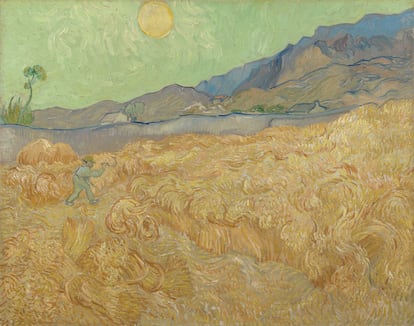

Color is reflected light, and among all colors, few are as significant as yellow for Vincent van Gogh, who explored its possibilities during his stay in Arles, in the south of France (1888-1889). It was there that he painted the series of “Sunflowers,” five canvases depicting the flowers in a vase. For the artist, who had left behind the darkness of his early period in the Netherlands, the complexity of this hue moved him deeply and led him to associate it with the brilliance of the sun. What it meant to him and his colleagues, and how it served as a symbol of modernity and independence in the literature and fashion of the late 19th and early 20th centuries, are the questions that the exhibition “Yellow: Beyond Van Gogh’s Color,” at the Van Gogh Museum in Amsterdam, seeks to answer until May 17.
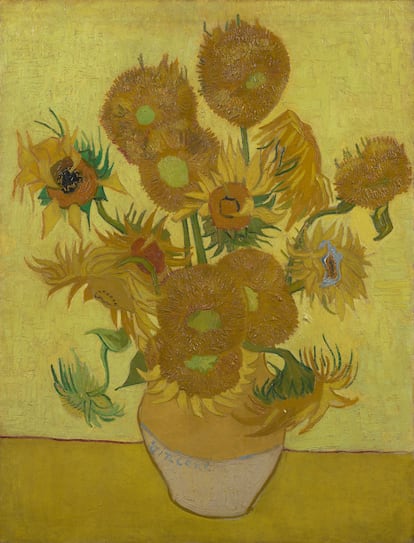
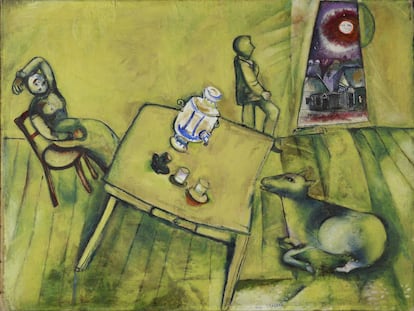
Chagall, Kandinsky, Manet, Turner and Hilma af Klint are among the more than 15 artists and up to 50 works of art brought together by the art gallery around the concept of yellow. For Af Klint, it signified inner growth. In Kandinsky, it is almost intrusive. In the apparent disorder of Chagall’s compositions, there are yellow suns and moons. Van Gogh’s passion for his art is well known, and it is the color he chose for his versions of Sunflowers, between 1888 and 1889, partly to decorate the so-called Yellow House, the building where he rented a studio in Arles with the hope of creating an artists’ workshop, which he depicted in his painting The Yellow House (1888). His friend Paul Gauguin moved there for a time and described the flowers, achieved “with yellow in three shades and nothing else,” as “totally Vincent,” according to the museum’s records. To his brother Theo, an art dealer in Paris and his main supporter, the Dutch artist wrote that he was painting “with hard or broken yellows, with the enthusiasm of a Marseillais eating bouillabaisse.”
Both paintings hang in the exhibition, but 40 years before that dazzling moment, another painter, William Turner, who ushered in modernity with his effects of fog, vapors and diffused light, had already declared that “the sun is God.” Tate Britain in London has loaned his painting Going to the Ball (San Martino), from 1846, and according to critics of the time, Turner dabbled his canvases with oil and vinegar, immersed in a kind of “yellow fever.” When Van Gogh bathed in the light of Arles, he told Theo that, for lack of a better word, he could only call it yellow. “Pale sulfur yellows, pale lemon gold. How beautiful is yellow,” he wrote in another of his letters.
In the 19th century, thanks to new ready-to-use pigments in manageable tubes, capturing the ever-changing tones of sunlight became a vital necessity. “Both Van Gogh and his contemporaries took advantage of cadmium and chromium yellow, new at the time, to make their paintings glow,” the museum explains. Towards the end of the century, color went from symbolizing warmth and open skies to being synonymous with modernity; the daring and the decadent. “This connotation stems from the yellow bindings of French editions of authors like Émile Zola, or the Goncourt brothers, of the naturalist movement,” explains Ann Blokland, the museum’s education curator.
Van Gogh was very fond of contemporary French literature, which included themes such as alcoholism and prostitution, and in 1887 he titled one of his canvases Piles of French Novels. “The women who read them were considered modern and dangerous,” says Edwin Becker, art historian and chief curator of exhibitions at the museum. Next to it hangs the painting Decadent Young Woman (After the Dance), an 1889 canvas by the Catalan modernist painter Ramón Casas. The girl, slumped on a green sofa, holds a yellow-covered book in her right hand. “An image that could be considered daring,” he adds.
The reputation gained by French novels led to the publication in London of a magazine called The Yellow Book, with yellow and black covers, “which was a challenge to the bourgeois norms of the Victorian era,” says Ann Blokland. She recalls that in The Picture of Dorian Gray, by Oscar Wilde, the protagonist reads a yellow book and plunges into corruption. And when Wilde was accused of indecency because of his homosexuality, “it was reported that he had been arrested with a yellow book in his hand.”
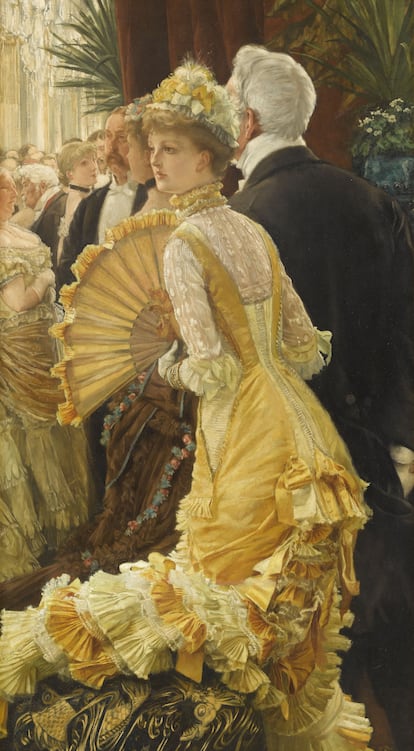
Very close to the display case exhibiting several yellowed volumes from the period, there is an 1878 canvas by the French painter and engraver James Tissot. Titled “Evening,” and also known as “The Ball,” it depicts a young woman in an elaborate yellow dress and carrying a large yellow fan, arriving at a party. “She’s holding hands with an older gentleman: could he be her father, her lover?” The curator wonders. “Perhaps he’s simply opening the doors of high society for her,” she continues. From the collection of the Musée d’Orsay (Paris), the only thing that’s clear is that the young woman is daring enough to wear a striking color.
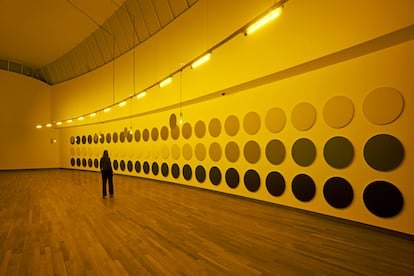
The Amsterdam museum has added two interactive elements to the exhibition that invite visitors to participate directly. One is a range of aromas created by the olfactory experts at Robertet. This company has been dedicated to creating fragrances since 1850 in the French town of Grasse, known as the perfume capital of the world. Inspired by the paintings on display, visitors are invited to choose their favorite. The other is an installation by the Danish artist Olafur Eliasson. He says, “I see red and I see blue, but I feel yellow,” and the three colors appear and fade in a room filled with circles attached to the wall. Paul Klee, the Swiss-born German painter, stated that “color is where our brain and the universe meet.” Perhaps Van Gogh achieved this.
Sign up for our weekly newsletter to get more English-language news coverage from EL PAÍS USA Edition
Tu suscripción se está usando en otro dispositivo
¿Quieres añadir otro usuario a tu suscripción?
Si continúas leyendo en este dispositivo, no se podrá leer en el otro.
FlechaTu suscripción se está usando en otro dispositivo y solo puedes acceder a EL PAÍS desde un dispositivo a la vez.
Si quieres compartir tu cuenta, cambia tu suscripción a la modalidad Premium, así podrás añadir otro usuario. Cada uno accederá con su propia cuenta de email, lo que os permitirá personalizar vuestra experiencia en EL PAÍS.
¿Tienes una suscripción de empresa? Accede aquí para contratar más cuentas.
En el caso de no saber quién está usando tu cuenta, te recomendamos cambiar tu contraseña aquí.
Si decides continuar compartiendo tu cuenta, este mensaje se mostrará en tu dispositivo y en el de la otra persona que está usando tu cuenta de forma indefinida, afectando a tu experiencia de lectura. Puedes consultar aquí los términos y condiciones de la suscripción digital.