Jens Stoltenberg, former NATO secretary general: ‘I am certain that the members of the Alliance will remain united to protect one another’
Norway’s current finance minister says ‘the attack on Iran has no basis in international law’
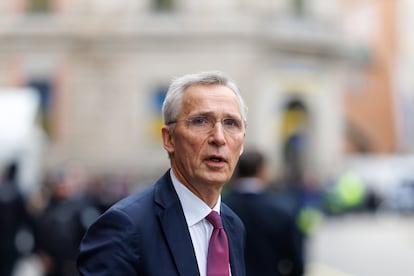

Jens Stoltenberg, 66, is the most important Norwegian politician of his generation. His party, the Norwegian Labour Party, won the September elections, but governs in coalition with left-wing parties and must negotiate to get measures approved. From his office in an imposing, austere building in the center of the capital, Oslo, he observes the reconstruction work on the nearby prime minister’s office. The building was badly damaged in the 2011 terrorist attack that killed 77 people, most of them young people at a camp hosted by the Norwegian Labour Youth league (AUF) on the island of Utøya. At the time, Stoltenberg was the head of government. The attack affected him deeply. Every summer, he returns to Utøya to pay tribute to the victims.
It was in 1993 that Stoltenberg first became a minister. He later served as minister of finance from 1996 to 1997, and was then elected prime minister for two terms: 2000-2001 and 2005-2013. After leaving national politics, he served as secretary general of NATO for a decade (2014-2024). At the beginning of his term, Russia annexed the Crimean Peninsula and began its takeover of eastern Ukraine.
Just when everything pointed to a peaceful retirement, the indomitable Stoltenberg accepted the offer to return as minister of finance, under the candidacy of Jonas Gahr Støre. His return was key to the Norwegian Social Democrats’ recovery in the polls and their eventual victory.
Question. What is Norway’s position regarding the Iran war?
Answer. War is always horrific. People die, homes are destroyed, and great values are lost. A small economy like ours has benefited for years from periods of peace and stability, along with respect for the international legal order. Now we live in an increasingly insecure world. We have seen this in recent years with the war in Ukraine, and now we see it even more clearly with the conflict in the Middle East.
Q. How will the war affect Norway’s economy? As a major oil exporter, will it benefit from rising crude oil prices?
A. It’s not clear that the rise in oil prices will benefit us. Norway now has significant exposure to international financial markets through our sovereign wealth fund. The stock market declines are hurting us more than the rise in the price of crude oil is helping us.
Q. Do you support Spain’s decision to oppose the war and prohibit the U.S. Military from using Spanish bases for further attacks in the Middle East?
A. The attack on Iran has no basis in international law. Norway has called on all parties to exercise restraint and resume diplomatic dialogue as soon as possible to find a solution to the conflict. Furthermore, Norway has clearly condemned the brutal violence of the Iranian regime against its own population, and we share the concern about the Iranian nuclear program.
Q. Is the Atlantic Alliance going through one of its worst moments since its creation in 1949?
A. There are significant challenges in the transatlantic relationship. But at the same time, it must be acknowledged that Europe is making an effort unseen in decades to guarantee its own security. Most NATO partners reduced their military spending after the end of the Cold War. But now they are all increasing it. There have always been some differences among the allies. I am certain that we will remain united to protect one another.
Q. Is Spain also making those efforts?
A. Yes, of course. Pedro Sánchez’s government is increasing its defense spending. I had the pleasure of working very well with him during my time at NATO. Spain also hosted the first NATO summit after the 2022 invasion, an important meeting to support Ukraine and to strengthen our own defense.
Q. The war in Ukraine changed everything...
A. The allies have dedicated considerable effort to helping and rearming Kyiv. In just six years, Norway’s defense spending has increased by almost 60%. Much of this spending goes directly to supporting Ukraine. Along with Germany, we are the largest contributor. I am very proud that one of the first measures I took as finance minister was to triple military support for Ukraine. We allocated around €7.3 billion [$8.4 billion] annually in 2025 and 2026.
Q. Having the sovereign wealth fund —a financial vehicle with assets valued at almost $2.3 trillion — is a significant help...
A. That’s right. Last year, we financed almost 25% of public spending thanks to the money we withdrew from the fund. But the important thing about this cash flow is that it’s sustainable. We withdraw resources from the fund while strictly adhering to the rules we set 25 years ago, when I became prime minister, that the amount cannot exceed 4% of the total [a few years later it was lowered to 3%]. That’s what we expect the fund to yield, above inflation, over time.
Q. Spain has announced the creation of a sovereign wealth fund...
A. I’ve heard about it, but I don’t know the details. What I must acknowledge is the leadership and vision of Pedro Sánchez, whom I know well from my time as head of NATO. The Spanish economy has developed impressively in recent years. I hope the fund idea works out well.
Q. Is it possible to have a sovereign wealth fund without those extraordinary oil revenues?
A. Having a sovereign wealth fund makes sense if you decide that the state should save for the future and invest those resources. That requires budgetary discipline. It’s not about going into debt to invest. If you don’t have oil revenues, you need other extraordinary sources to finance the fund.
Q. How does the Norwegian fund operate?
A. Each year, the government contributes all revenue from Norwegian oil and gas production to the fund. This comes from three sources: a 78% tax on private companies with extraction licenses; dividends from Equinor, the oil company in which the state holds a 67% stake; and additional revenue from state-owned shares in certain extraction licenses.
Q. And what is done with all that money?
A. We invested it in stocks and bonds of foreign companies and countries. The decision to invest in stocks was politically controversial, but it has subsequently proven to be very successful.
Q. How has it worked?
A. It has been a resounding success. One euro invested in the fund 30 years ago has grown, thanks to its profitability, to €6 today. By converting underground oil into an overseas financial portfolio, we have created a fund that manages assets of 21 trillion Norwegian kroner [approximately $2.19 trillion]. The average annual return since inception has been almost 6.5%. More than we expected.
Q. Where do you invest?
A. In publicly traded companies worldwide. We hold 7,200 different stocks in our portfolio to ensure proper diversification. The ministry sets a benchmark index — a kind of list of trades. The Norwegian central bank makes the decisions. It may deviate slightly from that index, but in general, we track the performance of the major stock market indices. In practice, the fund is a global index fund.
Q. A markedly different approach from that taken by the Persian Gulf’s sovereign wealth funds…
A. In 1996, during my first term as minister of finance, I met with several representatives of those investment vehicles. They insisted that it was better to make strategic investments. To buy large companies outright. But we opted to do just the opposite. To hold minority stakes in thousands of listed companies.
Q. The weight of stock market investments has been growing...
A. In the early years, it was only 40%, then we went up to 60% and now it represents 70%. The remaining 30% is bonds, mostly sovereign debt, and a small part is in unlisted real estate and renewable energy infrastructure.
Q. What portion of the fund’s current assets corresponds to oil revenues?
A. Of the fund’s current value, 63% can be explained by investment returns. Measured in Norwegian kroner, the value has also increased somewhat due to the krone’s weakening against other currencies. The remainder is oil revenue.
Sign up for our weekly newsletter to get more English-language news coverage from EL PAÍS USA Edition
Tu suscripción se está usando en otro dispositivo
¿Quieres añadir otro usuario a tu suscripción?
Si continúas leyendo en este dispositivo, no se podrá leer en el otro.
FlechaTu suscripción se está usando en otro dispositivo y solo puedes acceder a EL PAÍS desde un dispositivo a la vez.
Si quieres compartir tu cuenta, cambia tu suscripción a la modalidad Premium, así podrás añadir otro usuario. Cada uno accederá con su propia cuenta de email, lo que os permitirá personalizar vuestra experiencia en EL PAÍS.
¿Tienes una suscripción de empresa? Accede aquí para contratar más cuentas.
En el caso de no saber quién está usando tu cuenta, te recomendamos cambiar tu contraseña aquí.
Si decides continuar compartiendo tu cuenta, este mensaje se mostrará en tu dispositivo y en el de la otra persona que está usando tu cuenta de forma indefinida, afectando a tu experiencia de lectura. Puedes consultar aquí los términos y condiciones de la suscripción digital.