Directors of HBO Max’s ‘Neighbors’: ‘Doing whatever you want whenever you want to is the epitome of the conservative ideal’
Harrison Fishman and Dylan Redford talk about the stories behind a docuseries whose visuals sometimes border on the psychedelic, much like the realities it portrays

Each week, in just 30 minutes, filmmakers Dylan Redford and Harrison Fishman condense two mini-war diaries into the documentary series Neighbors, available on HBO Max. These are neighborhood battles that showcase what are often absurd situations (and people) in various corners of the United States. Sometimes, the conflict begins over a tiny patch of grass or a fence. Or over something even smaller, like the fluorescent yellow Speedo that a retiree wants to wear for outdoor workouts. The dispute escalates quickly, and soon involves firearms, security cameras, and cyberbullying as neighbors defend themselves and attack each other.
Their ensemble portrait, besides evidencing the regression of a post-Covid society, questions the dangerous concept of Trumpian freedom that other countries and regions are eager to export. “Doing whatever you want whenever you want to is the epitome of the conservative ideal,” Fishman tells EL PAÍS in a video call, adding that he sought an ideological balance among the series’ protagonists. “The word community comes up often, like that utopia everyone aspires to, but which is very difficult to achieve when it clashes with so many individual interests,” his co-director Redford adds.
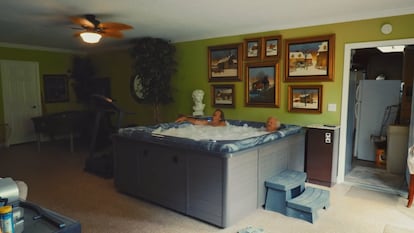
As an example, consider two of the cases featured in Neighbors. Darrell is something of a middle-class Liberace who has built himself a modest mansion with lots of gold, fake Roman busts, and garishly colored walls (plus a jacuzzi in the living room) in a residential neighborhood in Indiana. He just wants to enjoy his retirement in peace with his husband, Bruce. Over next door, Trever has decided to be self-sufficient and set up a farm with chickens, pigs, and goats on a property that belongs to his grandmother.
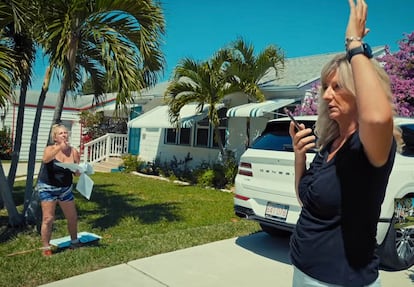
Around 1,200 miles away from Trever’s urban ranch we find Melissa and Victoria, former friends and residents of West Palm Beach, Florida. One day, they can’t agree on which part of the lawn between their adjacent houses belongs to whom. One puts out some flowerpots, the other raises a huge fuss, and it doesn’t take long for Melissa to head to a gun store to defend her plants and her property. They both instantly go from sisterhood to hatred over a square meter of grass.
There comes a point when the characters are so captivating that their conflicts cease to be the most important thing for the viewer. “The creation of the United States revolved around the desire to conquer, dominate, and protect property,” recalls Dylan Redford, grandson of the legendary Robert Redford. If you add to that “fierce individualism” Ellen DeGeneres fans, alternative therapies, professional polemicists born on social media, and internet conspiracy theories, as is the case in Neighbors, you get “something very American,” the filmmaker admits.
Despite the surreal or comedic tone, there’s a lot of sociology in these six episodes. The issues they address are tragic and universal. “Many viewers react with, ‘Why don’t they just move somewhere else?’ It’s not simply a matter of pride. The housing crisis has made it very difficult to just pack up and leave. And for some of them, like Trever, their home is their source of income,” Fishman explains.
The internet and all the recording devices we have at our fingertips make things more complicated than ever. “Sometimes a conflict between two people becomes one with a million people weighing in,” he continues. “With so many cameras available, it seems many people want to become the directors of their own life documentaries. And whoever gets the most positive reactions wins. Because social media algorithms reward conflict. Not to mention that recordings have become a common weapon in court,” Redford adds.
The narrative and visual tone of Neighbors sometimes borders on the psychedelic, much like the realities it portrays. This artistic choice makes sense, considering it’s the first non-fiction series from the prestigious A24, the indie studio that’s achieving worldwide success with titles like The Zone of Interest and Everything Everywhere All at Once. This documentary series boasts Josh Safdie as a producer and features much of the creative team behind the film Marty Supreme. And for those wondering how Dylan Redford and Harrison Fishman found such characters, there’s one name that explains it all: Harleigh Shaw, who also served as casting director for another HBO Max documentary series, How to with John Wilson.
The stories come from all sorts of sources: Facebook, Craigslist, TikTok and, mainly, local newspapers, which have guaranteed that the people in charge of Neighbors will find people “who were eager to make their situation known in order to solve what they feel is an injustice,” explains Fishman.
Sign up for our weekly newsletter to get more English-language news coverage from EL PAÍS USA Edition
Tu suscripción se está usando en otro dispositivo
¿Quieres añadir otro usuario a tu suscripción?
Si continúas leyendo en este dispositivo, no se podrá leer en el otro.
FlechaTu suscripción se está usando en otro dispositivo y solo puedes acceder a EL PAÍS desde un dispositivo a la vez.
Si quieres compartir tu cuenta, cambia tu suscripción a la modalidad Premium, así podrás añadir otro usuario. Cada uno accederá con su propia cuenta de email, lo que os permitirá personalizar vuestra experiencia en EL PAÍS.
¿Tienes una suscripción de empresa? Accede aquí para contratar más cuentas.
En el caso de no saber quién está usando tu cuenta, te recomendamos cambiar tu contraseña aquí.
Si decides continuar compartiendo tu cuenta, este mensaje se mostrará en tu dispositivo y en el de la otra persona que está usando tu cuenta de forma indefinida, afectando a tu experiencia de lectura. Puedes consultar aquí los términos y condiciones de la suscripción digital.