Trump administration admits it used a ‘flawed’ argument to justify arrests of immigrants in court
The Department of Justice acknowledged that a key ICE memo did not apply to immigration courts, where thousands of detentions have been carried out without a clear legal basis
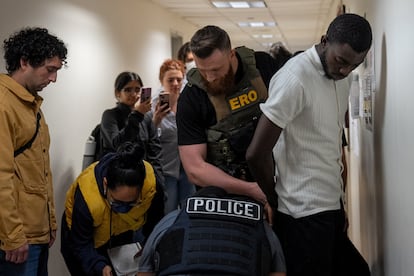

Donald Trump’s Department of Justice has acknowledged before a judge that it used an incorrect legal argument to defend the arrests of immigrants in court — a central practice in its recent immigration strategy that has been strongly criticized by civil rights organizations. The admission, made last Tuesday in a federal court in New York, is a direct blow to the Republican administration’s legal defense in a case examining the detention of individuals attending mandatory hearings as part of their immigration proceedings.
For months, the Department of Justice maintained that these detentions were supported by an internal guideline from Immigration and Customs Enforcement (ICE), which was repeatedly cited to justify the presence of agents in courthouses and the arrests. However, that basis crumbled this week when federal prosecutors themselves acknowledged in court that their interpretation was erroneous and that the document never applied to this type of operation.
“We write respectfully and regrettably to correct a material mistaken statement of fact that the Government made to the court and plaintiffs,” wrote Jay Clayton, U.S. Attorney for the Southern District of New York, in a letter addressed to Judge Kevin Castel. In that same communication, the government admitted that the memorandum in question “does not and has never applied to civil immigration enforcement actions in or near” immigration courts, according to court documents, thereby undermining one of the pillars of its defense.
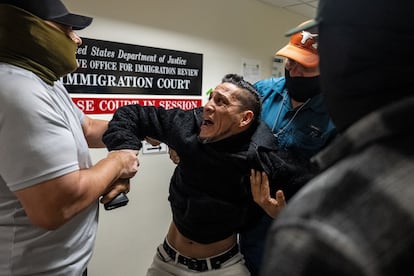
Case documents also show that ICE attorneys had previously argued the opposite, using the memo as justification for a policy that has led to thousands of arrests. According to the new allegations, the document “does not and has never authorized” detentions near immigration courts, even though it was presented as legal support during the litigation, raising questions about the validity of previous judicial decisions based on that argument.
The practice began to expand last year, when federal agents started detaining migrants inside immigration courts or immediately after their hearings, in some cases just minutes after appearing before a judge. This meant that people who were following the legal process — voluntarily showing up for their appointments — ended up being detained, which caused alarm among lawyers and advocates, who argue that the policy undermines the basic principle of access to due process.
For civil rights organizations, this recent admission reinforces their allegations. “It is yet again another example of ICE’s brazen disregard for the lives of immigrants in this country. It is now clearer than ever that there is no justification for ambushing and arresting people who are showing up to court,” Amy Belsher, an attorney with the New York Civil Liberties Union, told the press.
That impact, the plaintiffs argue, has been profound and widespread. “In the months since the court relied on the government’s representation to deny plaintiffs preliminary relief, defendants have continued arresting noncitizens at their immigration court hearings, resulting in their detention — often in facilities hundreds of miles away,” the attorneys noted in a filing with the judge, describing how the detentions have hindered the legal defense of those affected and the continuation of their cases.
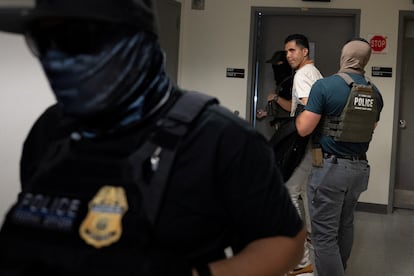
The government itself also acknowledged that the error was discovered at an advanced stage of the litigation, after significant resources had already been invested in the case. “We deeply regret that this error has come to light at this late stage, after the parties have expended significant resources and time to litigate this case,” wrote Assistant U.S. Attorney Tomoko Onozawa, though she stated that the error was not due to a lack of diligence on the part of the attorneys involved.
Following this correction, federal prosecutors indicated that key parts of the case must be reconsidered, including previous arguments and court decisions that relied on the erroneous interpretation of the memo. Among these is a September ruling in which Judge Castel refused to block the arrests, in part based on the idea that ICE’s guidance permitted such actions, which could now reopen the legal debate.
Despite this admission, the government is standing by its position. In their briefs, prosecutors argue that withdrawing the argument based on the memo does not alter their position that arrests in immigration courts are legal under other legal interpretations, suggesting that the legal battle will continue as the case is reevaluated in light of this error, which calls into question the basis for thousands of detentions across the country.
Sign up for our weekly newsletter to get more English-language news coverage from EL PAÍS USA Edition
Tu suscripción se está usando en otro dispositivo
¿Quieres añadir otro usuario a tu suscripción?
Si continúas leyendo en este dispositivo, no se podrá leer en el otro.
FlechaTu suscripción se está usando en otro dispositivo y solo puedes acceder a EL PAÍS desde un dispositivo a la vez.
Si quieres compartir tu cuenta, cambia tu suscripción a la modalidad Premium, así podrás añadir otro usuario. Cada uno accederá con su propia cuenta de email, lo que os permitirá personalizar vuestra experiencia en EL PAÍS.
¿Tienes una suscripción de empresa? Accede aquí para contratar más cuentas.
En el caso de no saber quién está usando tu cuenta, te recomendamos cambiar tu contraseña aquí.
Si decides continuar compartiendo tu cuenta, este mensaje se mostrará en tu dispositivo y en el de la otra persona que está usando tu cuenta de forma indefinida, afectando a tu experiencia de lectura. Puedes consultar aquí los términos y condiciones de la suscripción digital.