Judge refuses to dismiss narcoterrorism case against Nicolás Maduro and his wife
Venezuela’s deposed president and Cilia Flores appeared for the second time in a New York federal court on Thursday
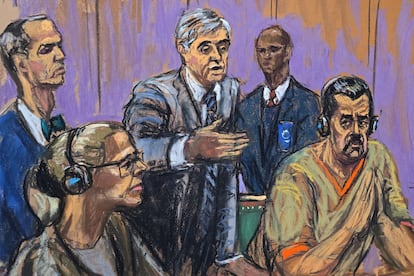

Nicolás Maduro, ousted from power in Venezuela on January 3 by a U.S. Military intervention, and his wife, Cilia Flores, returned to the federal court in the Southern District of New York on Thursday. The judge presiding over the case, 92-year-old Alvin Hellerstein, rejected the defense’s request to dismiss the case during the hearing.
“I am not going to dismiss the case,” said Hellerstein at the second hearing against the couple, who are accused by U.S. Authorities of charges related to drug trafficking, weapons possession, and corruption.
However, Hellerstein, whose voice sounded somewhat broken and who had a persistent cough during the hearing, has yet to officially confirm his decision.
Maduro entered the courtroom smiling and greeting his legal team, although during the hearing, which was delayed by 40 minutes due to the judge’s late arrival, he appeared nervous, frequently fidgeting on the table, unlike his wife, who remained more still. The deposed president seemed thinner and more serious than at the first hearing, held last January. His wife’s defense attorney requested that the judge order an electrocardiogram for him as soon as possible.
Nearly an hour of the hearing — a procedure that in other trials typically lasts no more than 10 minutes — was dedicated specifically to the issue of the freezing of Venezuelan funds intended to pay for Maduro’s defense. His lawyers requested the dismissal of the case in February, precisely after the Treasury Department’s Office of Foreign Assets Control (OFAC) denied the defendants permission to use Venezuelan government funds to pay for their defense. OFAC granted such permission on February 9, but revoked it three hours later.
Accused of four counts of narcoterrorism and weapons possession, the deposed Venezuelan presidential couple have faced their second hearing in a process that is expected to be tortuous and that began with the complaint by their lawyers of an “illegal blockage” of their funds to pay the bill.
Transferred from the Brooklyn maximum-security prison to the courthouse, where dozens of television cameras and photographers had been keeping watch since Wednesday night, Maduro and Flores appeared before veteran federal judge Hellerstein.
All eyes were on the Chavista leader, whose son, Congressman Nicolás Maduro Guerra — one of the co-defendants in the case — reported this week in a post on X that his father is “very well,” “in high spirits,” and “strong.” “We are going to see a slim, athletic president, [who] is exercising every day,” despite the harsh conditions of his confinement, Maduro Guerra wrote in the post. The congressman, who is considered a fugitive by the U.S. Justice system, added that Flores is also “steadfast and alert.”
Maduro faces four charges: three counts of conspiracy to commit narco-terrorism, importing cocaine into the United States, and possessing machine guns and destructive devices, and a fourth charge of possession of those weapons. Flores, for her part, is charged with four similar counts: two counts of conspiracy to import cocaine, one count of conspiracy to possess weapons, and one count of weapons possession. In his first court appearance in January, two days after being captured and transferred to New York, Maduro pleaded not guilty and presented himself as a prisoner of war.
The couple’s lawyers, Barry Pollack and Mark Donnelly, requested last week that the charges be dismissed, arguing that the U.S. Government, through the Treasury Department’s Office of Foreign Assets Control (OFAC), revoked the licenses that allowed the use of Venezuelan funds to cover their legal defense, citing an alleged “administrative error.” The defense maintains that this violates the Sixth Amendment to the Constitution and that the offer to appoint them as public defenders is invalid, as it deprives them of their right to free choice of counsel.
Furthermore, on Monday, the prosecutor in charge of the case, Jay Clayton, asked Judge Hellerstein to prohibit the defendants from sharing evidence with the four fugitive co-defendants: Maduro’s son; Venezuelan Minister of the Interior Diosdado Cabello; Ramón Rodríguez Chacín, former Minister of the Interior; and Héctor Rusthenford Guerrero Flores, known as “Niño Guerrero” and alleged leader of the transnational criminal organization Tren de Aragua.
In a letter addressed to the judge, the Justice Department argues that there is a “real risk of violence” and that Maduro’s entourage could use the information to identify and retaliate against witnesses and their families in Venezuela.
Thursday’s hearing will be key in determining whether the judge accepts the requests from the defense and the prosecution, or whether the procedural schedule continues toward a historic trial (this hearing is procedural). Most experts believe the formal trial will not begin for another year or two, when the judge would be 94 years old. According to The New York Times, Hellerstein was seen falling asleep during a hearing last year, raising doubts about his ability to preside over a trial that is expected to be lengthy and technically complex.
Sign up for our weekly newsletter to get more English-language news coverage from EL PAÍS USA Edition
Tu suscripción se está usando en otro dispositivo
¿Quieres añadir otro usuario a tu suscripción?
Si continúas leyendo en este dispositivo, no se podrá leer en el otro.
FlechaTu suscripción se está usando en otro dispositivo y solo puedes acceder a EL PAÍS desde un dispositivo a la vez.
Si quieres compartir tu cuenta, cambia tu suscripción a la modalidad Premium, así podrás añadir otro usuario. Cada uno accederá con su propia cuenta de email, lo que os permitirá personalizar vuestra experiencia en EL PAÍS.
¿Tienes una suscripción de empresa? Accede aquí para contratar más cuentas.
En el caso de no saber quién está usando tu cuenta, te recomendamos cambiar tu contraseña aquí.
Si decides continuar compartiendo tu cuenta, este mensaje se mostrará en tu dispositivo y en el de la otra persona que está usando tu cuenta de forma indefinida, afectando a tu experiencia de lectura. Puedes consultar aquí los términos y condiciones de la suscripción digital.