Israel kills head of Revolutionary Guard’s naval forces as Trump urges Iran to reach a deal ‘before it’s too late’
Alireza Tangsiri was targated as the man responsible for the blockade in the Strait of Hormuz
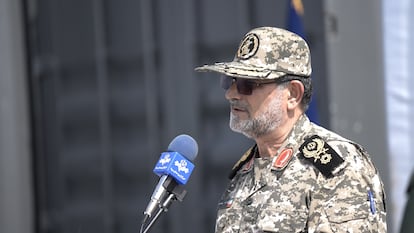

Amid calls for dialogue, more threats, and more deaths, and while U.S. President Donald Trump claimed on Thursday that Iran is “begging” for a deal to end the war in the Middle East (even though Tehran had rejected his demands a day earlier, deeming them excessive) and urged a ceasefire “before it’s too late,” Israel has once again killed a senior Iranian commander.
On this occasion, the target was Alireza Tangsiri, head of the Revolutionary Guard’s naval forces, whom Israel holds responsible for the closure of the Strait of Hormuz. Just when he most fears that Trump will unilaterally declare a ceasefire he does not want, Israeli Prime Minister Benjamin Netanyahu emphasized the “coordination” and “joint objectives” with Washington when announcing the assassination of Tangsiri.
The crossfire continues into the fourth week of the war, running parallel to the negotiating channel. Israel has launched a wave of bombings focused on Isfahan (the number of Iranians killed in the war exceeds 3,000, according to human rights activists), while Tehran has launched up to seven salvos of missiles against Israel in just a few hours, with air raid sirens sounding in Tel Aviv and Jerusalem at a faster pace than usual. In Nahariya, in northern Israel, one person was killed by a projectile fired by the Hezbollah militia from Lebanon. Two others have been killed in Abu Dhabi by debris from an intercepted Iranian ballistic missile, according to the Emirati government.
Pakistan’s Foreign Minister, Ishaq Dar, confirmed on Thursday that his country is acting as a mediator (with the help of Turkey and Egypt) between the United States and Iran. The mediators are trying to build on the momentum and organize a meeting for this weekend that will help overcome Tehran’s initial rejection of the U.S. Proposal, which is somewhat tougher than the one presented before the war. Despite the vast gulf between the positions of Washington and Tehran and the mistrust between the parties, the first glimmer of hope for a negotiated end to the war (or, at least, a ceasefire) has emerged.
Led today by more radical figures, after the U.S. And Israel assassinated its more pragmatic leaders, Iran sees itself as the victor in the conflict and is putting forward maximalist proposals to end it. It has also downplayed the process. “The messages being conveyed through our friendly countries, and our response by declaring our positions or issuing the necessary warnings, are not what we call negotiation or dialogue,” Foreign Minister Abbas Araqchi stated on Wednesday evening. “Currently, our policy is to continue the resistance and defend the country, and we have no intention of negotiating,” he added.
Trump paints a completely different picture. In a post on his social media account, Truth, on Thursday, he declared Iran “militarily obliterated, with zero chance of a comeback” and “begging” for a deal. Its negotiators are “very different and strange,” he wrote before issuing a threat: “They better get serious soon, before it is too late, because once that happens, there is no turning back, and it won’t be pretty.”

For now, Israel has removed Araqchi and the Speaker of the Iranian Parliament, Mohammad Baqer Qalibaf, from its target list, according to Reuters. This was at Pakistan’s request, as they are the two most experienced and pragmatic interlocutors available. Since the war began on October 28, Israel has killed, among others, Supreme Leader Ali Khamenei; Ali Larijani, another key figure in the regime; and the top leader of the Basij militia, Gholamreza Soleimani, and of intelligence, Esmail Khatib.
Israel hangs little chance of success on the talks, so it has not yet sounded the alarm. According to local media, it intends to continue fighting, at least until April 7, even if it does not achieve its goal of toppling the regime, as it initially hoped.
For now, by killing Tangsiri in Bandar Abbas, near the Strait of Hormuz, Israel is sending a message of continued warfare. This is how Defense Minister Israel Katz presented it, referring to the Revolutionary Guard: “The Israel Defense Forces will pursue and eliminate them one by one.”
Sign up for our weekly newsletter to get more English-language news coverage from EL PAÍS USA Edition
Tu suscripción se está usando en otro dispositivo
¿Quieres añadir otro usuario a tu suscripción?
Si continúas leyendo en este dispositivo, no se podrá leer en el otro.
FlechaTu suscripción se está usando en otro dispositivo y solo puedes acceder a EL PAÍS desde un dispositivo a la vez.
Si quieres compartir tu cuenta, cambia tu suscripción a la modalidad Premium, así podrás añadir otro usuario. Cada uno accederá con su propia cuenta de email, lo que os permitirá personalizar vuestra experiencia en EL PAÍS.
¿Tienes una suscripción de empresa? Accede aquí para contratar más cuentas.
En el caso de no saber quién está usando tu cuenta, te recomendamos cambiar tu contraseña aquí.
Si decides continuar compartiendo tu cuenta, este mensaje se mostrará en tu dispositivo y en el de la otra persona que está usando tu cuenta de forma indefinida, afectando a tu experiencia de lectura. Puedes consultar aquí los términos y condiciones de la suscripción digital.