Orphans and crimes: Spielberg’s misunderstood production scared kids but inspired ‘Harry Potter’
‘Young Sherlock Holmes,’ the Hollywood adaptation of the famous detective’s adventures, continues to fascinate viewers 40 years later, and many see it as the origin of many sagas that came after

As Bruce Broughton’s elegant music played and the end credits of Young Sherlock Holmes rolled across the screen, we saw a carriage moving through the snow—the very same carriage from which its main character, a young Sherlock Holmes, had bid farewell to his faithful Watson. Or so the unsuspecting viewers believed. The surprise came when, after entering a hotel, we finally saw the traveler’s face and read his signature in the guest register: Moriarty. A real treat for any fan of Conan Doyle’s work, who had just discovered the origin of an essential character. Holmes’s nemesis hadn’t died, and what’s more, he was going to become his future nightmare! The only problem? By that time, half the audience had left the theater.
“A lot of people didn’t stay to watch the end credits,” admitted its star, Nicholas Rowe, in The Telegraph. “And it’s a really funny scene.” It wasn’t unusual for this to happen at its premiere, 40 years ago now, but it still happens. If you’re not paying attention, you’ll miss it when you watch it on Netflix, which added it to its catalog a few weeks ago. These days, almost all superhero or animated films have not one, but two or even three post-credits scenes, but in the mid-1980s, there were only a couple of examples, which functioned almost as a reward for viewers who stayed in the theater. Moreover, on those occasions, their purpose was humorous and didn’t affect the main plot. But in this case it was relevant. Very relevant.
It wasn’t the only unique contribution of Barry Levinson’s film; it featured the first entirely computer-generated character. Born from a character’s hallucination, a medieval knight armed with a sword emerges from the stained-glass window he belongs to and attacks him. It took six months to film, though it lasts barely half a minute. This milestone earned it a nomination for Best Visual Effects, though it lost to Cocoon. John Lasseter, who years later would revolutionize animated film at Pixar, was on the team. In addition to the latest digital advances, Young Sherlock Holmes also used stop-motion animation and even puppets, as in the terrifying sequence with the charming-looking cupcakes that attack Watson.
Watson, as in Arthur Conan Doyle’s novels, is the one telling the story, which begins with his arrival at the fictional Brompton School, a prestigious boys’ boarding school where he meets Sherlock Holmes, a brilliant student. Together, they become embroiled in an investigation involving several murders and a sect of Osiris worshippers seeking revenge against a group of Britons who years earlier had desecrated the tombs of five Egyptian princesses. Colonialism? No, thank you.
Michael Eisner, head of Paramount, had given the premise to Chris Columbus, who then developed the story. A couple of years earlier, Columbus had sent Steven Spielberg a screenplay he had written while still in college about malevolent creatures. The director of E.T. Was fascinated by the young man’s story, and Gremlins became one of the biggest hits of 1984. The collaboration didn’t end there; at the time, Columbus was preparing a new film for Spielberg, so he was writing The Goonies by day and Young Sherlock Holmes by night.
As executive producer, Spielberg didn’t spend much time on set (he was immersed in The Color Purple), but he contributed to the script and, after deciding against directing it himself, chose the person who would: Barry Levinson. “I felt Barry was sort of a frustrated action-adventure director who had always wanted a shot at making an adventure story into a movie,” Spielberg told The New York Times in 1985.
The first hurdle to overcome were the heirs of the original author. Columbus confessed that he was very worried about offending some of the “Holmes purists.” And no one was more of a purist than Dame Jean Conan Doyle, Sir Arthur’s daughter. The heiress was horrified by the film’s violent imagery, so far removed from her father’s writing, and demanded changes to the characters’ behavior. To avoid problems and accurately depict something as foreign to them as Victorian England, Eisner hired Sherlock expert John Bennett Shaw and English novelist Jeffrey Archer to act as script consultants and adapt it into British English. Paramount also included a title card at the beginning and end of the film warning that it was not based on Doyle’s stories, but rather an “affectionate speculation” about what the detective’s youth might have been like.
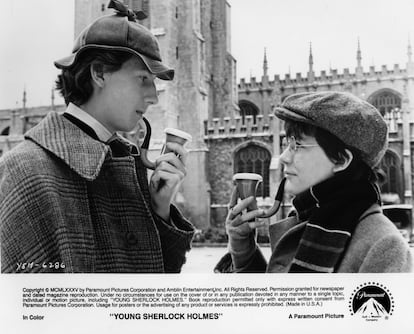
Columbus wasn’t interested in the aspects of the detective’s personality that we all already knew. “The thing that was most important to me was why Holmes became so cold and calculating, and why he was alone for the rest of his life,” he revealed. “That’s why he is so emotional in the film; as a youngster, he was ruled by emotion, he fell in love with the love of his life, and as a result of what happens in this film, he becomes the person he was later.” That was the fundamental change. Otherwise, it was an adaptation that respected the image everyone had of the detective and his faithful companion, which was really that of the Basil Rathbone and Nigel Bruce film adaptations that are paid homage to throughout the film. To achieve this, they selected two actors who could evolve into those characters.
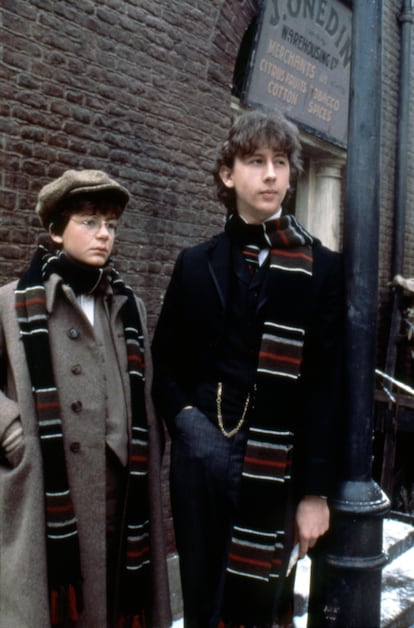
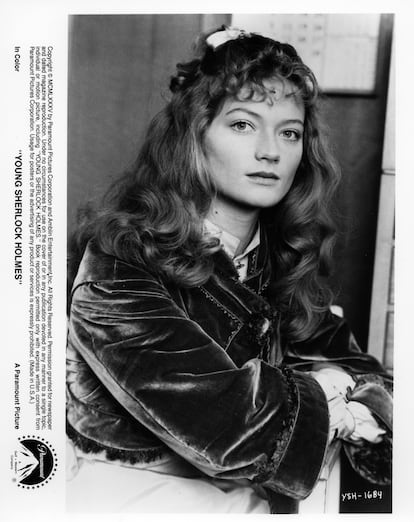
The relatively unknown Nicholas Rowe was chosen from 11,000, among them Hugh Grant. Alan Cox (son of Succession star Brian Cox), selected to play Watson, had somewhat more experience. Because he was much thinner than the character required, he was forced to go to the gym to bulk up and wear prosthetics to simulate a weight he didn’t actually have. And because, being a teen, he grew too much during filming, in the final scenes he appears sitting down or far away in the distance. Alongside them was the also-teenage Sophie Ward, playing Holmes’s love interest—and little else; she’s a wasted character—and a large group of prestigious British character actors, most of them connected in some way to the Holmes universe.
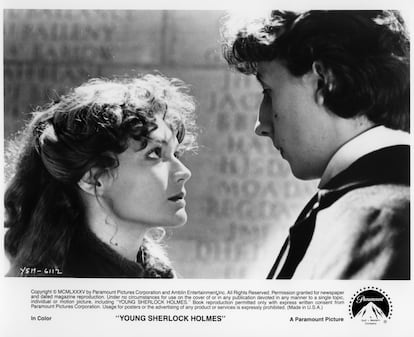
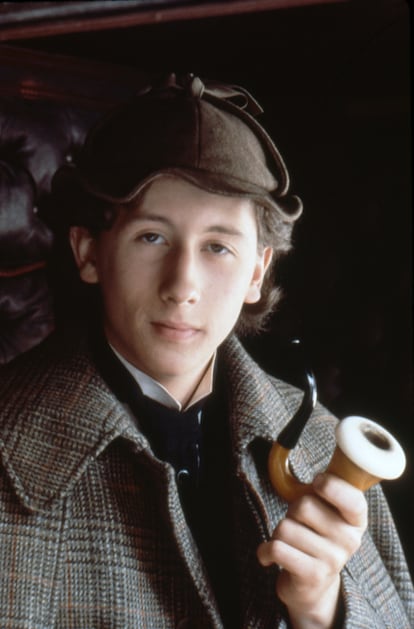
The Holmes character in the movie is canonical: tall, lanky, sharp and arrogant, and Columbus’ screenplay gracefully introduces his characteristic elements (the deerstalker hat, the pipe, the violin, the Inverness cloak, and even the “Elementary, my dear Watson,” so familiar to audiences even though it was never actually written by Conan Doyle). Also included is his ability to deduce from seemingly insignificant details and Scotland Yard’s Lestrade, who at that time was merely a sergeant. Everything sounds familiar, except for the detective’s cold and distant demeanor, which only changes when he looks at his beloved Elizabeth.
However, despite these refreshing innovations and its portrayal of one of literature’s most celebrated characters, this is a relatively unknown film. In other words, it’s not The Goonies or Gremlins, even though it’s also a Spielberg and Columbus collaboration. That’s why its poor box office performance was surprising. With a budget of $18 million, it barely grossed $70 million worldwide, thwarting any plans for a sequel that would have been expected after its post-credits scene.
“We had a potential three-picture deal,” Rowe admitted. “They were waiting to see how the first one did.” Audiences turned their backs on it, and while critics weren’t exactly enamored with it, they didn’t tear it apart either, with the exception of Pauline Kael, who called it “blandly entertaining.” Spielberg didn’t blame the screenwriter. “Although his concept of teenage Holmes and Watson didn’t appeal to a general audience, I think his characters were better realized in that film than in The Goonies or Gremlins.” He also acknowledged that it’s a film he’s very fond of.
What happened? It was too childish for adults, but terrifying for children. It was a Spielberg production, but it lacked the essential, heartwarming elements: there were no close-knit families, only helpless children suffering unimaginable dangers. There were no adorable creatures, no sweet puppies, only characters who commit suicide and plot gruesome crimes. It was too much for the children who flocked to theaters drawn by the name of the director of E.T.
Furthermore, many found too many similarities with the exoticism, curses, and human sacrifices of Indiana Jones and the Temple of Doom, a film written after Young Sherlock Holmes but released earlier. Some even considered it outright plagiarism.
Modern viewers, however, perceive similarities with another literary saga: Harry Potter. Over the years, every time a fan of J.K. Rowling’s characters discovers the 1980s classic, comparisons arise. It’s not hard to reach that conclusion. Three young people, two boys and a girl, one lanky and the other with round glasses who, as the newcomer to the institution, serves to reveal its secrets. They all live in an English boarding school within whose centuries-old walls there is a petulant and wealthy rival whose hair ends up bleached blonde—did someone say Draco Malfoy?—and they are protected by a retired professor, a member of a faculty made up of rather peculiar characters. There’s no Quidditch competition, but there is a fencing competition, taught by a tall, dark man who could easily be seen playing Severus Snape. There’s even a character with a wound on his face that won’t heal.
Perhaps a young J.K. Rowling went to the cinema in 1985, and something she saw on screen stayed with her subconscious. The author, who has opinions on so many things unrelated to her work, has never mentioned anything about it. Columbus has spoken about the similarities between the settings of both productions. This is understandable; after all, he was the screenwriter of Young Sherlock Holmes and the first director to bring Rowling’s imagined universe to life on screen in Harry Potter and the Philosopher’s Stone. “Young Sherlock Holmes was, in a way, a precursor to this film,” he confessed to the BBC. The movie wasn’t an instant success, but its memory lingers in the minds of many young people who felt treated like adults by its dark themes.
Sign up for our weekly newsletter to get more English-language news coverage from EL PAÍS USA Edition
Tu suscripción se está usando en otro dispositivo
¿Quieres añadir otro usuario a tu suscripción?
Si continúas leyendo en este dispositivo, no se podrá leer en el otro.
FlechaTu suscripción se está usando en otro dispositivo y solo puedes acceder a EL PAÍS desde un dispositivo a la vez.
Si quieres compartir tu cuenta, cambia tu suscripción a la modalidad Premium, así podrás añadir otro usuario. Cada uno accederá con su propia cuenta de email, lo que os permitirá personalizar vuestra experiencia en EL PAÍS.
¿Tienes una suscripción de empresa? Accede aquí para contratar más cuentas.
En el caso de no saber quién está usando tu cuenta, te recomendamos cambiar tu contraseña aquí.
Si decides continuar compartiendo tu cuenta, este mensaje se mostrará en tu dispositivo y en el de la otra persona que está usando tu cuenta de forma indefinida, afectando a tu experiencia de lectura. Puedes consultar aquí los términos y condiciones de la suscripción digital.