Why Trump isn’t worried about a weaker dollar as markets (and the ECB) grow uneasy
The rise in the euro and gold reflects a structural outflow of capital, even if it could end up stimulating the US economy
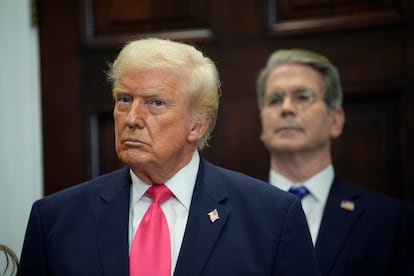

The tectonic ruptures in geopolitics triggered by Donald Trump are reverberating in the currency market, just as they did nine months ago with the trade war. This week, the dollar hit 1.20 per euro, making trips to the United States, bourbon, and Fender electric guitars cheaper. The abrupt trend — a drop of nearly 3% in just a few days — looks set to continue, as it has little or nothing to do with the economic cycle: it is the financial world’s response to the global order proposed by the U.S. President, whose first commandment (or second, depending on the day) is to limit risk.
And from political fragmentation — and the speed at which it is unfolding — a different financial world is emerging, one in which the dollar and the U.S. Have lost part of their aura of exceptionalism. For now, however, this does not seem to be a concern for Trump.
Is the market movement a fall of the dollar or a rise of the euro?
It’s a fall of the dollar, although it eased somewhat on Wednesday. The U.S. Currency is dropping against most of the world’s major currencies: against the basket that includes the top 10, it has traded at its lowest levels since 2022 and is down 10% over the past 12 months. Against the euro, it has fallen below 1.2 dollars, a level not seen since 2021, with a decline of nearly 20% since the beginning of 2025 — steeper than against other currencies.
Why is the dollar falling?
The reasons are not singular; short‑term, more speculative factors are mixing with longer‑term, structural ones. The frenetic month of January brought by Donald Trump — including his attack on the Federal Reserve, threats to the EU over Greenland, and intervention in Venezuela — has reinforced expectations of growing geopolitical and commercial fragmentation worldwide. In this context, investors are accelerating the diversification of their assets.
This new environment also means the dollar is no longer the currency investors flee to in times of turmoil; on the contrary, it is falling more than others. The swings in geopolitics are creating the conditions for a weaker dollar in the long term and are encouraging investors to bet against the currency in the short term. Over the longer horizon, the consensus is even clearer: major asset managers such as J.P. Morgan AM, Pimco, Allianz, and Amundi have reaffirmed their plans to diversify portfolios and reduce exposure to the U.S. Currency.
Does it have to do with the rise in gold?
Yes, to a large extent. It even has a name: debasement trade. With the dollar losing its safe‑haven status, investors flocked to the age‑old alternative — gold. It is the go‑to asset in turbulent times, and the (very reasonable) expectation that political uncertainty will continue to grow only strengthens demand for the metal. Since the beginning of 2025, gold has nearly doubled in price, and in 2026 alone it is up 22%. The fact that it is priced in dollars amplifies the increases, but measured in euros it has also appreciated. “The sensitivity of metals to fluctuations in the U.S. Dollar has increased significantly lately, reflecting its potential decline much more than its actual drop,” notes Julius Baer.
Why does Trump say he doesn’t care about a weak dollar?
Beyond his abrupt language, the real‑estate developer has a point: a weaker dollar acts as an economic stimulus — and in an election year, no less. It helps U.S. Goods exports: products made in the U.S. Become cheaper abroad, and companies that provide services overseas (financial, digital, or tourism‑related) or that have subsidiaries around the world earn more money when converting their profits. U.S. Products also become more competitive in the domestic market compared with imports… which comes with a downside: higher inflation. This inflationary impact adds to that of tariffs and the administration’s stance on immigration.
Another risk of a weak dollar is that capital outflows from the U.S. Could accelerate, potentially affecting public debt, though markets are not at that point for now. Still, Treasury Secretary Scott Bessent clarified on Wednesday that “the U.S. Always has a strong‑dollar policy,” a remark that helped lift the currency later in the day.
How does it affect the eurozone?
It affects the eurozone in the opposite way it affects the United States: a strong euro makes exports more difficult in an already challenging environment due to the trade war, and therefore acts as a handbrake on the economy. In this regard, the governor of Austria’s central bank (and member of the European Central Bank’s Governing Council), Martin Kocher, said on Wednesday that the ECB might face a “certain necessity to react in terms of monetary policy,” since a strong euro implies lower inflation. Another member of ECB’s Governing Council, France’s François Villeroy de Galhau, said that the euro’s appreciation will be taken into account in the bank’s decisions, and Luis de Guindos stated earlier this month that a euro above 1.20 dollars would be a “complicated” situation.
The mandate of the European monetary authority is to keep inflation close to 2% in the medium term, so if the exchange rate pushes expectations away from that target, a rate cut becomes more likely. Likewise, a strong euro is not good for Europe’s major listed companies. According to Citi, a 10% rise in the currency reduces European firms’ earnings per share by 2%.
What do experts and the market think?
Under current conditions, and barring any surprises, the outlook is bearish from virtually every angle. In the short term, according to derivatives‑market data, investor bets are pointing downward — both from speculators looking to profit and from traditional portfolios holding U.S. Assets that want to hedge currency risk (last year, Wall Street’s 16% rise translated into just 2.6% for European investors). Moreover — and perhaps most importantly — Trump’s stance clears the path. As ING analysts explain: “If the buy-side has decided to raise its dollar hedge ratios on US policy risk and a sense that Washington wants a weaker dollar, it makes no sense to stand in the way.”
According to data from the DTCC, the firm that processes U.S. Currency‑futures trades, trading volumes have surged over the past week, and one out of every 10 bets on the dollar/euro pair is targeting levels beyond 1.25 dollars.
Sign up for our weekly newsletter to get more English-language news coverage from EL PAÍS USA Edition
Tu suscripción se está usando en otro dispositivo
¿Quieres añadir otro usuario a tu suscripción?
Si continúas leyendo en este dispositivo, no se podrá leer en el otro.
FlechaTu suscripción se está usando en otro dispositivo y solo puedes acceder a EL PAÍS desde un dispositivo a la vez.
Si quieres compartir tu cuenta, cambia tu suscripción a la modalidad Premium, así podrás añadir otro usuario. Cada uno accederá con su propia cuenta de email, lo que os permitirá personalizar vuestra experiencia en EL PAÍS.
¿Tienes una suscripción de empresa? Accede aquí para contratar más cuentas.
En el caso de no saber quién está usando tu cuenta, te recomendamos cambiar tu contraseña aquí.
Si decides continuar compartiendo tu cuenta, este mensaje se mostrará en tu dispositivo y en el de la otra persona que está usando tu cuenta de forma indefinida, afectando a tu experiencia de lectura. Puedes consultar aquí los términos y condiciones de la suscripción digital.