Palestinians who fled horror encounter Israeli obstacles in attempt to return to Gaza
Around 100,000 people escaped the offensive through the Rafah border crossing in the first seven months of the war. Israel only allowed 12 of them to return when it reopened
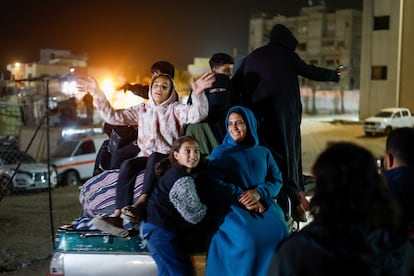
The reopening of Rafah, the border crossing between Gaza and Egypt, has rekindled the hope (or at least raised a previously unthinkable question) of returning to the Strip for the approximately 100,000 Palestinians who managed to escape almost two years ago from the constant air strikes, forced displacement, and hardships of the Israeli offensive. Almost all of them did so within the first seven months of the war, until Israeli troops seized Rafah in May 2024 and Gazans lost their only exit route. They were able to escape because they held a foreign passport, had thousands of dollars to buy a place on the list at the crossing, were seriously ill or wounded, or were accompanied by others.
Many families were separated, but returning to Gaza wasn’t an option until Monday, when Benjamin Netanyahu’s government fulfilled (after a delay of four months) its promise to reopen Rafah to traffic in both directions. However, Israel only allowed 12 people to cross and turned away 30. At this rate, if all the refugees from two years of massacre wanted to return (and Israel approved their names individually), it would take almost 23 years. In this context, this newspaper spoke with five Gazans abroad. They share the longing to reunite with their loved ones, but some fear being arrested by Israeli troops at the crossing or hesitate because their homes, jobs, and plans in Gaza lie in ruins. In any case, and despite their regrets, it’s neither an urgent decision nor one that rests solely with them.
The first people to return to Gaza on Monday recounted a humiliating experience. “They grabbed me, my mother, and another woman. Three of the twelve of us. They blindfolded and handcuffed us. And they started interrogating us about things we didn’t know, things we had nothing to do with,” one of them, Sabah al-Raqab, explained to reporters after crossing. “They grabbed a neighbor and tried to force her to cooperate, to act as a spy. [They asked us about] inspections, migration, Hamas, October 7 [2023, the Hamas attack]. We couldn’t bring anything back to cheer up our children. They forbade us from bringing food, water, perfume… They emptied everything, only letting us through with our clothes and one bag per person. A little girl said, ‘Give me my toy,’ but [the Israeli soldier] told her it was forbidden and took it away.”
The Hamas government in Gaza estimates that 80,000 of the approximately 100,000 refugees wish to return. The majority remain in Egypt, but several thousand have since moved to other countries. This estimate is supported by various sources, but the precise number is unknown. In April 2024, a month before the Israeli army reached the Rafah border crossing, the Palestinian ambassador to Egypt, Diab Al Louh, told Agence France-Presse that around 100,000 Gazans had entered the country. Cairo, for its part, asserted that more than 65,000 foreigners and dual nationals crossed Rafah during those months, in addition to some 10,000 wounded, sick, and their companions. Many were evacuated and treated in hospitals in North Sinai, the Egyptian province bordering the Strip. It is expected that most of those returning to Gaza initially will belong to this group.
“I want to go back to my family”
Raghed (who, like other interviewees, declined to give her last name for security reasons) longs to return to Gaza. “I’m here alone. I want to go back to my family. I’m simply trying to see them again and return to my country. To be honest, nothing gives us any hope anymore, but I’m trying. I’m trying to stay hopeful,” she says. She is 24 years old and arrived in Egypt in April 2024 with plans to get married, but the wedding fell through. Her father passed away two weeks ago, and the rest of her family is in Gaza City.
“I know how difficult the situation in Gaza still is. And crossing the border is also horrific,” she continues. “Those who returned to Gaza yesterday [Monday] told many stories that frighten me. But I can live through it with my family. Perhaps we can face this as a family, not alone.”
Raghed filled out an online form sent to her by the Palestinian Embassy in Egypt to be added to the waiting list. She says she is still “waiting for news.” And she fears losing “the opportunity to return if it’s not soon.” Rafah has already opened and closed three times in the last two years, depending on truces and military movements. “No one told me [how long it will take], and I know it will be a long time. But maybe, just maybe, I’ll have the opportunity and receive good news to return to Gaza soon.”
Said, on the other hand, admits from a Gulf country he prefers to keep secret that he hasn’t even bothered to register to return, despite wanting to. “Rafah is still very fresh in my mind. Besides, who knows when I might even be able to cross,” he says. His lack of faith in the future of the ceasefire doesn’t help either, as he’s convinced that Netanyahu “will use some excuse” to launch a large-scale operation against the capital in the coming months. He’s also less committed than others to return: he left with his immediate family.
Despite these circumstances, the reopening has been met with relief by Gazans (and applauded by the international community), perhaps due to a lack of other news to celebrate.
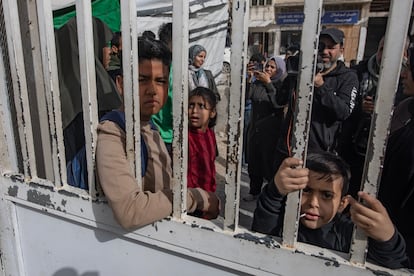
The reality, for now, is very meager numbers, with no established commitments and based on opaque criteria. Both entry and exit remain in Israel’s hands. In addition to its security authorization, crossing Rafah (now surrounded by reinforced concrete walls and barbed wire) involves passing through three gates and undergoing exhaustive checks.
Fear of the checkpoint
This is one of the main concerns of two other Gazan women who spoke to this newspaper on condition of anonymity, for fear of reprisals. They fear that Israeli agents will confiscate their belongings or detain their relatives along the way.
This is the case of Salwa (a pseudonym for security reasons). “Going through the checkpoint fills me with intense fear,” she laments. It makes the decision, she adds, “incredibly difficult,” although she believes she will ultimately take “all the risks” to try to reunite with her family. A mother in her twenties from the northern Gaza Strip, she fled to Egypt in April 2024, leaving behind her husband and parents and taking care of her two children in a place “where I had never been before,” in an exile for which she was unprepared.
Salwa describes a desperate situation in Egypt where she and her young children are struggling to survive, both psychologically and financially. For this reason, she prefers to return to Gaza, even though her home is completely destroyed and the Strip lacks basic necessities such as healthcare, education, and housing. “My husband and I will find a solution, perhaps renting a tent or a room, but I can’t stay here much longer,” she explains in text messages from Cairo.
In limbo
Many Gazans who fled to Egypt in the early months of the war find themselves in a kind of limbo, in a highly vulnerable legal, economic, and social situation. Most entered on ordinary visas with no option to renew them, leaving them without residency. This prevents them from working, accessing basic services such as public healthcare and education, signing a lease, opening a bank account, or getting a phone line.
The vast majority of those without dual nationality and who did not require urgent medical treatment were only able to leave Gaza by resorting to a shadowy network of intermediaries to whom they paid thousands of dollars per person, a significant financial burden they are now feeling the effects of. This was the infamous “coordination”: a business dominated by a travel agency owned by an Egyptian businessman with close ties to the highest levels of government.
Their plight is further compounded by the fact that Egypt does not recognize the mandate of the UN Refugee Agency (UNHCR) for Palestinians, preventing them from registering. And the UN agency specifically for Palestinian refugees, UNRWA, does not operate in Egypt either. Moreover, local authorities have deported hundreds of Sudanese and Eritreans in the past, despite the risks to their lives in their respective countries of origin, fueling their anxiety and uncertainty.
This is not the case for Leila, a young refugee in the Egyptian capital with her two children, husband, and other relatives. She has a stable legal status. Parents and children have Egyptian citizenship (“it has made things much easier for us,” she admits) and they had already decided to settle in Cairo before the invasion, which caught them by surprise while they were visiting Gaza, with Leila pregnant with her second child. “I was forced to leave to give birth,” explains the young woman, who watched as the Israeli offensive swept through everything, including her home, “at great speed.”
She, too, is now deterred by the prospect of crossing the Israeli military checkpoint to return to Gaza City. “If it weren’t there, we would have gone immediately,” she says without hesitation. “But we want to see how they treat those who enter first. The possibility of the young people in the family being arrested makes it very dangerous.”
Two years later, the same instinct that drove her to leave the Gaza Strip compels her to return. She asserts that the family she left behind is her “main reason for being” and cannot tolerate the idea of Israel turning her voluntary exile into an imposed and permanent one.
Not everyone thinks like her. Ahmed (another pseudonym so he can speak freely) is 38 years old, works in the telecommunications sector in Egypt, and is seeking political asylum for himself, his wife, and their five children. “I really don’t plan on returning to Gaza. I have nothing there: no source of income, no home… My family lives in a camp without drinking water.”
Sign up for our weekly newsletter to get more English-language news coverage from EL PAÍS USA Edition
Tu suscripción se está usando en otro dispositivo
¿Quieres añadir otro usuario a tu suscripción?
Si continúas leyendo en este dispositivo, no se podrá leer en el otro.
FlechaTu suscripción se está usando en otro dispositivo y solo puedes acceder a EL PAÍS desde un dispositivo a la vez.
Si quieres compartir tu cuenta, cambia tu suscripción a la modalidad Premium, así podrás añadir otro usuario. Cada uno accederá con su propia cuenta de email, lo que os permitirá personalizar vuestra experiencia en EL PAÍS.
¿Tienes una suscripción de empresa? Accede aquí para contratar más cuentas.
En el caso de no saber quién está usando tu cuenta, te recomendamos cambiar tu contraseña aquí.
Si decides continuar compartiendo tu cuenta, este mensaje se mostrará en tu dispositivo y en el de la otra persona que está usando tu cuenta de forma indefinida, afectando a tu experiencia de lectura. Puedes consultar aquí los términos y condiciones de la suscripción digital.