Photographer Valentina Sinis’ portrayal of Afghan women: ‘They all wanted to tell their story’
The Italian photojournalist, second finalist for the Luis Valtueña International Humanitarian Photography Award, portrays the intimate lives of women under the yoke of the Taliban
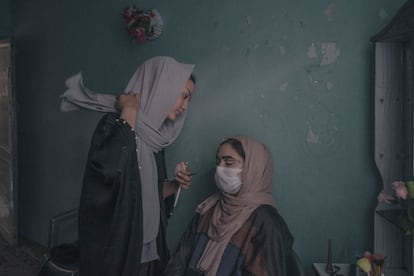

A group of women attend a secret sewing class in Bamyan, the same city where, in 2001, the Taliban blew up two monumental Buddhas carved into rock. Meanwhile, in a clandestine workshop in Kabul, a young woman teaches another how to apply makeup. And, in the neonatal intensive care unit of a hospital in Afghanistan — one of the few areas where women can work after the Taliban’s return to power in August of 2021 — a doctor washes her hands.
All of these images are part of a project entitled Were Afghan Women to Unveil Their Tales, by Italian photographer Valentina Sinis. She was the second finalist for the 2025 Luis Valtueña International Humanitarian Photography Award, which is presented by Doctors of the World.
“I have always worked with women’s stories,” she explains. “And, after the Taliban took power [in 2021], news from within [the country] was scarce; we knew that women were disappearing from public life, but not how they were actually living,” Sinis explains, in an interview with EL PAÍS at the Ortega-Marañón Foundation, in Madrid, where her photographs — along with those of the 2025 winner, Samuel Nacar, as well as the other two finalists, Jehad Al-Sharafi and Santi Palacios — will be on display until February 28.
Sinis is part of a field that’s still heavily male. Female participation in the 2025 award increased slightly (4% more than in 2024), although women represented only 36% of the 680 photographers who submitted 6,130 photographs in total.
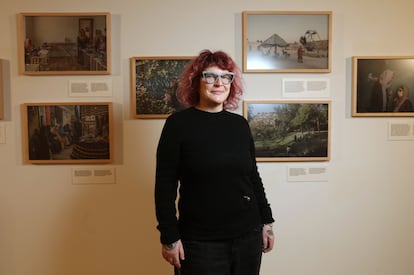
Without the support of any media outlet or institution, Sinis traveled to the Asian country in late 2024. What she found were women who wanted to speak out, not only as a form of rebellion, but out of the fundamental need for the world to know that they existed. “What impressed me most was that they all wanted to tell their stories, that they wanted someone to bear witness. And, above all, [they wanted] it to be understood that the most devastating thing isn’t just not being able to work, but [also] not being able to study,” the photographer explains.
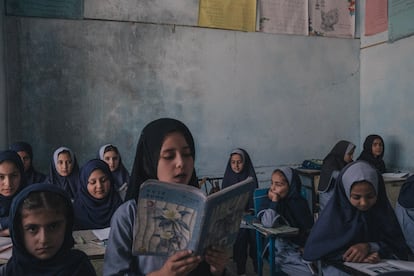
In March of 2022, the Taliban banned girls from attending secondary school. By the end of the year, they had also prevented women from accessing university. “For many,” Sinis opines, “if their right to education were restored, the rest of the restrictions would almost be secondary.”
They wanted it to be understood that the most devastating thing isn’t not being able to work, but rather not being able to study
In her photographs, there are no battles, no explosions, no mutilated bodies. There are courtyards, halls, hands sewing, the gazes of women supporting each other and smiling. “I’m not looking for sensationalism,” she explains. “It’s easy to take war photos. It’s harder to show the inner pain, what happens when your future is taken away.”
Hope is one of the few weapons that Afghan women have left. “In the privacy of their homes, there isn’t much they can do,” the Italian photojournalist notes. However, she adds, “there are women who secretly teach other women makeup [techniques] and sewing. And, in a way, they’re all fighters, because they go [beyond] what they’re allowed to do.”
“That fight,” she continues, “is mental; it’s a struggle to create a space for themselves where they can feel alive again… [one] that gives them a purpose to get up every morning.” Most confessed to Sinis that they are “very depressed.” Because, even if they study and train themselves, “there are no job opportunities for them.”
Being Trapped
One of the scenes that affected her most doesn’t appear in any of the photographs. It happened in the apartment of a young woman, who is married to a Taliban member. “It was a modern home, like any [middle-class] apartment: a fully equipped kitchen, a huge television, a comfortable sofa. She spoke English; she told me that she had learned online. She said she was happy, that her life was perfect, that her future daughter wouldn’t need anything more than that: a good husband, a house, children.”
While they were talking, the husband was banging on the wall from the next room. He called out to her over and over again. She would go, come back and keep talking. “It was [very] uncomfortable. She didn’t want me to take pictures, just to interview her. And, even then, I felt like every word was being watched.” As they were leaving, the husband insisted on giving Sinis and her translator a ride, but they pretended they had to go shopping. “Then, we saw him circling around [in his car], looking for us. We hid in the taxi… it was very stressful. I wondered if she had been completely brainwashed, or if she was talking like that out of fear,” Sinis sighs.
In contrast, women who live outside the Taliban circle express another kind of anguish: one having to do with senseless confinement. “Most are supported by their husbands or fathers. Many men want the women to work, because the economic situation is very bad. But they’re afraid and fear that they’ll be arrested, interrogated… that something will happen to them. So, sometimes they forbid [the women] from going out, or they accompany them. Not for control, but [to offer] protection. However, the result is the same: they’re locked up.”
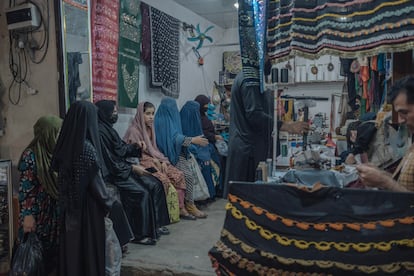
In this context, Sinis acknowledges that establishing a relationship of trust isn’t easy. But the networks woven by Afghan women opened a door for her. “At first, I had a fixer (a guide and translator), but he was a man. [He was] inexperienced and many problems arose. Then, I started to move around on my own. At the market, I met an activist lawyer. Later, other women. At a crafts fair, I connected with more. A baker introduced me to others. Little by little, with the help of a translator, I created my own network,” the photographer recalls. She approached her work with one basic premise: “I was always clear that my safety wasn’t the most important thing: rather, the fundamental thing was not to put them in danger.”
One of the stereotypes that Sinis disabused herself of on her trip is the idea that Kabul is “a city without women.”
“It’s not what you might imagine from the outside. Not all of them wear a burka. Many wear an abaya, or a hijab. And, in some cafes, you see women together… even some couples,” she describes, clarifying: “This doesn’t mean normality at all, because it’s a fragile, monitored and limited normality.”
This isn’t the first time that Sinis has covered the stories of women living in extreme and invisible contexts. For years, she has documented female suicide in Iraq, where many women set themselves on fire as a final act of despair in the face of a patriarchal society that oppresses them. She has also worked with Yazidi female survivors of the terrorist group Islamic State (ISIS). And, in Sierra Leone, she has photographed women and children making soap who have accidentally ingested caustic soda, after mistaking it for water, sugar, or salt. This causes severe burns to the esophagus and digestive system.
If an Afghan woman could speak freely to the world today, Sinis believes that she would ask for one thing above all: “The right to study, which was unjustly taken from them. And the support of the international community to get it back.”
Sign up for our weekly newsletter to get more English-language news coverage from EL PAÍS USA Edition
Tu suscripción se está usando en otro dispositivo
¿Quieres añadir otro usuario a tu suscripción?
Si continúas leyendo en este dispositivo, no se podrá leer en el otro.
FlechaTu suscripción se está usando en otro dispositivo y solo puedes acceder a EL PAÍS desde un dispositivo a la vez.
Si quieres compartir tu cuenta, cambia tu suscripción a la modalidad Premium, así podrás añadir otro usuario. Cada uno accederá con su propia cuenta de email, lo que os permitirá personalizar vuestra experiencia en EL PAÍS.
¿Tienes una suscripción de empresa? Accede aquí para contratar más cuentas.
En el caso de no saber quién está usando tu cuenta, te recomendamos cambiar tu contraseña aquí.
Si decides continuar compartiendo tu cuenta, este mensaje se mostrará en tu dispositivo y en el de la otra persona que está usando tu cuenta de forma indefinida, afectando a tu experiencia de lectura. Puedes consultar aquí los términos y condiciones de la suscripción digital.