Netanyahu moves up Washington visit to convince Trump to defend Israel’s interests against Iran
The Israeli prime minister is traveling to DC again to ensure that the talks include not just the nuclear program, but making Tehran limit its ballistic missiles and stop supporting militias in the Middle East
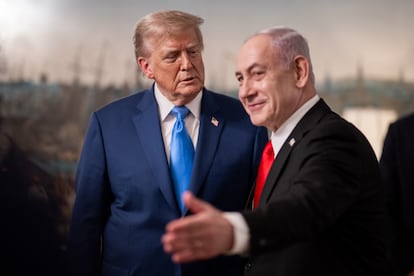
Without much fanfare from the U.S. Or plans for a joint press conference, Israeli Prime Minister Benjamin Netanyahu is set to meet with U.S. President Donald Trump in Washington this Wednesday, with one main topic on the table: Iran. The meeting was originally scheduled for next week, but Netanyahu insisted on moving it up after Trump’s envoys, Steve Witkoff and Jared Kushner, met in Oman with Iranian Foreign Minister Abbas Araghchi in the first round of talks that both sides have agreed to continue (amid a threatening military buildup in the Middle East), although without specifying a date or location for the next round. Araghchi said at the time that the talks are focusing exclusively on the Iranian nuclear program, but Netanyahu is now flying urgently to Washington to ensure that they also include the other issues that benefit him: limiting Iran’s ballistic missiles and ending Iranian support for militias in the region.
On Tuesday, before boarding his flight to the U.S., Netanyahu told reporters that he would present Trump with “our views regarding the essential principles of the negotiations - principles that, in our eyes, are vital not only for Israel but for anyone in the world who desires peace and security in the Middle East.”
This will be their seventh face-to-face meeting in the 12 months since Trump returned to the White House. This far surpasses any other world leader, not counting the speech Trump delivered in October before the Israeli Parliament, an opportunity meant to flatter him for securing the return of the last 20 living hostages from Gaza, marking the beginning of the ceasefire. “I believe this reflects the unique closeness of the extraordinary relationship we have with the U.S., that I personally have with the president, and that the State of Israel has with the U.S., something unprecedented in our history,” Netanyahu said before boarding the plane.
Netanyahu is counting on this personal rapport with Trump—he has even said that Israel might “not exist today” if he weren’t prime minister—to steer him away from Witkoff’s more negotiation-oriented approach. He wants to exploit the weakness of the ayatollahs’ regime to deliver the final blow, further solidifying Israel’s status as an unchallenged regional power. His strategy is to arrive at the October elections with regime change as the culmination of his victory against the Tehran-led axis, after devastating Gaza and humiliating Hezbollah.
Aware of what is at stake, the secretary of Iran’s Supreme National Security Council, Ali Larijani, addressed Netanyahu’s statements. He urged Americans to “act rationally” and “not allow” the Israeli prime minister to suggest that he will dictate the negotiating framework. They must remain vigilant against the ”destructive role played by Zionists,” he concluded in his message on the social media platform X.
Pressure
Israel, the country with the most powerful army in the Middle East and nuclear weapons (an open secret it has never confirmed), would only accept a kind of Iranian capitulation at the negotiating table: that it agree to far-reaching restrictions on its nuclear program, including the removal of enriched uranium from the country, and on its ballistic missile arsenal, both in number and range. It also advocates giving Tehran an ultimatum of a few weeks to accept its conditions, unlike Witkoff and Kushner, who are more flexible, according to the newspaper Israel Hayom.
Although Netanyahu and Trump are largely aligned on the Iranian issue, the former is directly opposed to the current negotiations. His energy minister, Eli Cohen, made this clear on Tuesday in an interview with military radio: “I believe one of the important messages that will be conveyed in the talks between Prime Minister Netanyahu and President Trump is that, at least from Israel’s point of view, based on past experiences, negotiations with Iran are pointless.”
In the first round of talks, and in an unprecedented move, the commander of U.S. Troops in the Middle East, General Brad Cooper, was part of the U.S. Delegation. His presence represented an apparent pressure tactic against Tehran, a reminder that Washington has deployed what Trump has described as “a beautiful Armada” in the region, including the aircraft carrier Abraham Lincoln and its escort destroyers. And that force could expand: the president told the online news outlet Axios that he is considering sending a second aircraft carrier if the talks fail.
Furthermore, the high command is very familiar with the area and can contribute experience and knowledge to a negotiating team with a background in real estate, not in diplomatic subtleties or nuclear technology knowledge, in which Aragchi is an expert. At the end of that round, little was clear. The good sign was that both sides remain committed to continuing talks. The bad sign is that they maintain very distant positions. And it’s not even clear what’s being discussed.
Deliver the enriched uranium
The U.S. Is demanding that Iran hand over all of its enriched uranium, including what’s buried under the rubble of the nuclear facilities it bombed last June during the 12-day war with Israel. It is particularly interested in the surrender of the uranium enriched to 60%, which is near the level needed to manufacture bombs. Last week, U.S. Secretary of State Marco Rubio insisted that negotiations must also address the range of Iran’s missiles, the withdrawal of support for militias such as Hezbollah in Lebanon, Islamic Jihad and Hamas in Gaza, and the Houthis in Yemen, as well as the treatment of the Iranian population following the brutal crackdown on protests.
Iran is open to negotiating its nuclear program, on which it already reached a limitation agreement that Trump withdrew from during his first term, but it categorically rejects abandoning its missile program, which it considers its last deterrent against Israel and part of its national sovereignty. “It is not negotiable, neither now nor in the future,” Aragchi said.
For the moment, the U.S. Is acting in a way reminiscent of the months leading up to its intervention in Venezuela, when it combined negotiations with Nicolás Maduro’s regime with increasingly suffocating economic pressure and an unprecedented buildup of military power. Added to this precedent is the Republican administration’s conviction that Iran is at its weakest point, further bolstered by the losses suffered by its allied militias.
Sign up for our weekly newsletter to get more English-language news coverage from EL PAÍS USA Edition
Tu suscripción se está usando en otro dispositivo
¿Quieres añadir otro usuario a tu suscripción?
Si continúas leyendo en este dispositivo, no se podrá leer en el otro.
FlechaTu suscripción se está usando en otro dispositivo y solo puedes acceder a EL PAÍS desde un dispositivo a la vez.
Si quieres compartir tu cuenta, cambia tu suscripción a la modalidad Premium, así podrás añadir otro usuario. Cada uno accederá con su propia cuenta de email, lo que os permitirá personalizar vuestra experiencia en EL PAÍS.
¿Tienes una suscripción de empresa? Accede aquí para contratar más cuentas.
En el caso de no saber quién está usando tu cuenta, te recomendamos cambiar tu contraseña aquí.
Si decides continuar compartiendo tu cuenta, este mensaje se mostrará en tu dispositivo y en el de la otra persona que está usando tu cuenta de forma indefinida, afectando a tu experiencia de lectura. Puedes consultar aquí los términos y condiciones de la suscripción digital.