In Venezuela, Chavismo is retreating, but it is not withdrawing
A month and a half after the US attack, the Bolivarian Revolution is testing a flexible opening and working on consensus to improve the economy
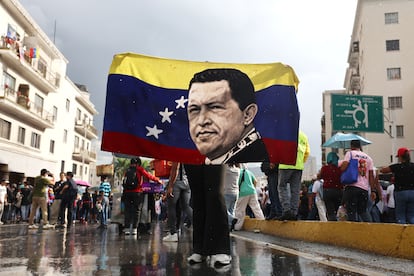
Faced with the most serious threat to its continuity in 27 years, the Chavista regime is retreating to survive. The U.S. Military attack on January 3 caused an internal upheaval within the ruling party and opened a phase of uncertainty whose moral and psychological effects remain to be seen.
In less than two months, the world has forgotten about Nicolás Maduro. The United States has taken center stage in the new Chavista agenda, and its envoys consider the nine-month timeframe proposed by María Corina Machado for organizing general elections to be “reasonable” in discussions with local authorities.
Internal shifts are also noticeable. An amnesty law is expected to be passed this Thursday. Civil society is once again calling for street protests. Some leaders are emerging from hiding, and the economic climate is improving. There is increasing talk of a new political era. For the most optimistic, there is even talk of a possible democratic transition.
At the helm of the government, Delcy Rodríguez, as interim president, faces pressure from the world’s most powerful nation as she tries to maneuver with the tools at her disposal, satisfying demands as far as she can and seeking to appease her critics. Even in what has been called a zone of obedience, her government appears stable. U.S. President Donald Trump has repeatedly stated that he recognizes and supports the Rodríguez administration as the official authority in Venezuela and has defended it, saying that “she is doing a very good job.”
Despite the emotional wounds inflicted by the U.S. Attack on Caracas and the crisis of representation following Maduro’s capture, the revolutionary leadership remains loyal to the state and the new government. The armed forces and the political structure still control the country and reaffirmed their public support for the interim president in the weeks following the assault.
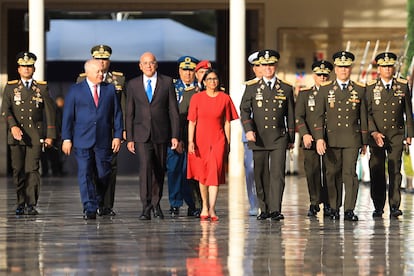
The Bolivarian Revolution appears a weakened political body with little popular support, but it remains organic and united around Rodríguez. Within Chavismo, there is a perception of an orderly retreat, not a withdrawal.
Chavismo has had to swallow its pride and accept the outrage of the U.S. Military attack. There was no sovereignty to defend: they took the president. “We have a Chavismo that is very weakened in terms of identity cohesion,” says Marisela Betancourt, a political scientist at the University of Los Andes. “There is a lot of internal confusion after January 3. For years, the pillar of Chavismo was the fight against imperialism, the armed struggle, and the sovereign rebellion. Now, the Rodríguez government responds to the interests of the occupying power, and the elite’s ultimate goal is to guarantee its continued hold on power. That is why it is implementing measures to appease the conflict.”
The political opening that the regime is attempting seeks to relieve external pressure as much as possible while simultaneously containing internal pressure.
Simultaneously, a climate of consensus is being fostered around economic recovery, which has become a shield against demands for democratization. The retreat is orderly and follows a defined political line. Even the most radical figures within Chavismo, such as Diosdado Cabello and Iris Varela, are now adopting a less confrontational tone in their statements.
This is not the first time that Chavismo has shelved or reversed course on its revolutionary project when circumstances demanded it. The metrics for measuring the progress of the process within the Venezuelan democratic framework were for years a subject of debate and a personal obsession of Hugo Chávez: “Neither a pact with the bourgeoisie nor revolutionary frenzy.” In the numerous challenges he issued to his adversaries, Chávez was also a master of tactical retreats, what in Venezuela became known as el recule (the backing down).
“From its inception, Chavismo has displayed a renewed cunning in maintaining power based on two tactics: first, knowing when to retreat, and second, launching a counteroffensive that surprises the adversary,” states Tulio Hernández, a sociologist and political analyst. “The new Chavismo — what some call the ‘Rodríguez regime’ — has accepted Trump’s conditions in exchange for sidelining María Corina Machado and [opposition political party] Vente Venezuela for this stage,” he adds. What remains unclear, Hernández continues, is the Chavista response: “Whether they will accept free elections within a reasonable timeframe, or postpone them as long as possible while constructing a new narrative and creating new economic and political conditions that allow the population to feel that something has changed.”
“Let’s not kid ourselves: Chavismo is very weakened by the events of January 3,” says Betancourt. “The regime was exposed as vulnerable, its flanks have been bombarded, and it is processing the impact of the aggression. It is trying to buy time and exploit the weaknesses around it.”
In recent weeks, a Commission for Democratic Coexistence and Peace was established in Miraflores Palace, and some figures from the moderate opposition were invited to participate; an atmosphere of consensus has been created. Spokespeople for the regime have apologized to the families of political prisoners, a gesture almost unimaginable just two months ago, and an amnesty law is being debated in the National Assembly that could lead to the release of hundreds of people detained for political reasons.
In recent weeks, some 600 political prisoners have been released. Anti-American and Guevarist rhetoric is waning. A more conciliatory tone toward the business sector is being strengthened. With the United States, the motto is “win-win.” Street patrols by the political police are decreasing. Concessions are being made to the language of bourgeois reformism.
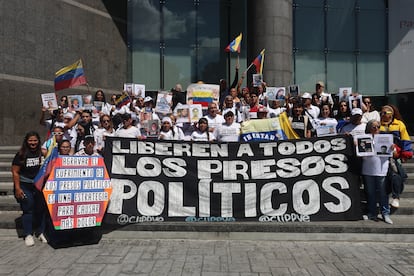
Although the issue is not openly debated, many people in Caracas are optimistic about the possibility of a transition to democracy in the short or medium term. However, the regime continues to impose its own terms and remind its critics of the limits of this opening: it applies selective punishments to those who, for example, go too far in their protests, as happened with opposition leader Juan Pablo Guanipa, arrested shortly after being released in an episode that the opposition has denounced as a sign that the repressive apparatus remains under the government’s control.
On television, radio, and in the streets, ads and banners calling for the release of Maduro and his wife, Cilia Flores, continue to circulate. Every Sunday at noon, the state-run Venezolana de Televisión broadcasts old anti-imperialist speeches by Hugo Chávez. Meanwhile, the regime meets with its supporters in increasingly modest events and continues to talk about communal projects and popular democracy.
Betancourt observes that the weakened state of the opposition — almost entirely in exile and devastated by the repression of recent years — illustrates the complexity of the approaching landscape. “The economic and political timings must align for a transition to occur. That may not be happening. The government is using this mismatch to its advantage,” she notes. “The fact that the opposition currently lacks the strength to lead a democratic opening with its own strategies indicates that we are not yet facing a genuine transition. A transition will be underway when there is a considerable force pressing in the streets to alter the government’s interests.”
Tulio Hernández asserts that a redesign of the current democratic arena is necessary, one in which Machado — still considered by many to be the undisputed leader of the opposition movement — must pave the way for the creation of a broader political front. According to the analyst, this implies “abandoning sole leadership” and forging an alliance that embodies the idea of a collective front: political parties, student leaders, social organizations, political prisoners and their families, all united in the pursuit of the return of freedom of expression and the restoration of democracy.
Sign up for our weekly newsletter to get more English-language news coverage from EL PAÍS USA Edition
Tu suscripción se está usando en otro dispositivo
¿Quieres añadir otro usuario a tu suscripción?
Si continúas leyendo en este dispositivo, no se podrá leer en el otro.
FlechaTu suscripción se está usando en otro dispositivo y solo puedes acceder a EL PAÍS desde un dispositivo a la vez.
Si quieres compartir tu cuenta, cambia tu suscripción a la modalidad Premium, así podrás añadir otro usuario. Cada uno accederá con su propia cuenta de email, lo que os permitirá personalizar vuestra experiencia en EL PAÍS.
¿Tienes una suscripción de empresa? Accede aquí para contratar más cuentas.
En el caso de no saber quién está usando tu cuenta, te recomendamos cambiar tu contraseña aquí.
Si decides continuar compartiendo tu cuenta, este mensaje se mostrará en tu dispositivo y en el de la otra persona que está usando tu cuenta de forma indefinida, afectando a tu experiencia de lectura. Puedes consultar aquí los términos y condiciones de la suscripción digital.