White House steps up pressure on Colombia over Serbian drug lord Antun Mrdeza
An intelligence report links the Serb and Giovanny Andrés Rojas, known as ‘Araña,’ to a transnational drug‑trafficking network, turning their extraditions into a diplomatic issue between Washington, Bogotá, and Caracas
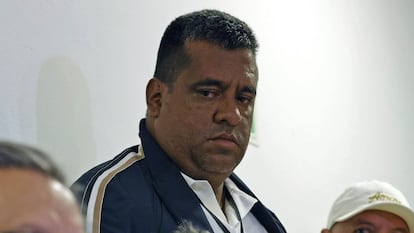

A meeting between two drug traffickers in the Amazon jungle region of Putumayo has become a new lever of pressure for Donald Trump on the governments of Colombia and Venezuela. A U.S. Intelligence report reveals that Giovanny Andrés Rojas aka “Araña,” the top leader of the Border Commandos and currently imprisoned in La Picota prison in Bogotá, is making illegal deals with the Serbian kingpin Antun Mrdeza, who has been held in Venezuela since 2025.
The White House has requested the handover of both criminals, and the issue has been shaping discussions between the leaders of the three countries.
In fact, the first meeting between Colombian President Gustavo Petro and Venezuela’s acting president, Delcy Rodríguez — which is expected in the coming days — is about more than simply strengthening ties. A government source who advised Petro ahead of his meeting with Trump told EL PAÍS that they must agree on the logistics for Colombia to request Mrdeza’s transfer, after the kingpin’s embarrassing escape in May 2023 from Rionegro airport, which serves the city of Medellín. Once in Colombia, the United States would request his extradition.
“Requesting him directly from Venezuela had been considered, but the explanation given is that, although relations have been restored, they can change quickly,” said the source. Colombia would therefore act as mediator and guarantor.
Antun Mrdeza, also known as “Nikola Boros,” is considered by Colombian authorities to be one of the members of the so‑called New Drug Trafficking Board, a transnational network that, according to the Petro government, brings together kingpins from Latin America and Europe who work together to move the world’s largest cocaine shipments. The Serbian trafficker, who has open cases in seven countries, moved freely through several Colombian cities in May 2023 after escaping at the airport. There, he asked the officers guarding him for permission to buy water and used the opportunity to flee in an Audi headed toward the city of Cali. The report states that there “he met with trusted associates responsible for finances, money laundering, and securing local drug sellers.”
He later traveled to the department of Putumayo, in the Amazon Rainforest on the border with Ecuador. According to the document, during that meeting “he allied himself with Araña to traffic drugs.” Those meetings with the Colombian trafficker were recorded by Drug Enforcement Administration (DEA) intelligence agents, who placed Araña in the sights of the United States and triggered an Interpol alert against him. From Putumayo, according to authorities, the Serbian trafficker went to Guayaquil in Ecuador, where he survived an attack. “He took refuge in Venezuela, where he was captured on May 22, 2025.”

That day, Diosdado Cabello, as Venezuela’s Minister of the Interior, announced that the Bolivarian National Guard had detained more than 70 people who were allegedly collaborators of Venezuelan opposition leader María Corina Machado — including Mrdeza. His name appeared on a long list of journalists, activists, human rights defenders, and political figures. His reappearance not only alerted Colombia, which had lost track of him two years earlier, but also reopened cases in the Dominican Republic and Italy.
According to the report, the Serbian national is an associate of Alejandro Salgado Vega, aka “El Tigre,” Spain’s most wanted drug trafficker and thought to be hiding in Dubai. According to the Spanish Anti-Narcotics Prosecutor’s Office, he is part of a network that trafficked more than €100 million ($118 million) worth of cocaine hidden in pineapples between 2020 and 2021. Within the transnational network, the Serbian’s supposed specialty is coordinating the Bolivia–Uruguay and Colombia–Ecuador–Brazil routes. His movements through the Colombian Amazon align with those corridors.
Colombian partner is in custody
Geovanny Andrés Rojas, the Colombian national identified in U.S. Intelligence reports as one of Mrdeza’s cocaine suppliers, remained free until February 2025. He had been appointed by the government as a peace negotiator with the armed group Border Commandos, a legal designation that suspended his arrest warrants. Despite that status, he was detained. The operation did not take place in the jungle, nor did it require the use of force.
Araña was arrested at the Marriott Hotel in Bogotá while negotiators from his armed structure were meeting with government delegates to review the third round of talks. The Attorney General’s Office burst into the meeting and, in front of the national media, detained him at the request of the United States. Since then, he has been held at La Picota prison in the same city, awaiting President Gustavo Petro’s signature on his extradition.
The request has been delayed for nearly a year. A secret diplomatic committee in the United States — revealed by EL PAÍS — had mediated with Trump to ease tensions and justify the delay. The Petro government has refused to sign the authorization because doing so would jeopardize the negotiations underway with the so‑called Coordinadora Nacional Ejército Bolivariano (National Coordinator of the Bolivarian Army), the dissident group to which the Border Commandos belong. Instead, Colombia agreed to send Andrés Felipe Marín, known as “Pipe Tuluá,” who landed in the United States on February 3, the same day Petro and Trump met. The agreement was fulfilled by its deadline.
On January 29, President Petro issued an ultimatum to Araña: his group had to eradicate 15,000 hectares of coca in Putumayo within 10 days. Twenty days have passed since that threat, and the extradition remains on hold. The Colombian government argues that approving the extradition could still jeopardize the ongoing peace process, so the decision remains on hold while the government weighs its consequences. Araña’s case is stuck between international pressure and the government’s own political calculations. And the extradition order from the Trump administration lies waiting.
Sign up for our weekly newsletter to get more English-language news coverage from EL PAÍS USA Edition
Tu suscripción se está usando en otro dispositivo
¿Quieres añadir otro usuario a tu suscripción?
Si continúas leyendo en este dispositivo, no se podrá leer en el otro.
FlechaTu suscripción se está usando en otro dispositivo y solo puedes acceder a EL PAÍS desde un dispositivo a la vez.
Si quieres compartir tu cuenta, cambia tu suscripción a la modalidad Premium, así podrás añadir otro usuario. Cada uno accederá con su propia cuenta de email, lo que os permitirá personalizar vuestra experiencia en EL PAÍS.
¿Tienes una suscripción de empresa? Accede aquí para contratar más cuentas.
En el caso de no saber quién está usando tu cuenta, te recomendamos cambiar tu contraseña aquí.
Si decides continuar compartiendo tu cuenta, este mensaje se mostrará en tu dispositivo y en el de la otra persona que está usando tu cuenta de forma indefinida, afectando a tu experiencia de lectura. Puedes consultar aquí los términos y condiciones de la suscripción digital.