Cindy Crawford: The 60th birthday of the supermodel who changed the rules of the game
Now an entrepreneur, she was one of the first to combine catwalks with TV work like the iconic 1992 Pepsi ad. She brought fashion to the masses with an MTV show, and is one of the few models who managed to overcome the industry’s ageism
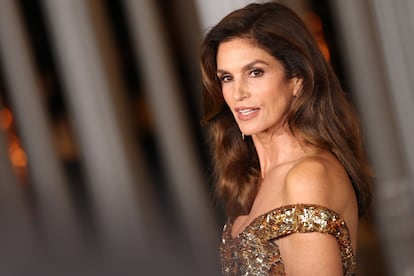

Her name is synonymous with fashion history. Cindy Crawford managed to break some of the unwritten rules of an industry resistant to major changes, and she is one of the few who has successfully defied ageism in a sector that often ignores women as they get older. This Friday, February 20, Crawford celebrates her 60th birthday, balancing her work as a model with her role as an entrepreneur at the helm of the cosmetics brand Meaningful Beauty, geared towards older women.
She was 16 when she was discovered by a local photographer in her hometown of DeKalb, outside Chicago. She had never considered fashion as a career path and, in fact, during her student years she held all sorts of jobs: from cleaning houses to folding clothes in a store to detasseling corn, as she recently revealed to Elle magazine.
Thanks to her excellent grades in school, she received a scholarship to Northwestern University to study chemical engineering. However, the world of fashion opened doors for her, and she traded the laboratories for the runways. As she has recounted in interviews over the years, the beginnings weren’t easy, and it took a while to get herself established as a model. She started working at an agency in Chicago where, ironically, they told her she had to remove the mole she had at the corner of her lip. She refused, and that mole became her trademark, a “brand” that helped her land lucrative contracts. “It’s that uniqueness that makes you stand out from the rest, which is why you have to embrace your individuality, even though it’s easier said than done,” she said in a 2020 interview.
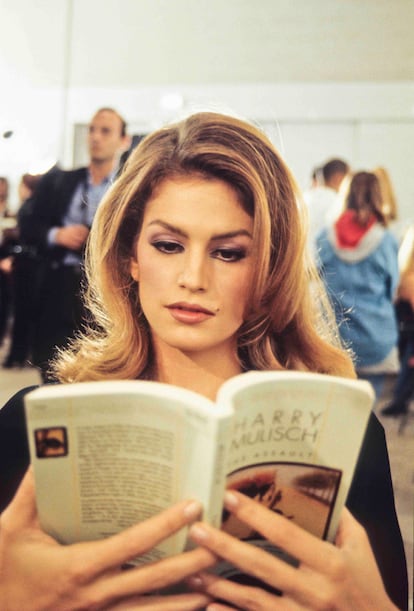
In the mid-1980s her agency was bought by Elite, one of the most powerful names in the industry, and everything changed in the 1990s. A cover story published in the January 1990 issue of British Vogue, with photographs by Peter Lindbergh, catapulted Cindy Crawford to fame. The feature is considered the starting point of the supermodel phenomenon. On that cover, Crawford appears with Naomi Campbell, Christy Turlington, Linda Evangelista and Tatjana Patitz, considered the original supermodels by fashion enthusiasts and fans. Shortly afterward, all five shared the screen again in George Michael’s music video Freedom! ’90, a song that became an anthem and cemented their status as global icons.
For the first time in history, models ceased to be known solely within the fashion world and became true stars, leading to a series of unprecedented events in which Crawford played a prominent role. The Illinois native proved that it was possible to be both a runway model and a commercial model, two mutually exclusive fields in those years. She would walk the runway for legendary couturiers like Valentino or leading 1990s brands like Versace, and then sign lucrative advertising contracts with consumer brands as deeply ingrained in the American psyche as Pepsi. Her commercial for the soft drink brand, aired during the 1992 Super Bowl, is one of the most memorable and has spawned countless versions.
“Every January I revisit my original Pepsi spot that I just love because the music was perfect and the little boys were perfect and it was just one of those commercials that everyone loved and it made people happy,” she recalled in People magazine in 2023. The last time she did a remake was in 2021, for a charitable cause: raising funds for the hospital that treated her little brother for leukemia. Her commercials with Revlon, the hair care brand she worked with for over a decade, were also very popular.
Crawford further reinforced her connection with the public and helped democratize fashion thanks to her role as host of the MTV show House of Style. The format of the show, on which she also served as executive producer, included interviews with designers and fellow professionals and showcased the inaccessible and exclusive world of high fashion for the benefit of TV viewers. The show started airing on MTV (then the most popular channel among young Americans) in 1989, and she left six years later, with its cancellation finally taking place in 2000.
Besides her success as a top model, her name was a recurring topic in the tabloids from 1991 onwards due to her relationship with Richard Gere, the actor du jour after the success of Pretty Woman. The couple met when she was just 22, and he was nearly 40, and they were married from 1991 to 1995. “In the beginning of a relationship, when you’re a young woman, you’re like, ‘You like baseball? I like baseball. Oh, you’re really into Tibetan Buddhism? I might be into that. I’ll try that. You’re willing to kind of mold yourself around whoever you are in love with,” the model revealed in the Apple TV+ docuseries Supermodels, which premiered in September 2023.
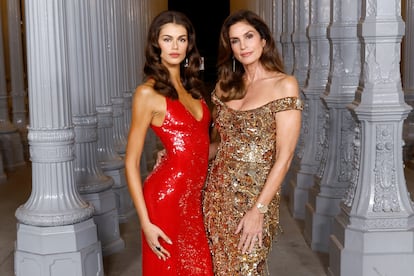
With the new century, the era of the supermodels came to an end. In 2002, Crawford’s contract with Revlon ended, by which time she had rebuilt her life with businessman Randy Gerber and was the mother of two children, Presley (1998) and Kaia (2001). Some media outlets alluded to ageism as one of the possible causes, although the supermodel maintained that it was all due to financial differences.
From the 2000s onward, her work pace slowed, but unlike other colleagues in the profession, such as Claudia Schiffer, who chose to disappear from the public eye after years of intense scrutiny, she never fully distanced herself from the industry. She is a regular at fashion weeks, although now she attends as a spectator — with a few exceptions, such as the tribute show to Gianni Versace held in 2017 to mark the 20th anniversary of the designer’s death. She stars in advertising campaigns for luxury brands like Omega (with whom she has worked since the beginning of her career) and sometimes shares the workday with her daughter Kaia Gerber, who is also a model. She has also continued to grace magazine covers. In 2018, she was on the cover of Vogue Spain for the magazine’s 30th anniversary, a publication for which she also appeared on the cover of its first edition, launched in 1988.
In her four decades in the industry, Crawford has witnessed significant changes. In her opinion, one of the most transformative in the last 10 years has been the rise of social media. “It’s like having two full-time jobs. When you’re young, which most models are, it’s sort of precarious because you’re still figuring yourself out. If you’re working out who you are on a public platform, that can be a lot of pressure,” she reflected in a 2024 interview with W Magazine. “Another thing is casting directors. That wasn’t a thing in my day. But when my daughter started modeling, the casting directors were so important,” she added.
Being so exposed in the 1990s wasn’t easy for Crawford, who still remembers some embarrassing situations, humiliating comments, and inappropriate requests made during a time when the objectification of women, especially in her industry, was rampant. In the documentary about supermodels, she recounted a 1996 interview with Oprah Winfrey in which the talk show host urged her to stand up and show off her body. She said it made her feel like a “chattel” or a child who was there “to be seen and not heard. [...] When you look at it through today’s eyes...that was so not OK, really especially from Oprah.”
Model, show host, producer, entrepreneur… the multifaceted Cindy Crawford is not only a role model for many young women who have just arrived on the catwalk, she continues to be relevant for an industry accustomed to discarding models as quickly as clothes are changed in a shop window, and that is not something that many of her colleagues have achieved.
Sign up for our weekly newsletter to get more English-language news coverage from EL PAÍS USA Edition
Tu suscripción se está usando en otro dispositivo
¿Quieres añadir otro usuario a tu suscripción?
Si continúas leyendo en este dispositivo, no se podrá leer en el otro.
FlechaTu suscripción se está usando en otro dispositivo y solo puedes acceder a EL PAÍS desde un dispositivo a la vez.
Si quieres compartir tu cuenta, cambia tu suscripción a la modalidad Premium, así podrás añadir otro usuario. Cada uno accederá con su propia cuenta de email, lo que os permitirá personalizar vuestra experiencia en EL PAÍS.
¿Tienes una suscripción de empresa? Accede aquí para contratar más cuentas.
En el caso de no saber quién está usando tu cuenta, te recomendamos cambiar tu contraseña aquí.
Si decides continuar compartiendo tu cuenta, este mensaje se mostrará en tu dispositivo y en el de la otra persona que está usando tu cuenta de forma indefinida, afectando a tu experiencia de lectura. Puedes consultar aquí los términos y condiciones de la suscripción digital.