Mexico, a country without drug lords
The strategy of decapitating the major cartels, culminating in the death of El Mencho, has so far resulted in more violence due to the fragmentation of small, unpredictable, and uncontrolled groups
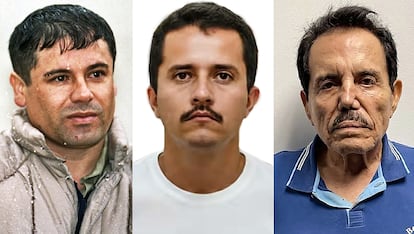

When the Mexican Navy killed Heriberto Lazcano, the leader of the fearsome Los Zetas cartel who pioneered narco-terrorism in Mexico, in 2012, El Mencho was just beginning to emerge. He had helped weaken that group of elite ex-military personnel and was already plotting a break with the Sinaloa Cartel to launch his solo career. By 2014, with Joaquín “El Chapo” Guzmán’s second arrest, he was already running his own cartel, but thanks to maintaining a low profile, he had kept a surprisingly clean criminal record. During El Chapo’s definitive capture, he had even managed to shoot down a military helicopter with cannon fire and bring Guadalajara, Mexico’s second-largest city, to a standstill. A couple of years later, he made a pact with the remnants of the Tijuana and Juárez cartels, bled dry by the war against Sinaloa, to consolidate his power. And when Ismael “El Mayo” Zambada was arrested last year in Texas, he had long since established himself as the head of Mexico’s most powerful cartel and the most-wanted man in the United States. El Mencho was the last great drug lord and, at the same time, the first to emerge from the disintegration of the classic cartels. Now, after his death on Sunday at the hands of the Mexican military, neither of those things exists anymore.
Mexico faces a new scenario where organized crime groups are leaderless. The big names that once personified the complex problem of violence in Mexico, elevated in the popular imagination as great villains, are gone. They are all either dead or in prison. The strategy of targeting the top of the cartels has been the norm for Mexican governments for almost two decades, with a slight pause during the previous presidential term, since the start of the so-called war on drugs and the deployment of the military to confront organized crime head-on. The results of these high-profile operations have not been very encouraging, judging by the data. Murders and disappearances have broken historical records during this timeframe, in addition to spikes in relatively new crimes such as extortion.
The consequence has been not only a dispersal of crimes, but also the emergence of new groups. With the large criminal organizations decapitated, a new mutation occurred: a galaxy of new, atomized groups, more uncontrolled and unpredictable, eager to profit from any opportunity. A decade ago, the then-Office of the Attorney General of the Republic (PGR) had identified eight major groups; today, the number has grown to over 80, according to military documents leaked a few years ago.
The short- and medium-term outlook is uncertain, including a new factor compared to the pattern of recent years. Mexico has transferred more than 100 mid-level and high-profile prisoners linked to organized crime to the United States. This move is a response to intense pressure from the Donald Trump administration, which has long flirted with the idea of intervention in Mexican territory. Federal sources indicate that, in addition to pressure from Washington, the transfer of these high-profile figures has an internal purpose: to prevent them from continuing to operate from within the Mexican prison system and to avoid further internal conflicts.
Among the three rounds of extraditions carried out so far are — in addition to historical drug lords like Rafael Caro Quintero and Servando Gómez-Martínez, alias “La Tuta” — mid-level commanders of the Jalisco New Generation Cartel (CJNG). These include Antonio Oseguera, alias “Tony Montana,” a brother of El Mencho in charge of money laundering, and Abigael González Valencia, alias “El Cuini,” El Mencho’s brother-in-law and right-hand man. “Mexican prisons, although they have improved, tend to be echo chambers for what happens outside. The fact that these figures are far away can complicate the local response capacity of the cartels,” says David Pérez Esparza, a security analyst and member of the Executive Secretariat of the National Public Security System during the administration of Andrés Manuel López Obrador.
Analysts emphasize that the root of the problem runs much deeper than just the big-name media figures. According to Carlos Flores, a security expert at the Center for Research and Advanced Studies in Social Anthropology (CIESAS), “as long as the web of complicity between political power and corporate money laundering networks remains untouched, the phenomenon will continue to reproduce itself. That is the structure that allows these figures to rise to power, regardless of their supposed cunning or skill.”
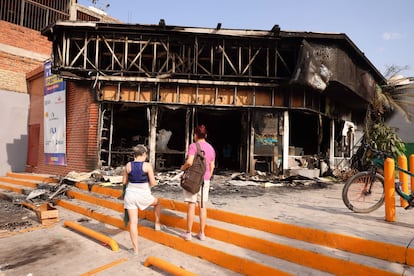
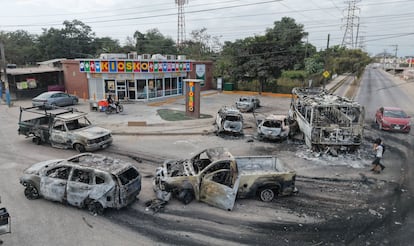
The CJNG case also has a unique characteristic. It is a modern, decentralized mafia that operates like a franchise, allowing it to extend its reach across almost the entire country. The response to the death of its leader demonstrated its firepower. Like a domino effect, violent incidents multiplied nationwide. Two hundred and fifty roadblocks were identified in 20 states, from Sinaloa, Colima, and Nayarit, through Guanajuato, Zacatecas, Hidalgo, Querétaro, Michoacán, and the State of Mexico, to Tamaulipas, Veracruz, Puebla, Chiapas, and Tabasco, which is over 800 miles from where the drug lord was captured.
Catalina Pérez Correa, a doctor of law and researcher at CIDE specializing in security and drug issues, believes that “what we are seeing surpasses even what happened during the Culiacanazo.” In 2019, the response to a failed army operation to arrest one of El Chapo’s sons, Ovidio Guzmán, was a wave of violence that paralyzed the capital of Sinaloa. “Their capacity for mobilization has now been much greater, as has the diversification of this group’s illicit businesses. It demonstrates that the cartel continues to operate, and as long as the state fails to neutralize not only drug trafficking, but also mining, logging, fuel theft, and extortion, there will continue to be incentives for crime.”
The strategy of taking down high-level drug lords, adds Esperanza, “is based on the highly questionable theory that large organizations pose a threat to national security and need to be confronted by the military. Conversely, by dismantling them, they lose the capacity, for example, to conduct transnational business and become a threat to public safety, which is then handled by state police forces.” So far, this squaring of the circle has not been achieved, with public security tasks increasingly falling into the hands of the military. Sunday’s operation against El Mencho, carried out by the Ministry of Defense in coordination with U.S. Authorities, is the latest example.
Sign up for our weekly newsletter to get more English-language news coverage from EL PAÍS USA Edition
Tu suscripción se está usando en otro dispositivo
¿Quieres añadir otro usuario a tu suscripción?
Si continúas leyendo en este dispositivo, no se podrá leer en el otro.
FlechaTu suscripción se está usando en otro dispositivo y solo puedes acceder a EL PAÍS desde un dispositivo a la vez.
Si quieres compartir tu cuenta, cambia tu suscripción a la modalidad Premium, así podrás añadir otro usuario. Cada uno accederá con su propia cuenta de email, lo que os permitirá personalizar vuestra experiencia en EL PAÍS.
¿Tienes una suscripción de empresa? Accede aquí para contratar más cuentas.
En el caso de no saber quién está usando tu cuenta, te recomendamos cambiar tu contraseña aquí.
Si decides continuar compartiendo tu cuenta, este mensaje se mostrará en tu dispositivo y en el de la otra persona que está usando tu cuenta de forma indefinida, afectando a tu experiencia de lectura. Puedes consultar aquí los términos y condiciones de la suscripción digital.