Nayib Bukele’s recipe against gangs that failed in Honduras: ‘We’re safer because Mara Salvatrucha rules here’
Xiomara Castro imposed a state of emergency similar to El Salvador’s, restricting rights and deploying the army in the streets, but criminal groups control large areas of one of Central America’s most violent countries
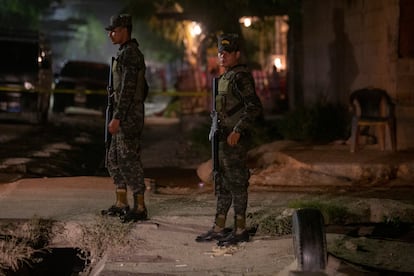
In the Rivera Hernández neighborhood of San Pedro Sula, Honduras, the government’s failed attempt to implement repressive measures against gangs similar to those imposed by Nayib Bukele in El Salvador is evident. At the entrance to this neighborhood, a taxi driver who asks to be identified as Mr. Jota explains the new nuances of his work: “Look, what we pay is no longer called extortion. It’s called ‘use of facilities.’ If you use the taxi stand, you have to pay the gang. If you don’t use it, you don’t pay. It’s that simple.” Mr. Jota lives in one of the most dangerous neighborhoods in Honduras and, for almost 50 years, he has witnessed gang violence firsthand. Now, he says, Rivera Hernández is one of the “safest” places in the country. The reason, however, seems contradictory: “Now we’re safer because Mara Salvatrucha [MS-13] rules here,” he says.
Honduras has historically been one of the most murderous countries in Latin America, and the Rivera Hernández neighborhood in San Pedro Sula is considered the most telling example of that violence. In 2014, the city reached a rate of 140 homicides per 100,000 inhabitants, 14 times what the World Health Organization considers an epidemic. However, since that peak, homicides in the neighborhood have steadily declined, in line with the national trend, reaching a rate of 25 homicides in the last year. “Now you can walk around here peacefully. You don’t see gang members anymore. Now there are surveillance cameras in the neighborhoods. They have everything under control from a command center, but in a more professional way,” says Jota.
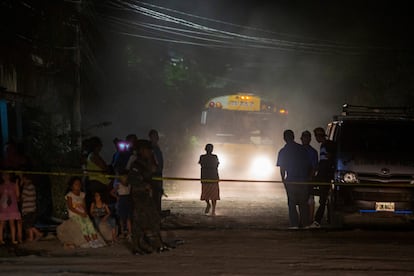
On December 6, 2022, following a surge in extortion reports, then-President Xiomara Castro imposed a state of emergency similar to that of El Salvador, restricting rights and deploying the army in the streets. However, according to official sources, the operation did not target gang leaders, nor did it include mass raids, capture key figures, or reform the justice system as in El Salvador. Although homicides have decreased, sources agree that this is not due to the state of emergency, but rather to internal decisions within the gang.
“Here, the gangs are more organized. There [in El Salvador], they killed just for the sake of killing. Here, they operate like a business. Here, if you join MS-13, it’s said that you work for MS-13. You’re an employee of MS-13. You, for example, manage businesses for them, a car wash, a restaurant, or you collect extortion payments and answer to your bosses. MS-13 isn’t so much interested in killing anymore, but in the business,” said a high-ranking military officer with intelligence duties.
The drop in homicides in Honduras coincided with the consolidation of MS-13’s criminal hegemony after eliminating its rivals. For example, in 2010, about a dozen rival gangs operated in the Rivera Hernández sector, but by February 2016, MS-13 had wiped them all out. “Now there are only about four or five small neighborhoods left that belong to the Barrio 18 gang: Kitur, Cerrito Lindo, Satélite… not many more. That’s why MS-13 now operates more surgically. They’re not going to kill a bunch of people to make a big fuss. They’re going to be selective. They know who they’re targeting,” said a former MS-13 founder on condition of anonymity.
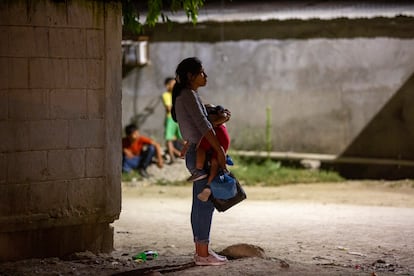
The failure of the state of emergency in Honduras is reflected, for example, in the 48 mass killings recorded in its first two years, with 220 victims, including the massacre of 46 women in the Támara prison in June 2023, the worst in a women’s prison in recent Latin American history. “On the very first day [of the state of emergency], they kidnapped three boys from this neighborhood, put them in the trunk of a car, drove past some soldiers, and nobody did anything,” says Jota.
The Honduran state of emergency was renewed 24 times and expired on January 26, the day before Nasry Asfura’s inauguration. The outgoing government did not present an assessment of the measure, and its expiry went almost unnoticed on the streets.
A failed attempt
On February 14, Bukele shared a video in which the Honduran Minister of Security stated that the Salvadoran model “applies to certain conditions” and “is not a recipe” that can be replicated in all countries. Bukele reacted angrily and accused the minister of defending the “human rights” of criminals. His message sparked criticism on social media, primarily directed at the Honduran government. “I had remained silent because I know that many of my Honduran brothers and sisters expect the new government to do something about security… Thousands of Hondurans will die because of these people,” he wrote.
The state of emergency in El Salvador began on March 27, 2022, after gangs orchestrated a massacre that left 87 people dead over the course of a weekend. This occurred amid a downward trend in homicides and at the same time as a triumphalist speech by President Bukele, who attributed the decrease to the effects of his “Territorial Control” security plan which, according to him, consisted of seven secret phases. Later, journalistic reports and investigations by the U.S. Attorney General’s Office indicated that Bukele, in reality, maintained a pact with the gangs.
Since its implementation, the Salvadoran government has detained nearly 90,000 people without trial over almost four years and has dismantled gang structures like no previous administration. The cost has been high: some 470 deaths in prisons and thousands of complaints of torture and arbitrary detentions, according to human rights organizations.
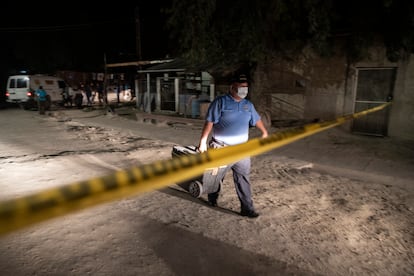
Since then, many Latin American politicians have sought to emulate the measure as if it were a surefire formula for success. Xiomara Castro replicated a regime similar to that of El Salvador. The Honduran government reported 70,000 arrests in July 2025, but without specifying how many were linked to gangs or how many resulted in convictions. Between 2022 and 2025, 924 complaints of police abuse were registered, in addition to investigations into enforced disappearances and allegations of torture.
According to the military source, one of the factors that prevented the state of emergency in Honduras from functioning as it did in El Salvador was the limitations placed on security forces. “Here, you can’t arrest anyone just for the sake of it, nor can you conduct mass raids on thousands of people. We don’t have that legal capacity,” the source said.
Sources indicate that MS-13 in Honduras no longer relies primarily on extortion, but is involved in national drug distribution and money laundering, so fighting gangs would also mean fighting drug trafficking, a more powerful force in the region.
In his inaugural address on January 27, President Asfura listed the main problems to be addressed during his term: unemployment, the centralization of the state, and healthcare. He made no mention of gangs or drug trafficking. This omission is significant, because after a state of emergency that failed to dismantle criminal structures or sever their ties to drug trafficking, the challenge his government now faces is more complex and profound. One need only look at Rivera Hernández, the notorious neighborhood of San Pedro Sula, where security is not guaranteed by the state, but by the Mara Salvatrucha gang, which has become a highly successful organization.
Sign up for our weekly newsletter to get more English-language news coverage from EL PAÍS USA Edition
Tu suscripción se está usando en otro dispositivo
¿Quieres añadir otro usuario a tu suscripción?
Si continúas leyendo en este dispositivo, no se podrá leer en el otro.
FlechaTu suscripción se está usando en otro dispositivo y solo puedes acceder a EL PAÍS desde un dispositivo a la vez.
Si quieres compartir tu cuenta, cambia tu suscripción a la modalidad Premium, así podrás añadir otro usuario. Cada uno accederá con su propia cuenta de email, lo que os permitirá personalizar vuestra experiencia en EL PAÍS.
¿Tienes una suscripción de empresa? Accede aquí para contratar más cuentas.
En el caso de no saber quién está usando tu cuenta, te recomendamos cambiar tu contraseña aquí.
Si decides continuar compartiendo tu cuenta, este mensaje se mostrará en tu dispositivo y en el de la otra persona que está usando tu cuenta de forma indefinida, afectando a tu experiencia de lectura. Puedes consultar aquí los términos y condiciones de la suscripción digital.