What Chinese politicians think about the attack on Iran: ‘This isn’t the world order I grew up with’
The situation in the Middle East is worrying members of parliament, which they acknowledge on the sidelines of the Asian giant’s major annual political gathering in Beijing
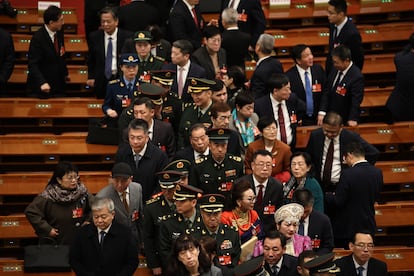
China is using its major annual political gathering, the so-called Two Sessions, which began this week in Beijing, to present itself as a haven of stability in an increasingly turbulent world. Even so, not even the tightly scripted nature of this gathering has been able to keep out the latest geopolitical shock.
The escalation of violence in the Middle East has become a topic of conversation in the corridors of the Great Hall of the People, the monumental building next to Tiananmen Square where China hosts its most solemn political events. The U.S.–Israel attack on Iran is described as an issue that “concerns” everyone and is being “closely monitored,” said Yang Debin, a Hong Kong deputy in the National People’s Congress, on Thursday.
“I believe China should continue on its own path and maintain its own growth. It will be a way of indirectly contributing to global stability,” said Yang, before heading toward the large auditorium where the plenary session of this body — one with limited oversight powers and under the absolute control of the Chinese Communist Party — was about to begin.
“I’m closely monitoring the conflict’s developments,” said Xie Rupeng, a representative of Guangzhou. “Although there are no clear signs of disruption at the moment, the situation could have negative effects on our supply chain, exports, and other areas.”
Once a year, China’s normally rigid political system briefly loosens, allowing journalists to mingle with deputies to the National People’s Congress and members of the Chinese People’s Political Consultative Conference (CPPCC), a vast and diverse advisory body.
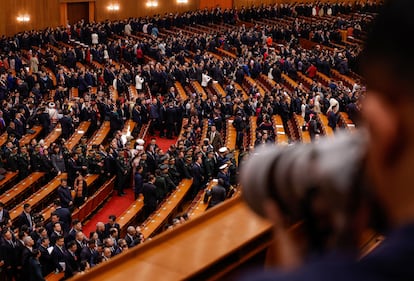
It is a fleeting moment: it lasts only as long as it takes the delegates and advisers to cross the spacious, marble-clad entrance hall of the Great Hall of the People on their way to their seats for the opening session, or return to the buses parked in Tiananmen once the meeting has ended. The constant coming and going offers a unique opportunity to ask direct, unfiltered questions about global crises. And this time, to gauge sentiment regarding the drift toward war in the Middle East and its consequences for China.
“Nobody is happy with what’s happening,” said He Junyao, one of the more than 2,000 members of the CPPCC. This Hong Kong lawyer and senator believes the international situation has become “dangerous,” “like skating on thin ice in spring,” and could pose an obstacle to Donald Trump’s trip to China, which is scheduled for the end of March, although Beijing has not confirmed the date. Speaking in English, he said: “If I were the president of the United States, I would reconsider postponing the visit rather than rushing into it.”
Anger over the military operation and the spread of fighting throughout the Middle East is palpable. “An attack on a sovereign country and the assassination of its leaders? I don’t think that’s legal,” said Wei Binjiang, also from Hong Kong, who is a member of the CPPCC and a technology expert. Regarding the current state of the fractured geopolitical map, he added: “This isn’t the world order I grew up with.”
Wei Binjian believes that this new war will affect China, “and the whole world.” Like his colleague, he also thinks that the situation complicates the expected meeting between Chinese President Xi Jinping and the Republican magnate: “I don’t think it’s the right time for Trump to visit China.”
Even so, he welcomes the talks expected next week in Paris between Chinese Vice-Premier He Lifeng and U.S. Treasury Secretary Scott Bessent, which aim to launch a new round of trade and tariff negotiations — Trump’s other war. “The world’s two largest economies cannot stop communicating,” he said.
Others are more optimistic about the future of relations between Beijing and Washington: “Very positive progress has been made with the latest negotiations,” said Feng Yidong, a member of the Economic Commission of the government’s advisory body, from Shandong. “We are an important partner. Neither can do without the other.” He continued: “Cooperation benefits both sides, and confrontation hurts us; the Americans recognize this as well.”
Dozens of reporters move back and forth in search of statements among hundreds of regional leaders, senior officials, businesspeople, Tibetan monks in robes, and other colorful representatives of different ethnic groups from every corner of the country. The Hong Kong delegates, accustomed to a somewhat looser media environment than that of mainland China — although one that is steadily shrinking — are among the most talkative.
Most deputies and advisers hurry away as soon as they sense the reporters’ intentions. “I’m sorry, I can’t talk,” said four military officers in turn. The armed forces are currently under intense scrutiny because of a series of purges among senior commanders, which Beijing describes as part of a prolonged “anti-corruption” campaign.
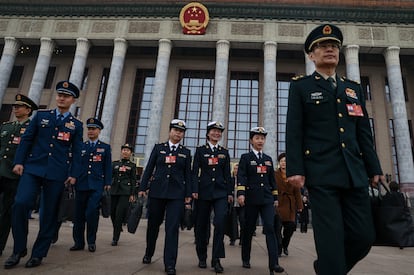
Each time a political representative agrees to speak, they are swallowed up by a cloud of cameras, smartphones and microphones. Those questioned hold forth on all kinds of local and national policies, discussing everything from agricultural production to the latest advances in China’s advances in artificial intelligence.
“The most important issue discussed today was domestic development and open cooperation with other countries,” said Chen Wei, a parliamentary delegate from Chongqing.
The economy was the most topic mentioned most often. In general, they representatives echo the words of the country’s top leadership.
“My view is the same as that of [Foreign Minister] Wang Yi. Our position is very clear in the official speeches and statements,” said Chen Xu, president of the Chinese People’s Institute of Foreign Affairs.
“We must observe [the international situation] and make our own assessments in order to take the right decisions,” added Ruan Hongxian, a member of the CPPCC.
“China always stands on the side of peace,” concluded Yao Jianping, a delegate from Suzhou and a renowned artist of traditional embroidery from her region.
Sign up for our weekly newsletter to get more English-language news coverage from EL PAÍS USA Edition
Tu suscripción se está usando en otro dispositivo
¿Quieres añadir otro usuario a tu suscripción?
Si continúas leyendo en este dispositivo, no se podrá leer en el otro.
FlechaTu suscripción se está usando en otro dispositivo y solo puedes acceder a EL PAÍS desde un dispositivo a la vez.
Si quieres compartir tu cuenta, cambia tu suscripción a la modalidad Premium, así podrás añadir otro usuario. Cada uno accederá con su propia cuenta de email, lo que os permitirá personalizar vuestra experiencia en EL PAÍS.
¿Tienes una suscripción de empresa? Accede aquí para contratar más cuentas.
En el caso de no saber quién está usando tu cuenta, te recomendamos cambiar tu contraseña aquí.
Si decides continuar compartiendo tu cuenta, este mensaje se mostrará en tu dispositivo y en el de la otra persona que está usando tu cuenta de forma indefinida, afectando a tu experiencia de lectura. Puedes consultar aquí los términos y condiciones de la suscripción digital.