Igbo-Ora, the scientific enigma of the ‘twin capital of the world’
The small city in Nigeria is known for its high rate of multiple pregnancies, and to date there is no conclusive explanation for the phenomenon

The small Nigerian city of Igbo-Ora boasts a unique title: the “twin capital of the world.” A stroll through its streets, in this territory of nearly 200,000 inhabitants, reveals an unusual presence of identical twins walking, shopping, or playing in the squares. While globally there are around 12 twin births per 1,000 deliveries, according to a 2021 study published in the journal Human Reproduction, the proportion in this city in southwestern Nigeria is much higher.
Back in the 1970s and 1980s, British gynecologist Patrick Nylander documented rates of between 45 and 50 twin births per 1,000 live births in Igbo-Ora, well above the global average. Decades later, new academic research has confirmed that the incidence remains extraordinary. A study by the University of Lagos and the University of Benin, published in the U.S.-based National Journal of Medicine, again placed the local rate above the global average and compiled community estimates that point to even higher figures.
The city, located around 60 miles from Lagos, has celebrated the World Twins Festival every October 11 since 2018. On that day, locals, foreign visitors, journalists, percussionists, griots, and high dignitaries gather to witness the phenomenon firsthand. The urban iconography reinforces this: in downtown Igbo-Ora stands a stone pedestal depicting a mother holding her twins, a symbolic declaration of collective identity.
However, despite decades of scientific study, there is no definitive explanation. Hypotheses range from genetic factors and inbreeding patterns to environmental conditions and dietary elements. By the 1970s, Nigeria was already recognized by the scientific community as having one of the highest twin rates in the world. Unusual concentrations of multiple births have also been described in Kodinhi, Kerala (India), and Cândido Godói, in southern Brazil, but none have reached the levels documented in Igbo-Ora.
If you want to cook our soup, you have to use our water, because if you don’t, it won’t turn out right; that’s the answer to the high twin birth rate in our communitySikiru Aminat, twin and mother of twins
A scientific review published in 2020 in PubMed Central analyzed the high incidence of twins in southwestern Nigeria and concluded that the phenomenon is mainly explained by a high rate of dizygotic twins — that is, non-identical twins — associated with a higher frequency of multiple ovulation in the Yoruba population. The study emphasizes that this predisposition has a strong hereditary component, especially through the maternal line, and that the concentration of marriages within the same community may have favored the persistence of these genetic traits over time.
The authors point out that, although hypotheses have been put forward regarding the influence of certain local foods — such as yams or cassava, which are rich in phytoestrogens — there is no conclusive scientific evidence demonstrating that diet is the direct cause of the high twin rate. Nutrition may influence overall fertility, but it does not, on its own, explain the magnitude of the phenomenon observed in Igbo-Ora.
The myth of the local diet
In Igbo-Ora, however, the popular explanation has a local flavor. At a market stall, 30-year-old Sikiru Aminat stirs green okra leaves in a large iron pot. She adds potash to soften them and mixes in carob seeds and ground melon until he has a thick, glossy soup. Every morning he prepares àmàlà, a dough made from cassava flour, which he serves with this soup, one of the most consumed dishes in southwestern Nigeria.
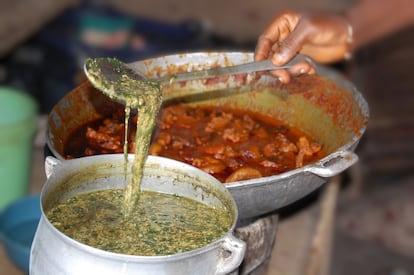
“If you want to have twins, you should eat okra leaf soup regularly,” she says, laughing, while asking how much meat to add to the dish. Popular belief holds that the combination of cassava, yam, and okra increases the likelihood of multiple pregnancies.
According to Dr. Peter Enyievi, a nutritionist at the Department of Public Health at the University of Calabar (southeast Nigeria), “the birth of twins is not directly caused by diet.” He adds, “Conceiving twins depends primarily on genetics and each person’s biological history.” The 2020 scientific review concurs: diet may act as a modulating factor, but it does not, on its own, explain the magnitude of the phenomenon.
Conceiving twins depends primarily on genetics and each person’s biological historyPeter Enyievi, nutritionist
Aminat is a twin. So are several members of her family and her youngest children, born in 2024. During the annual festival, she says, her clan represents a significant percentage of those who parade before the local king. “If you want to cook our soup, you have to use our water, because if you don’t, it won’t turn out right; that’s the answer to the high twin birth rate in our community,” she states confidently. The fertility of the soil and its micronutrient content also play a part in the explanation.
Beyond biology, Yoruba culture ascribes a profound spiritual significance to twins. In many families, it is customary to cook beans when twins are born and distribute them as an offering. Twins are considered bearers of good fortune and protection. When one of the twins dies at birth or in infancy, tradition dictates carving a wooden effigy, known as an ibeji, that represents the deceased child. It is dressed, symbolically fed, and cared for to avoid the wrath of its spirit.
Solihu Azeez, a 69-year-old twin, explains that his family maintains a small home shrine with carved figures. Every Saturday they prepare beans with palm oil as a sign of reverence. According to Professor Pious Abioje of Ilorin University, in the traditional Yoruba religion each deity has specific foods associated with its worship, and the twins are no exception.
Sign up for our weekly newsletter to get more English-language news coverage from EL PAÍS USA Edition
Tu suscripción se está usando en otro dispositivo
¿Quieres añadir otro usuario a tu suscripción?
Si continúas leyendo en este dispositivo, no se podrá leer en el otro.
FlechaTu suscripción se está usando en otro dispositivo y solo puedes acceder a EL PAÍS desde un dispositivo a la vez.
Si quieres compartir tu cuenta, cambia tu suscripción a la modalidad Premium, así podrás añadir otro usuario. Cada uno accederá con su propia cuenta de email, lo que os permitirá personalizar vuestra experiencia en EL PAÍS.
¿Tienes una suscripción de empresa? Accede aquí para contratar más cuentas.
En el caso de no saber quién está usando tu cuenta, te recomendamos cambiar tu contraseña aquí.
Si decides continuar compartiendo tu cuenta, este mensaje se mostrará en tu dispositivo y en el de la otra persona que está usando tu cuenta de forma indefinida, afectando a tu experiencia de lectura. Puedes consultar aquí los términos y condiciones de la suscripción digital.