Why Iran is targeting the artificial intelligence infrastructure of Gulf countries
Tehran’s attacks against the digital ecosystems of its neighbors are considered among the first military actions of their kind in the world

When Iran began launching drones and missiles against Arab Gulf states in response to the US-Israeli offensive against Iran on February 28, much of the attention turned to the attacks on energy infrastructure. Saudi Arabia’s main refinery, Qatar’s largest liquefied natural gas export complex, an oil terminal in the United Arab Emirates (UAE), and Bahrain’s largest refinery were all targeted.
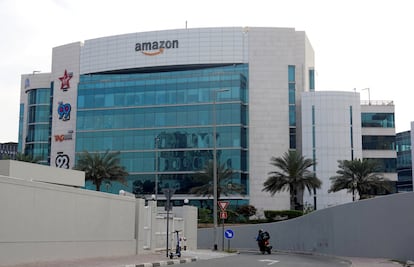
In the early hours of this escalation, however, other strategic facilities were also targeted in attacks that went largely unnoticed. In the early hours of March 1, an Amazon data center in the UAE was struck by a drone, the company reported. Shortly afterward, another center belonging to the American tech giant suffered a direct hit. And a short time later, a third, this time in Bahrain, was damaged by another drone strike.
Since Amazon is the preferred partner of many companies and governments in the region, the attacks caused immediate disruptions: customers of Abu Dhabi Commercial Bank, one of the largest banks in the Emirates, had trouble accessing their online banking services; readers of the business news outlet Enterprise were unable to access its website; and users of the Careem app were unable to order a taxi or food delivery.
Iranian attacks against the digital ecosystems of its Arab neighbors in the Persian Gulf are considered among the first military actions of their kind in the world, and have exposed new vulnerabilities in these countries, including their multi-billion-dollar investment to become a hub for the development of artificial intelligence (AI). For Iran, it has been a cheap and effective way to disrupt public and private services, while for its neighbors in the region, it has served as a warning about their economic diversification strategies.
“Tehran didn’t choose these targets at random,” says Mohammed Soliman, a senior fellow at the Middle East Institute (MEI) and author of the book West Asia: A New Grand Strategy for the Middle East. “Data centers are the backbone of the Gulf’s post-oil economic strategy, and Iran knows it,” he adds, so “attacking them was an attempt to sow doubt about whether the Gulf is a safe bet.”
Data centers are large physical facilities designed to store, process, and distribute massive amounts of digital data, and they are a key component of AI infrastructure. All the Gulf States have invested to varying degrees in the development of this technology and in transforming the region into a key hub for its global advancement, leveraging their geographic location between continents and access to both abundant and inexpensive energy, as well as the vast capital of their sovereign wealth funds. “This combination of location, energy and capital becomes a competitive advantage that is hard to match,” Soliman points out.
Leading this race are the UAE and Saudi Arabia, the two major Gulf powers. The Emirati initiative is spearheaded by G42, its main conglomerate specializing in AI development, chaired by the influential Tahnoon bin Zayed, a member of the royal family and the country’s national security advisor. The Saudi project is headed by Humain, backed by the Public Investment Fund (PIF) and directed by Tareq Amin, the former head of technology at the state-owned oil company Aramco.
While oil and gas from the Gulf countries have historically been central to U.S. Foreign policy in the region, in recent years its strong commitment to developing artificial intelligence has become increasingly important in its diplomatic ties. U.S. Technology companies need the Gulf’s energy and capital, and the Gulf depends on access to America’s cutting-edge technology and talent to drive its plans.
In December 2025, the United States spearheaded an international agreement, Pax Silica, to promote a consensus on the economic security that must guarantee the artificial intelligence ecosystem of the future. Among the 10 signatory countries were the United Arab Emirates and Qatar. The Under Secretary of State for Economic Affairs Jacob Helberg stated that “if the 20th century was based on oil and steel, the 21st century is based on computing and the minerals that power it.”
In May 2025, U.S. President Donald Trump undertook a four-day tour of the Gulf, including the UAE, Saudi Arabia and Qatar, which was marked by the signing of energy and AI agreements. Leading U.S. Companies in the sector, such as OpenAI, Nvidia, and Oracle, are developing a massive data center in Abu Dhabi in partnership with G42, and Amazon has become Humain’s main partner.
Theoretically, the location of technological infrastructure shouldn’t be as constrained as that of oil and gas, but as AI begins to expand on a large scale, the enormous data centers it relies on have become concentrated to make the massive supply of energy and connectivity they require more efficient. The recent attacks by Iran, however, have exposed their vulnerability and will force a rethink of how to protect them.
Nevertheless, Soliman believes the Gulf’s strategic ambitions will remain unaffected. “Iran’s decision to attack this infrastructure is the clearest sign that the Gulf’s AI ambitions are real and have consequences: military resources aren’t dedicated to hitting things that don’t matter,” he argues. “Their miscalculation,” he suggests, “is thinking that sovereign wealth funds with 50-year investment horizons will be scared off by a drone attack.”
Sign up for our weekly newsletter to get more English-language news coverage from EL PAÍS USA Edition
Tu suscripción se está usando en otro dispositivo
¿Quieres añadir otro usuario a tu suscripción?
Si continúas leyendo en este dispositivo, no se podrá leer en el otro.
FlechaTu suscripción se está usando en otro dispositivo y solo puedes acceder a EL PAÍS desde un dispositivo a la vez.
Si quieres compartir tu cuenta, cambia tu suscripción a la modalidad Premium, así podrás añadir otro usuario. Cada uno accederá con su propia cuenta de email, lo que os permitirá personalizar vuestra experiencia en EL PAÍS.
¿Tienes una suscripción de empresa? Accede aquí para contratar más cuentas.
En el caso de no saber quién está usando tu cuenta, te recomendamos cambiar tu contraseña aquí.
Si decides continuar compartiendo tu cuenta, este mensaje se mostrará en tu dispositivo y en el de la otra persona que está usando tu cuenta de forma indefinida, afectando a tu experiencia de lectura. Puedes consultar aquí los términos y condiciones de la suscripción digital.