Delcy Rodríguez seeks to draw a line under Maduro regime with government reshuffle
In less than three months, the interim president has replaced almost half of her team, diminished the influence of the former leader, and defined her own profile for her administration
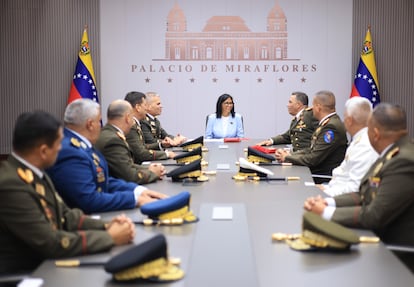
Venezuela’s interim president, Delcy Rodríguez, continues to reshuffle her cabinet. The personnel changes had been introduced somewhat slowly since she assumed office on January 3, but the process accelerated on Wednesday, affecting more than a third of the executive branch. This month alone, Rodríguez has replaced ministers in Defense, Transportation, Hydrocarbons, Electric Power, Labor, Housing, Higher Education, Tourism, and Culture. Weeks earlier, she had replaced the heads of Industries, Communications, Ecosocialism, and Water, and the Office of the President. This does not include the changes in the military hierarchy that began with the dismissal of Vladimir Padrino as Minister of Defense on Wednesday.
Since taking office, following the U.S. Military attack that captured Nicolás Maduro, Rodríguez has made 13 changes to her cabinet, almost half of the 32 positions, a tally that does not include minor moves such as those of several deputy ministers.
This represents a fairly profound reshuffle of the government team, one of the most extensive in a long time within the Chavista power structure — Maduro used to make infrequent and targeted cabinet changes. These moves, however, do not currently indicate a new commitment to democracy or a political opening, but rather an internal power struggle and a realignment of the new president’s inner circle. The military changes are also aligned with the cabinet’s orientation, designed to retain power and guarantee institutional loyalty.
Rodríguez is working quickly to put her personal stamp on the composition of the government, prioritizing her personal connections and promoting mostly — though with some exceptions — civilians with technical credentials to the most important positions. She is always careful to keep her choices within the ideological boundaries of the Bolivarian Revolution.
Among the moves that have drawn attention is that of former Attorney General Tarek William Saab, who has been appointed by Rodríguez as president of the Great Mission “Viva Venezuela, mi patria querida” (Long Live Venezuela, My Beloved Homeland), a program promoting local music and popular culture under the Ministry of Culture. The position is not particularly high-profile, but it represents the rehabilitation of a disgraced figure who was key to the regime during Maduro’s time.
The most newsworthy and consequential decision of all has been the replacement of the Minister of Defense, a position held for the last 12 years by General Vladimir Padrino López, a key figure in the power structure of Maduro’s government. Padrino had become the military face of the revolutionary dictatorship. His departure appears to be the final touch to the end of Maduro’s regime as a political project.
Padrino has been replaced by General Gustavo González López, a military officer specializing in intelligence services, also clearly committed to the Bolivarian Revolution — and close to both Diosdado Cabello and Maduro — who has maintained consistent ties with the PSUV’s power structure. The interim president has also appointed Rear Admiral Germán Gómez Lárez to head the Directorate of Military Counterintelligence. The Presidential Honor Guard regiment will be under the command of General Henry Navas Rumbos.
Padrino’s replacement triggered the retirement of General Domingo Hernández Lárez, director of the Strategic Operational Command (CEO), another officer linked to the political objectives of the Chavista government who controls one of the operational nodes of the military world.
For the Ministry of Electric Power, traditionally controlled by military personnel — one of the most notorious administrative failures of the Bolivarian Revolution — Rodríguez appointed engineer Rolando Alcalá, a graduate of Simón Bolívar University. General Jorge Márquez, who previously headed the Energy Ministry, will now assume the Ministry of Housing and Habitat.
The Ministry of Hydrocarbons was taken over by Paula Henao, an experienced technical expert and longtime close associate of Rodríguez. The Ministry of Transportation is now headed by Jacqueline Farías, who has held prominent positions in various ministries in recent years. Farías is a staunch supporter of Hugo Chávez’s legacy. She replaces Vice Admiral Ángel Coronado.
Eduardo Piñate, an orthodox Marxist loyal to Maduro, is leaving the Ministry of Labor and will be replaced by Carlos Castillo, a lawyer specializing in labor law. The Ministry of Higher Education is now headed by Ana María San Juan, a social psychologist, an independent figure with no ties to Chavismo, and a member of the social dialogue team with the opposition proposed by Miraflores Palace in 2026. The Ministry of Culture is now led by Raúl Cazal, a figure very similar to his predecessor, Ernesto Villegas: both are ideologically driven civilians committed to the indefinite continuation of the Bolivarian Revolution in power.
“Delcy Rodríguez is trying to define her profile, to remove the Maduro-esque characteristics from her administration,” observes Trino Márquez, a sociologist, columnist, and political analyst. The academic states that the first important decision Rodríguez made to dispel Maduro’s shadow was to remove Colombian businessman Alex Saab from his post, who is accused of corruption and money laundering by the United States. “She is looking to surround herself with loyal people. People who can guarantee that her administration will have some success. I also believe that Rodríguez is not trying to project herself as an interim president, but rather wants to offer the image of someone with stamina, with the skills to remain at the helm of the presidency for an extended period, even longer than the Constitution allows.”
“I think that change at the Ministry of Defense couldn’t have been possible without the approval of the United States,” says a well-known political observer who preferred to remain anonymous. “On the other hand, it’s striking that Miguel Rodríguez Torres — one of the exiled candidates rumored to [be in line to] replace Padrino in this new context and who presumably has the support of [former Spanish prime minister] José Luis Rodríguez Zapatero — didn’t make the cut,” he notes.
Moreover, the cabinet changes announced by Rodríguez have been met with complete apathy and disinterest by the leaders of the Venezuelan opposition.
Sign up for our weekly newsletter to get more English-language news coverage from EL PAÍS USA Edition
Tu suscripción se está usando en otro dispositivo
¿Quieres añadir otro usuario a tu suscripción?
Si continúas leyendo en este dispositivo, no se podrá leer en el otro.
FlechaTu suscripción se está usando en otro dispositivo y solo puedes acceder a EL PAÍS desde un dispositivo a la vez.
Si quieres compartir tu cuenta, cambia tu suscripción a la modalidad Premium, así podrás añadir otro usuario. Cada uno accederá con su propia cuenta de email, lo que os permitirá personalizar vuestra experiencia en EL PAÍS.
¿Tienes una suscripción de empresa? Accede aquí para contratar más cuentas.
En el caso de no saber quién está usando tu cuenta, te recomendamos cambiar tu contraseña aquí.
Si decides continuar compartiendo tu cuenta, este mensaje se mostrará en tu dispositivo y en el de la otra persona que está usando tu cuenta de forma indefinida, afectando a tu experiencia de lectura. Puedes consultar aquí los términos y condiciones de la suscripción digital.