Trump wants more money and military reinforcements for new phase of Iran war
The Pentagon will request an additional $200 billion in funding to finance the offensive, now dominated by attacks against the energy sector
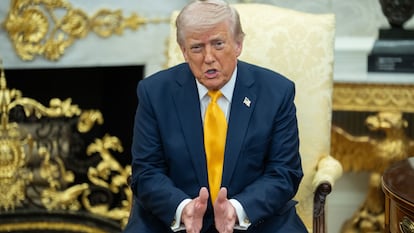

March 20 marks 23 years since the violent explosions in Baghdad that heralded the start of the disastrous invasion of Iraq, one of the endless wars in the Middle East that have consumed thousands of lives and billions of dollars in resources, and which the American public has come to detest. The anniversary coincides with a new war, this time against Iran, and also with no end in sight. The United States is now preparing for a new phase of the conflict, dominated by attacks on the energy sector. The Pentagon has promised that this will not be a perpetual war, but at the same time it will request $200 billion in additional funds to finance it. While awaiting the arrival of reinforcements in the region next week, President Donald Trump is ambiguous about the possibility of further deployments.
Trump, who just 10 days ago claimed the joint Israeli-American offensive was “almost over,” is considering sending thousands of reinforcements, according to Reuters. These troops, according to the agency’s sources, could give the Republican options to occupy Iranian islands in the Strait of Hormuz, in an attempt to secure maritime traffic through that passage, or even seize Kharg Island, Iran’s major oil terminal, which the United States attacked last week.
Adding fuel to this possibility were ominous statements by Israeli Prime Minister Benjamin Netanyahu, who on Thursday raised the possibility of sending troops to Iran to overthrow the Iranian regime. “It is often said that you can’t win, you can’t do revolutions from the air... There has to be a ground component as wel,” he stated at a press conference. According to the online newspaper Politico, which cites two sources “familiar with the discussions,” the decision has not yet been made, but the Pentagon is considering increasing the number of troops already deployed in the region by 50,000.
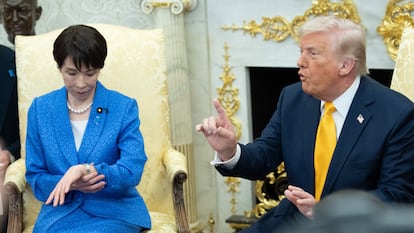
In a White House meeting with Japan’s prime minister, the conservative Sanae Takaichi, the president did not completely clear up the uncertainty. “I’m not putting troops anywhere,” he declared to the media, before adding, “If I were, I certainly wouldn’t tell you.” Trump also assured that he would do “whatever it takes” to stabilize oil prices and restore calm to the markets.
The U.S. President asserted that Tokyo “will play its part” in supporting the United States in the war in Iran. “Unlike NATO,” he added, after a brief pause. Trump also indicated that he would speak with the Japanese prime minister about “military equipment.”
Japan is one of the signatories of a seven-government statement — along with the United Kingdom, Canada, France, Germany, and the Netherlands — expressing their “readiness to contribute to appropriate efforts to ensure safe passage through the Strait.” The seven also pledged “other steps to stabilise energy markets, including working with certain producing nations to increase output.”
Uncertain outcome
With the war about to enter its fourth week, hundreds have already died in the conflict. Trump is trying to find allies to participate in military actions to guarantee maritime traffic in the Strait of Hormuz — without much success so far — and the price of oil is skyrocketing, threatening the global economy. Israel’s attacks on Wednesday against Iran’s largest gas field, South Pars, and Tehran’s retaliation against Qatar threaten to unleash economic and military chaos in a war that the U.S. President continues to call a “detour.”
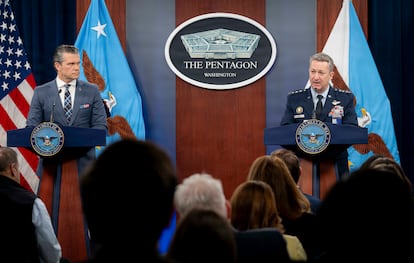
The message the Pentagon is trying to send is one of triumphalism. The United States is “decisively winning” the offensive against Iran, declared Secretary of Defense — or Secretary of War, as he prefers to call himself — Pete Hegseth on Thursday. Speaking at a press conference, Hegesth said the Iran offensive would not be a “forever war,” or a “quagmire,” and that U.S. “Objectives are being achieved according to our plan.” Those objectives are the destruction of Iran’s missile program and military industry, and preventing Tehran from acquiring nuclear weapons, he specified. Trump, for his part, reiterated from the White House that the conflict will end “soon.”
Reality seems to be heading in a different direction. Hegseth himself, who in the early days of the conflict spoke openly of four to six weeks, perhaps eight, before the war would end, now avoided setting a timeframe in his address to the press. The end, he emphasized, is something that Trump will decide.
That end does not appear to be on the horizon. The State Department approved new arms sales to Arab Gulf countries this Thursday. Hegseth acknowledged — and Trump later confirmed from the Oval Office — that the Pentagon is requesting additional funding from Congress for the war, equivalent to almost a quarter of its entire fiscal year allocation of some $900 billion.
“It takes money to kill the bad guys. So we’re going back to Congress and our folks there to ensure that we’re properly funded for what’s been done, for what we may have to do in the future, ensure that our ammunition is — everything’s refilled,” the Pentagon chief stated, in remarks that suggest the war will continue for the foreseeable future.
The United States has the largest military budget in the world. The requested amount represents three times the military aid Washington has sent to Ukraine during the four years of war there, approximately $67 billion. It is unclear whether Congress will authorize such a large sum, given the conflict’s unpopularity among voters and the staunch opposition from the Democratic caucus.
Hegseth also declined to clarify whether a massive deployment of reinforcements was being considered. “You’re going to hear a lot of noise about expanding missions or new missions, a lot of speculation about what we will or won’t do,” he concluded. Last week, the Pentagon ordered the deployment of an amphibious group of approximately 2,500 Marines from the Pacific to the area. Their objective will be to contribute to U.S. Efforts to keep the strategic Strait of Hormuz open, a key waterway for maritime oil traffic.
Conversation with Netanyahu
The U.S. President asserted that he has told Netanyahu not to attack Iranian oil infrastructure again. “I told him, don’t do that and he won’t do that. We do independent, but get along great. It’s coordinated,” he stated. “But on occasion he’ll do something. And if I don’t like it. And so we’re not doing that anymore.”
Israeli and U.S. Government sources have indicated to U.S. Media that the Republican president authorized the operation as a warning to Tehran. This warning is similar to the one the United States sought to send last week with the attack on military targets on Kharg Island.
The Trump administration “faces a drastic dilemma,” argues Danny Citrinowicz, a former Israeli military intelligence officer and now an analyst at the Atlantic Council, in a social media post. “It can use force to reopen the strait, knowing that any attack on Iran’s energy infrastructure will trigger retaliation. That’s not a limited operation. It’s an escalation — potentially rapid and potentially uncontrollable. There’s no room for half measures: if Washington wants to open Hormuz, it will have to fight for it.”
The other option, the expert points out, is “to accept reality, try to minimize losses, and seek an agreement with Tehran on access terms. Politically untenable? Of course. But when the global flow of oil and the stability of Asian markets are at stake, strategic necessity tends to take precedence over rhetoric. What has become crystal clear (in Wednesday’s attacks) is this: there is no clean break, nor an easy victory.”
The United States, meanwhile, maintains its triumphalist rhetoric. According to Hegseth and General Caine, U.S. Forces have struck 7,000 targets and destroyed, among other things, 11 Iranian submarines and 120 warships. The adversary’s missile program has also been decimated, according to Hegseth.
But soldiers who fought in Iraq 23 years ago have words of warning for this administration. “Back in 2003, when that war began, we were told it would be quick, cheap, and would change things. Instead, we squandered two trillion dollars, lost more than 4,000 American lives and hundreds of thousands of Iraqi lives, watched Al Qaeda transform into the Islamic State, and left a power vacuum that strengthened the very Iranian regime we are now fighting,” said Naveed Shah, a veteran of Operation Iraqi Freedom and now director of the veterans’ organization Common Defense, at a press conference this Thursday.
Sign up for our weekly newsletter to get more English-language news coverage from EL PAÍS USA Edition
Tu suscripción se está usando en otro dispositivo
¿Quieres añadir otro usuario a tu suscripción?
Si continúas leyendo en este dispositivo, no se podrá leer en el otro.
FlechaTu suscripción se está usando en otro dispositivo y solo puedes acceder a EL PAÍS desde un dispositivo a la vez.
Si quieres compartir tu cuenta, cambia tu suscripción a la modalidad Premium, así podrás añadir otro usuario. Cada uno accederá con su propia cuenta de email, lo que os permitirá personalizar vuestra experiencia en EL PAÍS.
¿Tienes una suscripción de empresa? Accede aquí para contratar más cuentas.
En el caso de no saber quién está usando tu cuenta, te recomendamos cambiar tu contraseña aquí.
Si decides continuar compartiendo tu cuenta, este mensaje se mostrará en tu dispositivo y en el de la otra persona que está usando tu cuenta de forma indefinida, afectando a tu experiencia de lectura. Puedes consultar aquí los términos y condiciones de la suscripción digital.