Iran maintains its threat in the Strait of Hormuz despite opening passage to some vessels from non-combatant countries
Oil tankers bound for Asian markets and Greek and Chinese merchant ships have crossed the strategic strait in the past week, despite the danger of attacks. If the offensive does not cease, Tehran will ‘maintain pressure on the enemy’
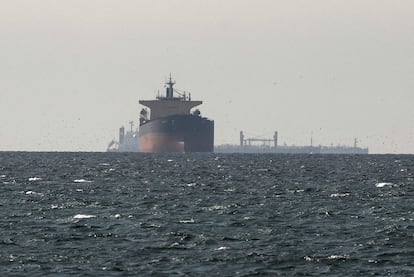
Iran has begun allowing certain ships to pass through the strategic Strait of Hormuz at its discretion, aware that its main asset in the war against the United States and Israel is control of the waterway through which 20% of the world’s hydrocarbons reach international markets. These are mostly oil tankers and cargo ships heading to Asian countries such as China, India, and Pakistan, and freighters bound for or having already docked in countries bordering the Persian Gulf.
Iranian sources consulted by EL PAÍS assert that the Strait of Hormuz is not and has never been officially closed, and that ships are currently transiting it. These sources maintain that the criteria for allowing passage through the strait separating the Iranian coast from its Gulf neighbors are based on international law, and that they will continue to block the passage of any vessel that could “benefit the aggressors,” referring to the United States and Israel.
Iranian authorities, who have repeatedly stated from both Tehran and their foreign ministries that they will not currently accept a ceasefire, assert that they will maintain the situation in the Strait of Hormuz until there is a “complete” cessation of hostilities against the country: “If there is a ceasefire, the situation could return to 90% of its pre-war level.” But if the offensive against the Islamic Republic persists, the situation in the Gulf will remain as it is: “We will maintain pressure on the enemy,” the same sources affirm.
Last Sunday, the oil tanker Karachi, belonging to the Pakistan National Shipping Corporation, crossed the Strait of Hormuz carrying approximately 700,000 barrels of crude oil. The Stellan and the Nora also passed through, carrying a combined total of over two million barrels destined for China.
The following day, several cargo ships owned by Greece, China, and India transited the Strait of Hormuz. According to data from the specialized website Marinetraffic, these vessels used the channel between the islets of Larak and Qeshm, opposite the Iranian port of Bandar Abbas. Maritime analyst Martin Kelly suggests this could be a “verification process” by Iranian authorities to confirm that neither the ships nor their cargo are linked to the United States, as he posted on the social network X.
Data provided to EL PAÍS by trade analytics firm Kpler shows that 34 ships have crossed the Strait of Hormuz in one direction or the other in the last week: 13 oil tankers, four tankers loaded with liquefied gas, and the rest cargo ships. Ten belong to Greek shipping companies, another nine to Chinese shipowners, and further behind are Iranian, Indian, and Emirati companies, as this newspaper has been able to verify through the Equasis database.
“The signs indicate that the Iranian Revolutionary Guard has established a checkpoint where transit vessels can be inspected. And it appears that vessels bound for India and China, or owned by these countries, are more likely to be granted passage,” Tomas Alexa, senior analyst at the maritime intelligence firm Ambrey, explained to EL PAÍS. “By selectively restricting access rather than completely closing the strait, Iran is signaling two key points: first, that it maintains operational control over the waterway; and second, that it can differentiate between states, exerting pressure on the United States and its allies while allowing others, such as China and India, to continue transiting,” the analyst added.
Threat of attacks
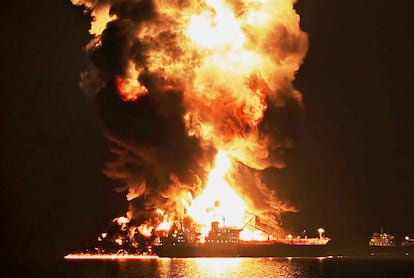
Since the start of the Israeli and U.S. Offensive against the Iranian regime on February 28, at least 17 ships have been attacked in the waters of the Persian Gulf and the Gulf of Oman, according to data compiled by the maritime news outlet Lloyd’s List. The latest victim was a Kuwaiti tanker anchored in waters near the port of Fujairah, in the United Arab Emirates, which was struck by a projectile of unknown origin on Monday night.
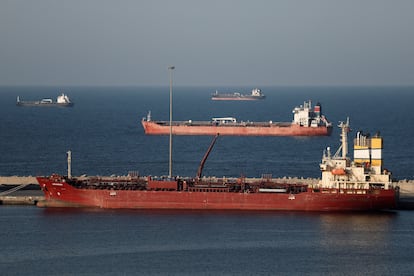
According to information from the U.S. Administration, the Iranian armed forces have also begun laying mines in the Strait of Hormuz, which has a minimum width of 34 kilometers (21 miles) and a navigable width of just over three kilometers (1.8 miles). Washington has damaged or destroyed approximately 30 of these mine-laying vessels and has bombed Kharg Island, Iran’s main oil supply port.
This has caused traffic through the critical strait to plummet by 90%-95%, insurance premiums to triple, and many shipping companies to invoke force majeure to cancel orders. This, coupled with damage to oil and gas infrastructure in the region, has driven up hydrocarbon prices. Around 1,000 ships are stranded on either side of the strait, waiting to cross. “This strategy seeks to impose a cost on the United States and its allies after the recent attack. Even a partial disruption of traffic through the Strait of Hormuz has significant repercussions for global hydrocarbon prices. With the U.S. Midterm elections just around the corner and constant pressure on the cost of living in Europe and other regions, any sustained increase in crude oil prices represents a powerful tool of leverage,” argues Alexa.
This is why U.S. President Donald Trump has unsuccessfully requested the cooperation of allied countries to guarantee security in the strait. Official sources within the Iranian government maintain that any military vessel that enters the area to support Washington in its mission would be considered a “target.”
Iranian crude
Data from Kpler and Equasis suggests that Iranian oil tankers have continued sailing, exporting an estimated six million barrels of oil in the past week, all destined for Asian markets. This occurred despite the U.S. Bombing of Kharg Island on March 13. Regime sources maintain that crude oil exports from the island never ceased. The maritime traffic monitoring company TankerTrackers.com, using satellite imagery, reported on Tuesday that Tehran is indeed continuing to load crude oil from the Kharg facilities.
The Chinese ships that have passed through Hormuz, however, are not those of large shipping companies like Cosco, but of small companies that operate some of the ships considered part of the “phantom fleet”: old vessels, sailing under false flags, often without the necessary insurance and that usually turn off the transponder that allows other ships and ports to determine their position.
According to The Wall Street Journal, these ships broadcast the message “We are a Chinese ship, we are friends” via loudspeakers and shortwave radio to notify the Iranian Revolutionary Guard, which controls armed actions in the Gulf, of their presence and thus prevent any attack.
Greece is one of the European countries that has most clearly distanced itself from Trump’s proposal to form a military coalition to open the Strait of Hormuz. “Under no circumstances do we plan to become involved in the war,” stated Greek government spokesman Pavlos Marinakis. Greek shipowners own a quarter of the world’s cargo ships and 30% of its oil tankers, although they often sail under flags of convenience, and the maritime business is one of the pillars of the Greek economy.
Other European countries, such as France and Italy, are also reportedly trying to negotiate passage for their merchant ships with Iran, according to a report in the Financial Times, which states that Turkey, Pakistan, and China have already established communication channels with Tehran. Indeed, last week, the Turkish Ministry of Transport announced that one of its ships trapped in the strait had passed through to load cargo at an Iranian port, while also reporting that 14 others are still awaiting Iran’s approval.
But the Strait of Hormuz is not only key for hydrocarbons: it is also the main supply route for landlocked states like Qatar, Bahrain, and Kuwait. “Since the beginning of the war, we haven’t sent anything to the area by ship because the major shipping companies demand war premiums and, even then, they cancel almost all orders,” explains a source from a Turkish logistics company.
Instead, these companies are shipping goods to the Gulf countries by truck, via Syria, Jordan, and Saudi Arabia (because the spread of the conflict to Iraq makes that route impossible). “The truck route is more expensive, but somewhat safer than by sea. Even so, I tell clients that we can’t guarantee anything, because the delays are also increasing: there are so many trucks on the route that they have to wait up to five days to cross the Turkish-Syrian border,” this source continues.
Sign up for our weekly newsletter to get more English-language news coverage from EL PAÍS USA Edition
Tu suscripción se está usando en otro dispositivo
¿Quieres añadir otro usuario a tu suscripción?
Si continúas leyendo en este dispositivo, no se podrá leer en el otro.
FlechaTu suscripción se está usando en otro dispositivo y solo puedes acceder a EL PAÍS desde un dispositivo a la vez.
Si quieres compartir tu cuenta, cambia tu suscripción a la modalidad Premium, así podrás añadir otro usuario. Cada uno accederá con su propia cuenta de email, lo que os permitirá personalizar vuestra experiencia en EL PAÍS.
¿Tienes una suscripción de empresa? Accede aquí para contratar más cuentas.
En el caso de no saber quién está usando tu cuenta, te recomendamos cambiar tu contraseña aquí.
Si decides continuar compartiendo tu cuenta, este mensaje se mostrará en tu dispositivo y en el de la otra persona que está usando tu cuenta de forma indefinida, afectando a tu experiencia de lectura. Puedes consultar aquí los términos y condiciones de la suscripción digital.