Venezuela forgets about Maduro and starts down an irreversible path
The country is trying to turn the page while Venezuelans take to the streets to gauge the true openness of Delcy Rodríguez’s government
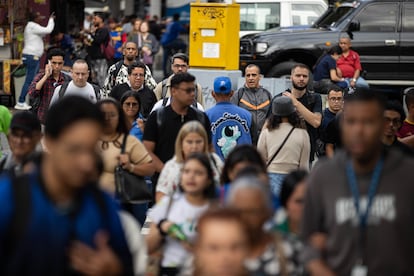

Screenwriter Gaba Agudo Adriani was using GPS to find a friend’s house in Caracas when she ended up on a street blocked off by police and checkpoints. It took her several seconds to realize not only that Delcy Rodríguez lives there, but who Delcy Rodríguez is now. That moment of bewilderment perfectly encapsulates a common feeling about the country’s new reality. After years trapped waiting for change, Venezuela has entered a new phase without its citizens fully understanding where they stand. Reality shifted abruptly, but remains shrouded in a mixture of optimism and uncertainty. Something has changed: the difficult part is defining how much, in what direction, and for how long. Although it does seem irreversible.
In Caracas, Nicolás Maduro’s name and face still appear on some billboards and television ads, but his presence has faded until it has disappeared from everyday conversations. And even from the sphere of power. Almost three months after his capture in a dramatic U.S. Operation and just weeks before his trial begins in New York, the country functions—better—without him.
Instead, Delcy Rodríguez is gaining ground within Chavismo, and while she hasn’t dismantled the system that sustains her, she has been sidelining those most loyal to her predecessor in an attempt to distance herself from Maduro’s regime. In recent weeks, Rodríguez has shaken up her cabinet, replacing some ministers with others more aligned with her leadership. She has also dismantled the military hierarchy—including the powerful Minister of Defense, Vladimir Padrino—that controlled the country even after the defensive failure that resulted in Maduro’s capture. The new generals don’t represent a break—they remain loyal to the Bolivarian Revolution—but they are now her handpicked appointees.
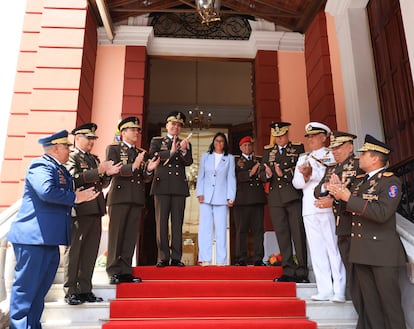
One of the clearest examples of this turning of the page has been the removal of General Jorge Márquez, one of Maduro’s most trusted men. He was first sidelined from key areas such as energy and telecommunications and, in the latest reshuffle, relegated to the Ministry of Housing, a portfolio with a large budget but far less strategic importance. He was the last major representative of Maduro’s inner circle within the government.
“Perhaps the central element of Venezuela today is the political disappearance of Nicolás Maduro. It’s not just about his figure, but about the entire power structure that sustained him,” warns an international observer who requests anonymity. “Changes are taking place that no longer reflect Maduro’s regime, both in the executive branch and at other levels of power.”
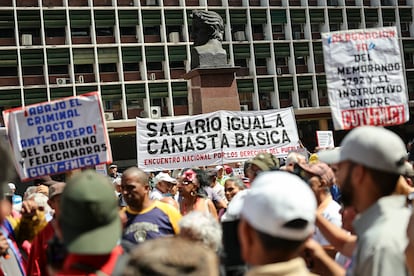
There are scenes in Venezuela today that would have been unthinkable a few months ago. A transportation strike paralyzed Caracas, a released opposition member held a press conference to denounce Chavista repression, and a union march proceeded toward the National Assembly with signs demanding better wages and greater freedoms. “Venezuelans are fed up with a corrupt and inefficient system, and that discontent could become a real engine for change,” says Geoff Ramsey, a nonresident senior fellow at the Atlantic Council.
These images are now relatively common: workers, students, opposition members, and civil organizations are testing the limits of what they can do each day. They are taking the pulse of Chavismo. “There is a significant change on the streets. Every day the limits of freedom of expression and assembly are being explored, in a process that seems irreversible,” observes a diplomatic source.
The most significant gesture of openness has been the amnesty law promoted by Rodríguez herself. The law contains clear exclusions—leaving out figures like María Corina Machado, whom Chavismo accuses of inciting military intervention—but it has benefited nearly 5,000 people, who have been released from prison or had their pretrial detention measures lifted. And while some 500 political prisoners still await their release, key figures in the system, such as the businessmen Raúl Gorrín and Alex Saab, and, this week, Wilmer Ruperti, have been arrested.
Every morning, the radio is filled with news reports about the economic recovery: the construction sector, oil revenues, incoming investments, gold sales. The same refrain is repeated on public television. In the streets, in fact, there’s a palpable sense of optimism. People are talking openly about life again, events and cultural activities have resumed, and there’s more nightlife. It might seem that the country is in the midst of a rebound thanks to U.S. Intervention, but these improvements haven’t yet reached the pockets of Venezuelans.
“There’s a widespread expectation that something is about to happen, rather than a feeling that it’s already happening. In practice, the situation remains dire: the dollar rises daily, the exchange rate gap hasn’t been resolved, and inflation continues to be the main problem for ordinary Venezuelans,” laments Agudo, the Venezuelan woman who unexpectedly stumbled upon Delcy Rodríguez’s house. “Perhaps the clearest evidence that something has changed is that I’m using my own name, because when you and I spoke in January, I didn’t dare let you publish it. I was afraid.”
With unreliable inflation figures that nonetheless reach triple digits—the highest in the world—the country remains extremely expensive. The average salary for an unskilled worker is around $160, leaving a limited budget for the cost of a set lunch menu (over $15), a dozen eggs ($6), or a kilo of coffee ($8).
After shrinking by nearly 70% between 2014 and 2020, the economy grew strongly in 2022, but since then it has been advancing at a much more modest pace—too slow to recover what has been lost. Wages remain depressed, the fiscal deficit is high, and although oil is once again a source of hope, it is not enough. The economy is growing—around 8% in 2025, according to official figures—but it is doing so on such an eroded foundation that the progress is barely noticeable. “There is a huge gap between rhetoric and reality in Venezuela,” argues Ramsey, a specialist on the country. “While the economy may grow modestly this year, we are talking about a country where the majority of the population lives in poverty.”
The opposition is also trying to find its footing in this new phase. It is undergoing its own restructuring. María Corina Machado, the leader with the greatest popular support, remains outside the country, and although her priority is to return, it is not clear that she can do so as soon as she would like. Her return could accelerate the process, fuel demands for elections, but also strain an already fragile balance. And in Washington, the priority is stability, which is essential for business. Meanwhile, Machado’s allies in the Unity Platform have begun to show cracks and nuances.
Some parties are already exploring channels of communication with Chavismo to gain ground in a scenario that is no longer one of total confrontation. Meanwhile, other figures are emerging, such as former presidential candidate Enrique Márquez, recently released from prison and publicly endorsed by Donald Trump, who invited him to deliver the State of the Union address.
Less than three months after Maduro’s abrupt end, Venezuela continues to advance along this new, uncharted path. Power is being reorganized, street protests are mobilizing, the economy is showing signs of recovery, and the opposition is vying for position. It’s difficult to predict where the country is headed, whether elections will be held soon, and who will lead it in the coming years. What does seem clear, however, is that there’s no turning back. This is largely because Venezuelans will no longer accept going back.
Sign up for our weekly newsletter to get more English-language news coverage from EL PAÍS USA Edition
Tu suscripción se está usando en otro dispositivo
¿Quieres añadir otro usuario a tu suscripción?
Si continúas leyendo en este dispositivo, no se podrá leer en el otro.
FlechaTu suscripción se está usando en otro dispositivo y solo puedes acceder a EL PAÍS desde un dispositivo a la vez.
Si quieres compartir tu cuenta, cambia tu suscripción a la modalidad Premium, así podrás añadir otro usuario. Cada uno accederá con su propia cuenta de email, lo que os permitirá personalizar vuestra experiencia en EL PAÍS.
¿Tienes una suscripción de empresa? Accede aquí para contratar más cuentas.
En el caso de no saber quién está usando tu cuenta, te recomendamos cambiar tu contraseña aquí.
Si decides continuar compartiendo tu cuenta, este mensaje se mostrará en tu dispositivo y en el de la otra persona que está usando tu cuenta de forma indefinida, afectando a tu experiencia de lectura. Puedes consultar aquí los términos y condiciones de la suscripción digital.