The violence of the ‘incel’ world strikes Mexican classrooms again
A teenager shot and killed two teachers in Michoacán in a direct attack after spreading misogynistic messages on social media
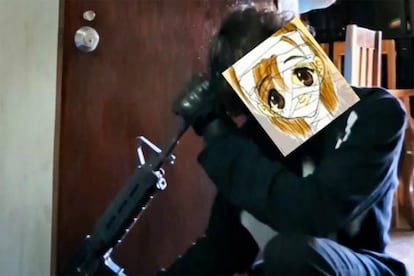

Nine hours before the attack, 15-year-old Osmer H recorded himself in front of a mirror dressed in black, holding an AR-15 rifle. He posted a message on social media: “Today is the day.” He then shared a video on Instagram with references to hatred toward women and school shootings. Later, he entered the private Anton Makarenko High School, where he was a student, in the coastal municipality of Lázaro Cárdenas, Michoacán, and killed two of his teachers, María del Rosario and Tatiana, aged 36 and 37, respectively.
The content Osmer shared is associated with the “incel” universe, a digital subculture made up of men who call themselves “involuntary celibates” and who share extremist discourses on masculinity in forums, addressing the supposed feminization of the world, and in its most extreme versions, inciting violence. The young man uploaded a reel in which another armed individual declares: “I’ve decided to send the feminists, who have always ruined my life, back to their creator. I hate feminists.” The sequence ends with a fictional armed attack at a school.
“The attack was targeted, that can be confirmed. The security camera footage shows him attacking one of the women from behind,” said Carlos Torres Piña, the state’s Attorney General, in an interview with Milenio. He shot the first teacher once, and the other, who tried to take cover behind a desk, was hit by three shots. The teenager is the stepson of a Mexican Navy serviceman, and the weapon he used is for the exclusive use of the military. Osmer said he found it at home, but the soldier later told authorities that the AR-15 was not his.
The attack reignites the debate about young people’s access to guns in Mexico. Juan Martín Pérez García, a specialist in children’s rights, points out: “It’s clear that a teenager doesn’t normally have access to an AR-15 rifle. There is a responsibility on the part of adults and the state. It’s not as if a child wakes up and decides to kill; it’s a process with prior warning signs that went unheeded.” Studies on shooters in the United States identify three recurring factors: the availability of weapons, radicalization around issues such as white supremacy or hatred of women, and the sensationalization of violence. They also repeat the same strategy in attacks, involving pre-planning, dissemination on social media, and attention-seeking.
The incel phenomenon has international precedents and its presence has spread across the globe, although it is at its strongest in the United States. In 2014, a young U.S. Citizen named Elliot Rodger committed a mass shooting and has since become a symbol for these online forums. In incel slang, “Going ER” means “to do an ER,” an expression used to refer to imitating a violent attack like Rodger’s. It is among the most radical ideas, preceding “beta uprising” or “incelocalypse,” the fantasy of a violent revolt by these rejected men against society and an apocalyptic vision of a future dominated by rebellious incels. The presence of these groups in Mexico became evident last October, when Lex Ashton, a 19-year-old student, murdered a classmate at his school, the College of Sciences and Humanities in Mexico City, after posting his plan in incel groups online.
Sources close to the investigation indicate that the teenager was withdrawn and suffered from bullying, a common profile among young people who fall into these communities. Pérez emphasizes that the context of prolonged violence in Michoacán also plays a role. “Children and adolescents are products of violence and they perpetuate it,” he points out. The case is reminiscent of other recent incidents involving young people, such as that of 17-year-old Víctor Manuel, who murdered the mayor of Uruapan, Carlos Manzo, in November. That same month, a 13-year-old student threatened his teachers and called on his classmates to “agree” to kill them.
“There is no investment in violence prevention or prediction,” warns Pérez. “We are abandoning adolescents and young people. The adult world prefers to criminalize and move on to the next case instead of taking responsibility. Teenagers are crying out to be heard.” The specialist points to the existence of a “hate algorithm” that amplifies these discourses. “The ‘manosphere’ has grown with millions of followers because it’s profitable. Platforms allow hate to be monetized, and those who consume this content the most are adolescents who are building their identity and sense of belonging.” In some cases, rituals like the “hero’s journey” are created, which turn the aggressor into an aspirational figure for other young people, fueling the phenomenon of copycats.
Some accounts from young people who identify as “incels,” collected by this newspaper in October, agree that social media algorithms led them to online forums through searches about exercise and questions about relationships. A sad or angry teenager asks questions about their body or what false accusations are, and this will automatically lead them to “incel” or far-right groups.
Sign up for our weekly newsletter to get more English-language news coverage from EL PAÍS USA Edition
Tu suscripción se está usando en otro dispositivo
¿Quieres añadir otro usuario a tu suscripción?
Si continúas leyendo en este dispositivo, no se podrá leer en el otro.
FlechaTu suscripción se está usando en otro dispositivo y solo puedes acceder a EL PAÍS desde un dispositivo a la vez.
Si quieres compartir tu cuenta, cambia tu suscripción a la modalidad Premium, así podrás añadir otro usuario. Cada uno accederá con su propia cuenta de email, lo que os permitirá personalizar vuestra experiencia en EL PAÍS.
¿Tienes una suscripción de empresa? Accede aquí para contratar más cuentas.
En el caso de no saber quién está usando tu cuenta, te recomendamos cambiar tu contraseña aquí.
Si decides continuar compartiendo tu cuenta, este mensaje se mostrará en tu dispositivo y en el de la otra persona que está usando tu cuenta de forma indefinida, afectando a tu experiencia de lectura. Puedes consultar aquí los términos y condiciones de la suscripción digital.