Iraq mourns its dead after worst strike against its army since the start of the war: ‘Why did the Americans attack us?’
The crossfire between the US and Tehran against pro- and anti-Iranian militias on Iraqi soil threatens to escalate into open conflict, fueled by the rising casualties among regular Iraqi and Kurdish soldiers
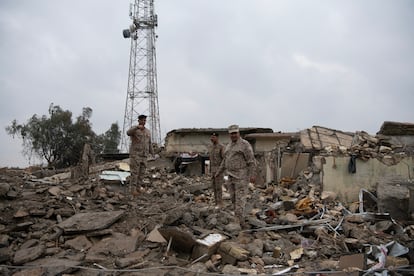

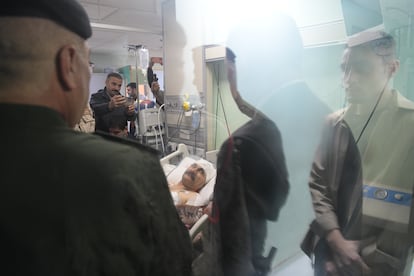
The pungent smell of explosives fills the air as soldiers’ boots turn over the earth where, just 24 hours earlier, the clinic at the Iraqi army base in Habbaniyah had been operating. The base was reduced to rubble and craters on Wednesday after being struck by two missiles. Officer Abdullah was in the clinic with several colleagues at 9 a.m. When he heard a loud bang, followed by another. The next thing he remembers is being trapped under a concrete wall that had been breached by the impact. His colleagues rushed to his aid when “the plane turned around in mid-air, descended, and began firing bursts of machine-gun fire,” the soldier recalls from a hospital bed in Fallujah, where some of the 23 wounded have been taken. This attack, which resulted in seven deaths, is the worst suffered by Iraqi troops since the United States and Israel began their war against Iran on February 28.
“This is a U.S. Attack because we identified the aircraft, an A-10, which only they use,” General Tahseen, who arrived from Baghdad, told a handful of Iraqi journalists. “Why have the Americans attacked us?” He asked the assembled reporters. The Ministry of Defense has openly accused Washington and maintains that it “fully reserves the right to take all necessary measures to respond to this aggression in accordance with approved legal frameworks.” The Baghdad government summoned the U.S. Chargé d’affaires for consultations on Wednesday. For its part, Washington has denied attacking a clinic, but this has not managed to quell the deep-seated discontent among soldiers and the widespread feeling among the population that the war is beginning to engulf a country still licking its wounds from previous conflicts.
Most of the dead fell from bullets, several wounded interviewees confirmed. Those still hospitalized have skull fractures, broken ribs, shrapnel that has perforated organs, and numerous broken bones, stated one of the doctors, who was on his way to check on those still in critical condition.
The high command maintains that the attacked barracks was once a shared base between U.S. Troops and Iraqi forces during the fight against the Islamic State (ISIS) in 2016, so they say they know “perfectly well” that only the Iraqi army was there.
To reach the base, you first have to pass through Abu Ghraib — known for housing the infamous U.S. Prison during the 2003-2011 invasion of Iraq — and then Fallujah, the scene of the fiercest fighting between U.S. Marines and Iraqi militants. In 2014, this region became one of ISIS’s strongholds. In the last five years of relative calm and prosperity, Fallujah seems to be rising from the ashes with new paved roads and mosques lining both sides of the roadside, flanked by gleaming streetlights.
On Tuesday, U.S. Fighter jets struck another base in the same town of Habbaniyah, this time belonging to the Popular Mobilization Forces (PMF), killing 16 fighters and wounding 30 others from the coalition of militias operating under the command of Iraqi Prime Minister Mohammed Shia’ al-Sudani, which Washington and Israel accuse of being proxies for Iran. The site attacked on Wednesday houses barracks for regular soldiers, but it is a base shared with PMF units, stationed several hundred meters from where piles of rubble now lie. Although most of its members are Shia, the latest U.S. Fighter jet attack killed members of a Sunni unit, further inflaming public anger.
That same day, six more Peshmerga soldiers, members of the regular Iraqi Kurdish army, were killed and 45 others wounded after six Iranian missiles struck their base. This time, it was the government in Erbil, the Kurdish capital, that summoned the Iranian diplomat for consultations to demand an explanation. Tehran claimed it was a “mistake” and that it would “investigate it.”
Chain of errors
As the mistakes multiply, and with them the funerals, tensions rise in Iraq. Among the khaki-green procession moving through the hospital corridors, led by General Fariq Rukun, head of Iraqi army operations for Anbar Governorate, walks a man in a blue jacket with white stripes. He carries a worn maroon briefcase from which he pulls out a slip of paper each time the general speaks with a wounded person. “These are financial compensations for the wounded on behalf of the Ministry of Defense,” the uniformed man whispers. The dead have been declared martyrs and posthumously awarded a medal, which helps their widows and orphans obtain better pensions.
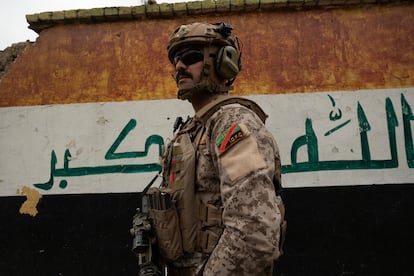
Since the start of the Israeli-American offensive against Iran on February 28, the barrage of drones and missiles has claimed 100 lives and left 200 wounded, General Tahseen asserts from inside an SUV with tinted windows, en route from Baghdad to the base. Only five are civilians. Eighty percent of the casualties are militia members, and the rest are Iraqi soldiers, Kurdish-Iranian opposition fighters, and regular Kurdish soldiers in the north of the country. “Until now, they hadn’t attacked Iraqi soldiers, only once at the beginning in Karbala,” the general notes. The incident he mentions took place in the holy city of Karbala, a week after the war began, when American fire killed one Iraqi soldier and wounded two others.
In Iraq, 60% of the population is Shia, and the country maintains deep historical, cultural, and religious ties with neighboring Iran, with whom it shares a 1,500-kilometer border. The ruling Shia coalition government finds it difficult to disarm the militias, as requested by U.S. President Donald Trump, especially in the context of a regional war where taking sides against Iran would mean aligning with the “Zionist enemy” [referring to Israel]. The formation of a government after the November elections has been postponed until “after the war,” with the hope that this conflict will remain someone else’s and not their own.
The government’s public outrage is echoed by that of the soldiers. In hospital corridors, uniformed personnel speculate about the answer to the same question posed by General Tahseen: Why has the U.S. Killed their comrades?
“They did it to send a message: if [prime minister] Al-Sudani doesn’t disarm the militias, they’ll attack us, just like they did with the Lebanese army,” one person opines. “The U.S. A-10 is using bases in Jordan; Arab countries are already joining the war,” another laments. “The Americans are leaving [Iraq]. In a few days, there won’t be any Marines left except in the Kurdish area [Iraqi Kurdistan]. Who do they expect to defend their embassy?” Another asks, taking a drag on his cigarette.
Everyone agrees that this week is critical to determine whether Iraq will descend into war.
After decades of joint training exercises between U.S. Marines and Iraqi soldiers, including with the PMF fighters who battled ISIS, resentment toward the U.S. Is growing. “We’ve been allies for so long, but the only one they provide air cover for is Israel,” another soldier pointed out.
NATO and US evacuate bases
“Do not attempt to go to the Embassy in Baghdad or the Consulate in Erbil,” the U.S. Embassy said in a statement, reiterating its recommendation to its citizens not to travel to Iraq and to leave the country “immediately” if they are already there.
In both Erbil, in the north, and Baghdad, in the center, night falls as Iran and the U.S. Exchange fire. From the east comes the roar of Iranian ballistic missiles heading toward the Victory Air Base, the airports, or Baghdad’s Green Zone, where the U.S. Diplomatic mission is located. These are usually destroyed in flight by Iraqi air defenses. Drones launched by the militias that make up what they call the resistance factions are also neutralized in mid-air. But the Iraqi army has no air defenses, nor do the Popular Mobilization Forces, which have begun to evacuate their bases in the face of airstrikes from the west by U.S. Fighter jets.
Last week, NATO confirmed that it had evacuated all its personnel from its mission in Iraq on March 20, including Spain, which brought back its 205 soldiers and military personnel. The Turkish government announced this Thursday the withdrawal of the approximately 25 soldiers it has deployed in Iraq as part of the NATO mission to train Iraqi security forces, and has blamed Israel for threatening peace in the Middle East.
Sign up for our weekly newsletter to get more English-language news coverage from EL PAÍS USA Edition
Tu suscripción se está usando en otro dispositivo
¿Quieres añadir otro usuario a tu suscripción?
Si continúas leyendo en este dispositivo, no se podrá leer en el otro.
FlechaTu suscripción se está usando en otro dispositivo y solo puedes acceder a EL PAÍS desde un dispositivo a la vez.
Si quieres compartir tu cuenta, cambia tu suscripción a la modalidad Premium, así podrás añadir otro usuario. Cada uno accederá con su propia cuenta de email, lo que os permitirá personalizar vuestra experiencia en EL PAÍS.
¿Tienes una suscripción de empresa? Accede aquí para contratar más cuentas.
En el caso de no saber quién está usando tu cuenta, te recomendamos cambiar tu contraseña aquí.
Si decides continuar compartiendo tu cuenta, este mensaje se mostrará en tu dispositivo y en el de la otra persona que está usando tu cuenta de forma indefinida, afectando a tu experiencia de lectura. Puedes consultar aquí los términos y condiciones de la suscripción digital.