Trump orders payment for airport security amid lack of agreement to fund DHS
The president announced the measure via his social media network, Truth, to end the chaos that has gripped US airports for days
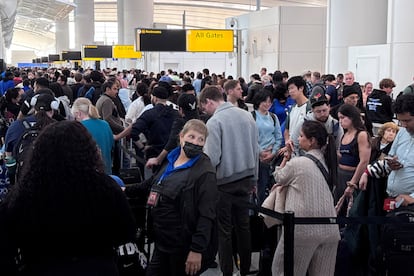

U.S. President Donald Trump announced Thursday that he will sign an executive order directing the new Secretary of the Department of Homeland Security (DHS), Markwayne Mullin, to pay Transportation Security Administration (TSA) workers who have gone more than a month without pay due to the DHS shutdown. The order aims to end the chaos that has gripped U.S. Airports in recent weeks and prevent the long lines at security checkpoints — which have caused thousands of travelers to miss their flights — from continuing through Easter week when travel volume increases.
Trump made his announcement via a post on his social media platform, Truth, in which he blamed Democrats for the DHS shutdown. “It is not an easy thing to do, but I am going to do it,” the Republican wrote. Earlier in the week, ICE agents had already been deployed to several airports across the country on the president’s orders, but with limited results, as they are not trained to work at security checkpoints and, therefore, have been seen with little to do, checking identification documents and handing out water in the long lines.
In this context, pressure has only increased to end the impasse and fund the DHS, on which the TSA and its workers depend. According to reports, the White House had explored the possibility of declaring a national emergency to pay airport security agents, given the lack of real progress in negotiations between Republicans and Democrats in Congress to limit ICE agents and thus free up DHS funds.
At the moment, it is unclear whether the executive order Trump has vowed to sign will include a declaration of a national emergency, but if it does, it could be subject to legal challenges. It is possible the president will simply reallocate funds from other departments to cover TSA costs temporarily. In that regard, Senator Susan Collins, a Republican from Maine and chair of the Appropriations Committee, has pointed out that funds exist in other budget lines that can legally be used to pay the TSA and the Coast Guard without declaring a national emergency.
The DHS shutdown began in mid-February because Democrats are demanding clear limits on ICE agents. Specifically, they want them to be prohibited from wearing masks, to wear body cameras, and to only be able to make arrests with a warrant. These red lines have proven insurmountable, and lawmakers from both parties have been unable to reach a compromise, while each side accuses the other of being inflexible. Now, one day before the start of a two-week congressional recess, the urgency to reach an agreement to fund DHS, which also supports other agencies like the Coast Guard and the Federal Emergency Management Agency (FEMA), has reached its peak.
While the DHS shutdown has affected tens of thousands of federal workers across multiple agencies, the most visible impact by far has been at airports. Several are reporting absenteeism rates exceeding 40% among TSA workers, and nearly 500 of its approximately 50,000 transportation security agents have resigned during the shutdown.
Trump, who until recently had left the matter to Congress, threatened this week to deploy the National Guard to airports, in addition to deploying ICE agents. “They have to end this shutdown immediately or we will be forced to take drastic measures,” he said during a cabinet meeting Thursday morning at the White House.
Before that, Senate Majority Leader John Thune, a Republican, announced that he had presented Democrats with a final offer. He gave no details but indicated that it was based on the Republican proposal from the weekend. When senators retired to discuss the plan privately, negotiations stalled again.
The massive Republican tax-cutting package that Trump enacted last year allocated billions to the Department of Homeland Security, including $75 billion for ICE operations, ensuring that money continues to flow for his immigration and deportation agenda even amid the budget shutdown.
Sign up for our weekly newsletter to get more English-language news coverage from EL PAÍS USA Edition
Tu suscripción se está usando en otro dispositivo
¿Quieres añadir otro usuario a tu suscripción?
Si continúas leyendo en este dispositivo, no se podrá leer en el otro.
FlechaTu suscripción se está usando en otro dispositivo y solo puedes acceder a EL PAÍS desde un dispositivo a la vez.
Si quieres compartir tu cuenta, cambia tu suscripción a la modalidad Premium, así podrás añadir otro usuario. Cada uno accederá con su propia cuenta de email, lo que os permitirá personalizar vuestra experiencia en EL PAÍS.
¿Tienes una suscripción de empresa? Accede aquí para contratar más cuentas.
En el caso de no saber quién está usando tu cuenta, te recomendamos cambiar tu contraseña aquí.
Si decides continuar compartiendo tu cuenta, este mensaje se mostrará en tu dispositivo y en el de la otra persona que está usando tu cuenta de forma indefinida, afectando a tu experiencia de lectura. Puedes consultar aquí los términos y condiciones de la suscripción digital.