Kurdish-Iranian militias seeking the end of the Islamic Republic: ‘Never in 47 years have we been so close to seeing the regime fall’
After three decades stationed in Iraq, the fighters are vacating their military bases and preparing for ‘the day after’ the possible collapse of the Tehran apparatus
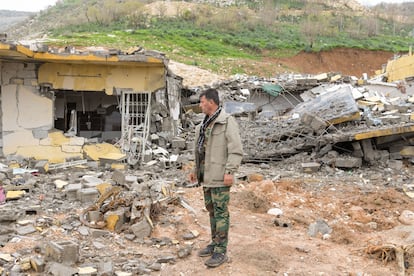

Wearing sneakers and military fatigues, General Rebaz Sharifi walks over mounds of rubble scattered around a crater left a few days ago by an Iranian ballistic missile at his military base in Erbil province, northeastern Iraq. He claims to command more than 500 fighters in the ranks of his Kurdistan Freedom Party (PAK) and Kurdish-Iranian forces opposed to the Tehran regime, based in the semi-autonomous Kurdish region of northern Iraq for the last three decades. The military complex is deserted, including the housing. Only a couple of dogs wander among some colorful swings built for the fighters’ children.
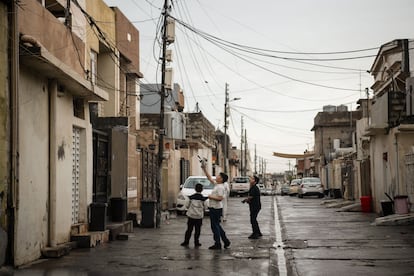
“A martyr has fallen here, and three comrades have been seriously wounded,” says Sharifi, pointing to what used to be the entrance to an office. At 38, he has spent two decades in the ranks of the opposition to the Iranian regime. Having opposed the Shah of Persia first in the 1960s and, since 1979, the Islamists, they found refuge across the Iranian border in Iraqi Kurdistan when it was formally established in 1991 with U.S. Support. Like the PAK, the other five Kurdish-Iranian militias, which recently joined together in the Coalition of Political Forces of Iranian Kurdistan, are abandoning their bases and evacuating their fighters to secret locations within Iraqi Kurdistan. In their headquarters, they can now only count the trickle of dead and wounded from Iranian drone and missile attacks, with no capacity to respond. It is usually late afternoon when Iranian missiles shoot across the sky over Erbil or drones explode over the city.
They have been waiting 47 years for the fall of the ayatollahs’ regime to build an Iranian Kurdistan. They say they are training their men and women to take advantage of this unique historical window, and, although they are the only Iranian troops stationed on the border with Iran, they claim they have received no tangible support or concrete proposal from either of the two allied powers — the United States and Israel — since they launched their joint offensive last month. Up to now, they have only attracted the wrath of Iranian artillery and, in doing so, agitated their host: the Iraqi Kurdistan Regional Government (KRG), which provides the salaries and permits for their fighters on Iraqi soil.
“We have very good relations with the KRG, which is why we can’t expose them or the civilian population to further Iranian attacks on their territory because of our presence,” explains Baba Sheikh Husseini, leader of the Khabat group — also a member of the opposition coalition against Tehran. He speaks from a safe house where he has just moved after burying two of his men killed in Iranian attacks on their bases. He asserts that on the other side of the border, the Iranian Revolutionary Guard is also evacuating its barracks, which are targets for U.S. And Israeli missiles, to occupy clandestine positions and blend in with civilians in the cities.
Against the characteristic baggy trousers worn by the Kurds, the sirwal, rubs a cat whose left paw is stitched from side to side after being wounded in the most recent attack. Husseini places his pistol safely on the arm of the sofa and opens a photo on his mobile phone of an 18-year-old who appears to be wounded: “This was the first time I was hit, by a helicopter of the Islamic Republic in Rojalat [as he calls Iranian Kurdistan].”
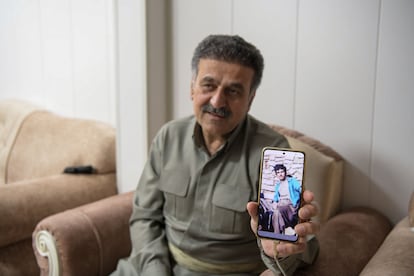
He swipes his finger on the screen and there he is again, a little older, on a stretcher, his head covered in blood: “This is from an attack on my car, an attempt to kill me.” He was only 13 when he joined the ranks of the Kurdish revolutionaries under his father’s command. Later, he became one of the founders of Khabat. “Never in these 47 years have we been so close to seeing the Iranian regime fall,” he says, a broad smile spreading across his face.
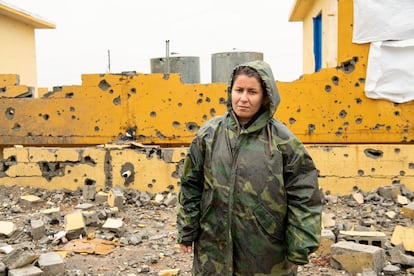
While keeping their primary goal of overthrowing the Islamic Republic in mind, Husseini’s militiamen have fought for the causes of their “Kurdish brothers” in Iraq. Baran, 32, a member of the PAK, joined the party at age 20. Like the rest, she cut her teeth as an activist in Iran, and once located by Tehran’s intelligence services, she crossed the mountains and sought refuge in Iraqi Kurdistan. She arrived in 2016 and has since been hardened by battles, but none against the Iranian Revolutionary Guard.
Upon arrival, Baran joined the diverse front alongside the Iraqi-Kurdish Peshmerga, U.S. Fighter jets, the Iraqi regular army, and pro-Iranian Shia militias in the joint offensive to retake Mosul and expel the Islamic State (ISIS). The memory and brutality of the battle are etched on her phone: from the faces of her fallen comrades to an image of her, along with other female militia members, surrounding the bodies of slain jihadist fighters. In 2017, she fought again, this time against the Popular Mobilization Forces (PMF, an alliance of more than 50 pro-Iranian militias) to challenge them for some of the positions they had seized from ISIS. If she receives orders to cross into Iran to fight, this would be her first battle in her homeland.
Unknowns
But the truth is that the role these Kurdish opposition groups will play remains an enigma, even to their own leaders, who are confused by each new tweet from the administrations of Donald Trump and Benjamin Netanyahu. “I’ve seen the social media, but we’re not up to date on it. There’s no direct contact with the United States or Israel,” says Kako Alyar, a member of the Politburo of the Komala Party — founded in 1968 for the liberation of Iranian Kurdistan — referring to statements made to CNN by Michael Leiter, Israel’s ambassador to the United States. “I think that we need boots on the ground, but they have got to be Iranian boots, and I think they’re coming,” Leiter declared without elaborating, after asserting that the Iranian people must mobilize to overthrow the regime of the Islamic Republic. The Kurdish-Iranian groups are the only allied groups — armed or poorly armed — stationed on the Iranian border.
“Psychological warfare, including media manipulation, is a crucial component of this war precisely because it lacks public support,” says a diplomat in Erbil who requested anonymity.
The source comments that the statements by Trump and Netanyahu serve as a “trial balloon,” lacking serious backing, even though “some calls” have been made. The diplomat says that exaggerating the real power of these groups has led to more attacks against them and prompted Turkey to react in order to prevent any possibility of an Iranian Kurdistan on its border. The armed group PJAK (Party for a Free Life in Kurdistan), a member of the Kurdish-Iranian opposition coalition, has the largest number of fighters and maintains bases within Iranian territory. A Marxist movement, it considers itself the “Iranian PKK,” the Kurdistan Workers’ Party, which Ankara labels a terrorist organization.
“We are nobody’s pawns and we are only at the service of the Kurds,” Alyar of the Komala group maintains, also annoyed by the confusing messages in the media. He speaks in a telephone conversation after his planned visit to his base in the Sulaymaniyah region of northeastern Iraq was canceled due to threats of an imminent Iranian attack, which ultimately occurred with a drone strike against an already empty facility.
While Kurdish-Iranian opposition fighters train in the Iraqi mountains and construct tunnels in anticipation of a possible ground offensive in Iran — and awaiting the arrival of air support and weapons supplies — these groups are already preparing for the day after the fall of the Islamic Republic. To this end, when the U.S.-Israeli offensive began, they formed a coalition that brings together six Kurdish-Iranian armed groups, Alyar explains. The PAK speaks of independence, Khabat of autonomy within Iran and elections, while Komala advocates for an Iranian federal system. They have already witnessed regime change in Syria, with the overthrow of Bashar al-Assad, and in Iraq, with the downfall of Saddam Hussein, as well as the different scenarios for Kurdish regions and their expectations of self-determination in those countries.
Driven by the same goal of an Iranian Kurdistan, they believe that now is the time to unite and position themselves to fill the void left by a potential collapse of the regime in Iran. Israel is an ally “because it also seeks regime change in Tehran and is a de facto power in the region,” the PAK leader points out. They also do not rule out the possibility that, after opposing the Shah, Ayatollah Ali Khamenei, and now Mojtaba Khamenei, his son and successor, they might once again see the Shah’s son on the throne of Tehran, although he has already publicly rejected any concessions to the linguistic, cultural, political, or social aspirations of Kurdish autonomy.
“There is no serious and charismatic alternative on the horizon,” concludes the diplomatic source, for whom the calls from Israel and the United States for “the Iranian people to rise up against the regime” are unrealistic in a country of 90 million people where civilians are unarmed and the Iranian regime can begin “to perpetrate brutal massacres against them” if it is truly cornered.
Sign up for our weekly newsletter to get more English-language news coverage from EL PAÍS USA Edition
Tu suscripción se está usando en otro dispositivo
¿Quieres añadir otro usuario a tu suscripción?
Si continúas leyendo en este dispositivo, no se podrá leer en el otro.
FlechaTu suscripción se está usando en otro dispositivo y solo puedes acceder a EL PAÍS desde un dispositivo a la vez.
Si quieres compartir tu cuenta, cambia tu suscripción a la modalidad Premium, así podrás añadir otro usuario. Cada uno accederá con su propia cuenta de email, lo que os permitirá personalizar vuestra experiencia en EL PAÍS.
¿Tienes una suscripción de empresa? Accede aquí para contratar más cuentas.
En el caso de no saber quién está usando tu cuenta, te recomendamos cambiar tu contraseña aquí.
Si decides continuar compartiendo tu cuenta, este mensaje se mostrará en tu dispositivo y en el de la otra persona que está usando tu cuenta de forma indefinida, afectando a tu experiencia de lectura. Puedes consultar aquí los términos y condiciones de la suscripción digital.