The new robber barons are the tech tycoons
The great American fortunes of the 19th century tried to impose titanic monopolies. Today’s magnates want to do the same

The first time anti‑immigration legislation was approved was likely in 1879, in a country where anti‑immigrant sentiment — tinged with racism — had always lurked beneath the surface, despite the well‑known fact that foreign labor was essential to its development. That country was the United States, whose Congress and a Republican president named Chester A. Arthur enacted, in 1882, the so‑called Chinese Exclusion Act, which prohibited the arrival of Chinese workers for at least 10 years.
This was the era known as the Gilded Age, a period in which enormous industrial and railroad fortunes were created — comparable to today’s dazzling tech fortunes. During the Gilded Age, those Chinese laborers, who were derogatorily called coolies, built with their own hands the impressive railroad and telegraph network that enabled the development of a nation with vast physical territory and an urgent need for rapid communication routes. The United States became the world’s leading producer of steel, coal, wheat, and cotton. The law remained in force far longer than 10 years. It lasted until 1943 — 61 years — and only disappeared when World War II began and China became an ally of the United States against Germany and Japan.
What most defined the Gilded Age was the rise of fortunes like those of John D. Rockefeller, Andrew Carnegie, and J. P. Morgan. Altogether, the richest 10% of the population owned 70% of all property in the country. Their presence in U.S. Society caused a stir comparable to the one caused today by Elon Musk, Jeff Bezos and Mark Zuckerberg. They were long referred to as “robber barons,” and they were far less discreet than today’s tycoons. Their parties — and their art collections (the Frick Collection in New York contains an extraordinary group of Vermeer and Rembrandt paintings) — were legendary in their time.
What they did have in common with today’s barons was their constant fight to avoid paying taxes and to block any kind of regulation of their businesses. It was not until figures like Franklin D. Roosevelt came to power that it became clear these companies had amassed too much power and were capable of triggering enormous economic crises. For the Democratic Roosevelt, this was not a problem of free enterprise but of corporations — such as Cornelius Vanderbilt’s — that had grown excessively powerful and enjoyed privileged treatment. As historian T. J. Stiles wrote, the term robber barons “conjures up visions of titanic monopolists who crushed competitors, rigged markets, and corrupted government.”
In fact, some of these barons quelled strikes by hiring up to 300 armed agents from the Pinkerton National Detective Agency, although even with 300 rifles they didn’t achieve their objective. This was a time, the early 20th century, when U.S. Labor unions had also gained power and a huge number of members across the country. Economic historian Hal Bridges said that the term robber baron represented the idea that U.S. Business leaders in 1900 were “on the whole, a set of avaricious rascals who habitually cheated and robbed investors and consumers, corrupted government, fought ruthlessly among themselves, and in general carried on predatory activities comparable to those of the robber barons of medieval Europe.”
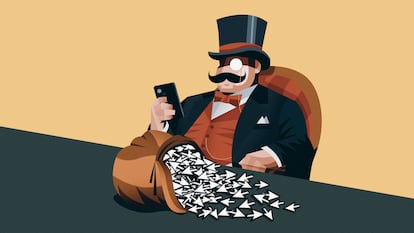
The fortunes of the so-called “Magnificent Seven” — the seven leaders of the technology market (Apple, Microsoft, Alphabet, Amazon, Meta, Nvidia, and Tesla) — represent an unprecedented concentration of wealth and operating methods in the U.S. Economy, acting as the primary engine of its financial markets. The combined market capitalization of these companies exceeds $20 trillion, with Nvidia leading the group with a valuation of $4.6 trillion. In his book Outsider in the White House, Democratic Senator Bernie Sanders is quoted saying: “We believe in this country; we love this country; and we will be damned if we’re going to see a handful of robber barons control the future of this country.” The business practices and political power of Silicon Valley’s billionaires have, quite rightly, led to their being identified with the aforementioned robber barons. Let’s repeat that: robber barons.
Sign up for our weekly newsletter to get more English-language news coverage from EL PAÍS USA Edition
Tu suscripción se está usando en otro dispositivo
¿Quieres añadir otro usuario a tu suscripción?
Si continúas leyendo en este dispositivo, no se podrá leer en el otro.
FlechaTu suscripción se está usando en otro dispositivo y solo puedes acceder a EL PAÍS desde un dispositivo a la vez.
Si quieres compartir tu cuenta, cambia tu suscripción a la modalidad Premium, así podrás añadir otro usuario. Cada uno accederá con su propia cuenta de email, lo que os permitirá personalizar vuestra experiencia en EL PAÍS.
¿Tienes una suscripción de empresa? Accede aquí para contratar más cuentas.
En el caso de no saber quién está usando tu cuenta, te recomendamos cambiar tu contraseña aquí.
Si decides continuar compartiendo tu cuenta, este mensaje se mostrará en tu dispositivo y en el de la otra persona que está usando tu cuenta de forma indefinida, afectando a tu experiencia de lectura. Puedes consultar aquí los términos y condiciones de la suscripción digital.