Electrodes connected to the brain allow two people with paralysis to type with their minds
One of the patients, with tetraplegia, achieved speeds similar to the average and with almost no errors
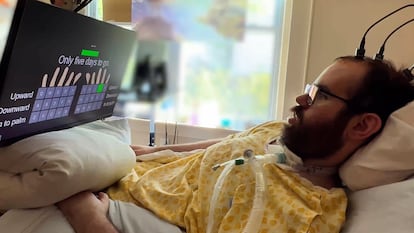

Little by little, science is getting closer to fulfilling the dream of empowering those who cannot empower themselves. With the help of artificial intelligence, machine language, algorithms, and a wealth of technology, neuroscience is bringing us closer to the day when people with spinal cord injuries can walk; when people with Parkinson’s disease no longer experience mental freezes; when those who have lost sensation can feel touch again; or when those who have lost their sight can once more perceive light. Now, American neuroscientists have designed a brain-machine interface (BCI) that allows users to communicate by typing on a keyboard using only their minds. As detailed in the scientific journal Nature Neuroscience, they have successfully tested it on two patients with paralysis, who have managed to type at high speed and almost flawlessly. There are only two of them, and the system is still in its early stages, but it brings that dream a step closer.
At one end of the BCI are small plates with hundreds of microelectrodes placed directly on the brain. But not just anywhere; they’re placed in areas of the motor cortex that previous research has identified as responsible for fine finger movements. At the other end, there’s a screen displaying a QWERTY keyboard. In between, a lot of science.
“It’s not based on trial and error, but rather on a calibration process in which the participant attempts to type a series of predefined sentences,” says Justin Jude, a researcher at the Center for Neurotechnology and Neurorehabilitation at Massachusetts General Hospital and lead author of the study. “The machine learning algorithm then learns which patterns of neural activity [recorded] at the electrodes correspond to each of the 30 possible finger movements,” he adds. The English-language QWERTY keyboard has 26 letters. The other four movements were for the period, comma, question mark, and space bar.
The results of about 30 exercises to train the system are impressive. One of the participants, whom the researchers called T18, a 48-year-old man with a spinal cord injury at the cervical level, achieved a mental typing speed of 110 characters per minute, almost the same speed as people in his age group without quadriplegia. He only had to think about typing. The BCI was able to discriminate that extending his index finger always meant pressing R or T, that lowering it on the keyboard corresponded to F, and that bringing it back towards his palm indicated that T18 wanted to type V or B. The error rate was only 1.6%.
“The most frequent errors were those that occurred between keys controlled by adjacent fingers or between movements that controlled different keys with the same finger,” Jude explains. To reduce these errors, they used language models that anticipated T18’s true intention, “similar to autocorrect when typing on a smartphone keyboard, in order to generate the phrase the user likely intended,” adds the researcher, who is also affiliated with Harvard Medical School.
The other participant in the trial, T17, is a 33-year-old man with amyotrophic lateral sclerosis (ALS) who did not write as quickly and made more errors. His slower performance could have been due to the state of his condition — tetraplegia — the need for mechanical ventilation, and anarthria, the total inability to articulate words caused by being unable to activate the speech muscles. But it could also be due to the use of fewer electrodes — 128 compared to T18’s 384 — which would have affected his accuracy, something already anticipated in the study design. Even so, despite his near-complete locked-in syndrome and the limitations of his brainstem communication, T17 managed to write 47 words per minute; not from dictation, but the words he wanted to say.
T17 and T18 are two of several patients participating in a larger project called BrainGate, which is exploring all possible approaches to facilitate communication for those who are unable to speak. One such approach involved asking participants to think about writing. The results for the patient, whom they called T5, were very promising, achieving a handwriting speed of 90 characters per minute thanks to two chips implanted in the brain’s writing area. The clinical trial is ongoing with nine participants across the United States.
The same small plates with those 384 microelectrodes are used by Eduardo Fernández, director of the Bioengineering Institute at the Miguel Hernández University of Elche. But based on this, his team is designing BCIs not for typing, but to help those who have lost their sight see again. As he points out, “one of the most serious and challenging problems associated with some neurological disorders, such as ALS and strokes, is the loss of communication skills caused by weakness in the muscles responsible for speech or the movement of the arms, hands, and fingers.” In many cases, such as those involving T17 and T18, “intellectual capacity and thinking skills tend to remain intact,” the scientist emphasizes. And that is what we must try to capitalize on.
“This study introduces a new strategy to facilitate communication for these individuals,” says Fernández. “Unlike other approaches that ask subjects to imagine the movement of a cursor, the experimental paradigm is simpler, since they only have to think about moving a finger on a standard computer keyboard. In this way, users simply have to try to move their own fingers as if they were in front of a physical keyboard,” he adds.
Although there are only two participants, what’s relevant for Fernández, who wasn’t involved in the study, is that it “confirms that the neural representations for fine motor skills remain intact in the brain, even years after paralysis.” And for those concerned about external mind control, the neuroscientist settles the matter: “This type of technology isn’t capable of reading minds in the sense of involuntarily extracting information from a subject; what it does is allow users to communicate using brain signals instead of muscles.”
Sign up for our weekly newsletter to get more English-language news coverage from EL PAÍS USA Edition
Tu suscripción se está usando en otro dispositivo
¿Quieres añadir otro usuario a tu suscripción?
Si continúas leyendo en este dispositivo, no se podrá leer en el otro.
FlechaTu suscripción se está usando en otro dispositivo y solo puedes acceder a EL PAÍS desde un dispositivo a la vez.
Si quieres compartir tu cuenta, cambia tu suscripción a la modalidad Premium, así podrás añadir otro usuario. Cada uno accederá con su propia cuenta de email, lo que os permitirá personalizar vuestra experiencia en EL PAÍS.
¿Tienes una suscripción de empresa? Accede aquí para contratar más cuentas.
En el caso de no saber quién está usando tu cuenta, te recomendamos cambiar tu contraseña aquí.
Si decides continuar compartiendo tu cuenta, este mensaje se mostrará en tu dispositivo y en el de la otra persona que está usando tu cuenta de forma indefinida, afectando a tu experiencia de lectura. Puedes consultar aquí los términos y condiciones de la suscripción digital.