Questions are piling up ahead of a World Cup overshadowed by Trump
In the United States, there is little talk about the world’s biggest sporting event two and a half months before the opening game
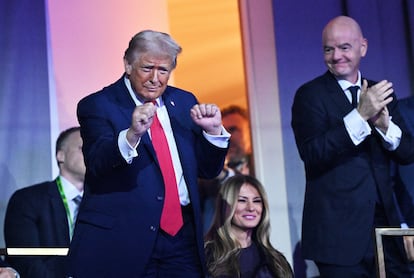

In the United States, everyone is wondering when the endless lines at airports, caused by the partial shutdown of the Department of Homeland Security (DHS), will end. Few, however, are asking — given the chaotic nature of the administration — what will happen if this situation continues until June, when the World Cup begins and six million visitors are expected to arrive. The world’s biggest sporting event, with 48 teams and 104 matches, has been completely overshadowed by President Donald Trump, who is creating uncertainty about the event’s organization.
The war with Iran has raised a huge question that remains unanswered: the participation of that country’s national team. Trump commented on the matter on March 12: “The Iran National Soccer Team is welcome to The World Cup, but I really don’t believe it is appropriate that they be there, for their own life and safety,” he wrote on social media, in what many saw as a veiled threat. The Iranian Minister of Sport asserted that he sees “no possibility” of Iran’s participation, but the players and the football federation have made it clear that they do want to compete.
FIFA is handling the case. Iran has at least three matches scheduled in Los Angeles and Seattle, and possibly more if they qualify from their group, which includes Belgium, Egypt, and New Zealand. Mexico, one of the three host countries along with Canada, stated they would be willing to host Iran’s matches if necessary. Organizers ruled out the possibility this week, leaving the matter unresolved. There is speculation that another team could replace Iran in the coming weeks, once the playoff matches have been played.
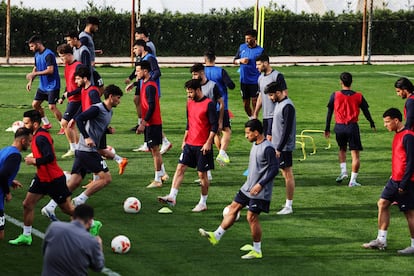
The uncertainty about attending the tournament extends to the fans, and not just Iranians. Trump has implemented a restrictive visa processing system for foreigners, including a ban on entry for citizens of Haiti, Ivory Coast, Senegal, and the Democratic Republic of the Congo, which is playing for a spot in the next few days. Neither the U.S. Government nor FIFA has announced any alternative plan, which would leave these teams with very limited support in the stands.
Even those eligible for a visa could find themselves unable to travel to the United States. The U.S. Announced a fast-track process for those with World Cup tickets in their name. This includes interviews and fees that can exceed $500, not including a refundable $15,000 deposit for certain nationalities. However, wait times have increased, and some people may not receive their visas in time. Many may also choose not to even try, given the difficulty and cost.
Doubts about DHS funding and airport operations loom over the tournament’s organization. A few days ago, the DHS finally disbursed the $625 million promised to the host cities to cover security expenses. Previously, several organizing committees had warned they would be forced to cancel events surrounding the games, such as fan fests where matches can be enjoyed on giant screens in public spaces.
The presence of ICE agents at stadiums and fan fests is another concern. Immigration officers have been terrorizing the streets for a year with raids based on racial profiling. The agency’s acting director, Todd Lyons, declined in February to clarify whether or not agents would be operating during the World Cup. Democratic Representative Nellie Pou of New Jersey introduced a bill last week to prohibit ICE from being present around stadiums and at related fan events.
“The World Cup should bring the world together and not leave families wondering if ICE agents will be waiting outside stadiums,” Pou declared. “There is no successful tournament if fans and players are looking over their shoulders.”
High prices, empty stands, and extreme temperatures
These problems are compounded by other, more general issues not directly related to the Trump administration’s handling of the situation. Exorbitant ticket prices prompted a complaint from fan groups against FIFA before the European Commission on Wednesday; and New York City Mayor Zohran Mamdani has also repeatedly spoken out against the prices, which he considers exclusionary and discriminatory, with tickets for the final costing over $8,000.
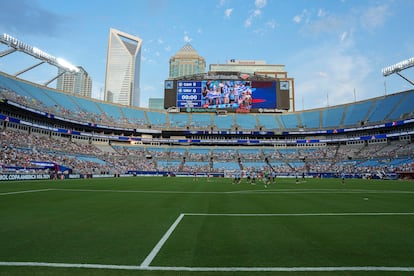
The experience of the Club World Cup and the Copa América, both held in the United States last year, also raises other concerns. While interest is high for matches in the knockout stages and featuring top national teams, group stage matches between less prominent nations will likely see lower demand. It’s possible that we’ll see a repeat of the half-empty stadiums that marred the overall outcome of those competitions.
Likewise, the extreme heat that plagued that tournament, as well as the unexpected summer thunderstorms that forced matches to be delayed for hours, also pose threats. On the one hand, the players’ health could be affected by playing in temperatures exceeding 35°C, in stadiums not equipped with climate control systems like those installed in Qatar in 2022, and during peak heat times chosen to accommodate global audiences. On the other hand, these scheduling plans aimed at maximizing viewership could be disrupted by lengthy delays caused by thunderstorms.
These are questions that — preoccupied with keeping up with Trump’s erratic behavior — few are asking and even fewer are answering. For now, with fewer than 80 days until the start of the tournament, they’re not on the radar of public discourse in the United States. Time will tell if the apparent apathy toward the world’s biggest sporting event has been a mistake and these problems will ultimately materialize. Or if, on the contrary, they are just minor stumbles for a titanic event that not even Trump can derail.
Sign up for our weekly newsletter to get more English-language news coverage from EL PAÍS USA Edition
Tu suscripción se está usando en otro dispositivo
¿Quieres añadir otro usuario a tu suscripción?
Si continúas leyendo en este dispositivo, no se podrá leer en el otro.
FlechaTu suscripción se está usando en otro dispositivo y solo puedes acceder a EL PAÍS desde un dispositivo a la vez.
Si quieres compartir tu cuenta, cambia tu suscripción a la modalidad Premium, así podrás añadir otro usuario. Cada uno accederá con su propia cuenta de email, lo que os permitirá personalizar vuestra experiencia en EL PAÍS.
¿Tienes una suscripción de empresa? Accede aquí para contratar más cuentas.
En el caso de no saber quién está usando tu cuenta, te recomendamos cambiar tu contraseña aquí.
Si decides continuar compartiendo tu cuenta, este mensaje se mostrará en tu dispositivo y en el de la otra persona que está usando tu cuenta de forma indefinida, afectando a tu experiencia de lectura. Puedes consultar aquí los términos y condiciones de la suscripción digital.