Ali Vaez, Iran expert at the International Crisis Group: ‘Trump has started a war he now cannot end’
The exiled analyst and nuclear physicist believes that a US victory narrative will be very fragile and that the Iranian regime has become radicalized
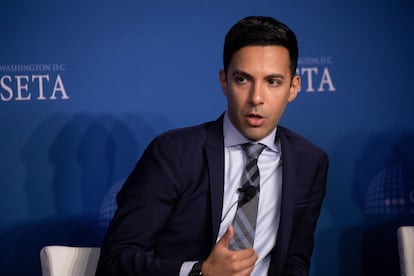

Iranian security expert Ali Vaez, 46, is convinced that President Donald Trump’s withdrawal from the nuclear agreement with Iran was a mistake that paved the way for the war now being waged by the United States and Israel against Tehran. The agreement limited Iran’s nuclear program in exchange for lifting economic sanctions against the country. Vaez, a nuclear physicist in exile, was directly involved in efforts to build bridges between the Islamic Republic and the powers that negotiated the agreement in 2015. Vaez is co-author of the book How Sanctions Work: Iran and the Impact of Economic Warfare, and he heads the Iran area at the International Crisis Group, a center for conflict prevention analysis based in Geneva, from where he spoke to this newspaper by telephone on Monday.
Question. Was withdrawing from the nuclear agreement Donald Trump’s first step towards war?
Answer. That was the original sin. The 2015 nuclear agreement had placed the Iranian program under the most rigorous international oversight ever implemented. Had this agreement been in place in 2025, when the United States and Israel bombed Iranian nuclear facilities, Iran would have only been able to acquire one-fifth of the material needed to produce enough enriched uranium for a single nuclear weapon. Until 2030, the country would have remained subject to restrictions. In practice, throughout President Trump’s second term, Iran would not have come close to developing nuclear weapons and would have remained under the strict supervision of the International Atomic Energy Agency. If Iran is any closer to the threshold of nuclear weapons, it is because of President Trump’s decision to withdraw from the agreement.
If Iran is closer to the nuclear weapons threshold, it is due to President Trump’s decision to withdraw from the 2015 agreement
Q. Regarding the most recent negotiations, before the war, do you believe there was a genuine intention to reach an agreement?
A. Those negotiations were neither professional nor serious. It is difficult for anyone with experience in the Iranian nuclear issue to believe that the kind of capitulation the American negotiators had in mind was ever truly possible. In most of the negotiations, the American team didn’t even bring technical experts, because they were looking for yes-or-no answers, which is not how such difficult technical negotiations are normally conducted.
Trump chose the worst possible option: resorting to a military solution that doesn’t actually offer a real solution. Iran still has a path to a nuclear weapon through its unaccounted-for stockpile of highly enriched uranium. The military option only bought eight months, from June 2025 to February 2026. The diplomatic option would have bought 15 years at a much lower cost.
Q. In recent years, has the Revolutionary Guard gained more power?
A. There are two things that have made the Revolutionary Guard more powerful than ever. One is the years of maximum pressure sanctions [implemented by Trump], which allowed it to enrich itself by controlling all the black markets and smuggling networks to circumvent the sanctions. The second has been the removal of the Supreme Leader, Ayatollah Ali Khamenei, to whom this military body was always subordinate. The new Supreme Leader [Mukhta Khamenei] owes his position to the Revolutionary Guard, and if this system survives, it will be thanks to them. Therefore, they are no longer just the second most powerful force in Iran, but are at the pinnacle of power.
Thus, in the process of trying to weaken and isolate the hardliners within the Islamic Republic, the United States has made them more powerful and increasingly prominent in the Iranian political system.
Q. Have the sanctions had any deterrent effect?
A. The sanctions have certainly weakened Iran, but there are no signs that they have weakened the regime’s ability to repress its own population or to pursue aggressive policies in the region, whether by funding partners and allied groups in the region, investing in its nuclear, missile, and drone programs, or cooperating with Russia in its war of aggression against Ukraine. By any metric, the sanctions have not achieved their intended objective; instead, they have weakened the Iranian middle class, which is the West’s strongest ally in Iran.
Q. By weakening the middle class, was the possibility of reforming the regime from within reduced?
R. Absolutely. There are two obstacles to transformation: one was at the level of the deep state in Iran, as represented by Khamenei himself, who opposed reforms, and those around him who benefited from the system and did not want to see their economic or political interests undermined. But the other has been the weakening of society, which was caught between a regime that pressured it from above and the United States and the West, which pressured it economically from the outside. It really wasn’t in a position to act as an agent of change because its leadership was imprisoned by the regime and its base was devastated by the impact of the sanctions.
Q. Did the 2003 invasion of Iraq send any kind of message to the Iranian regime?
R. Undoubtedly. Iran had already seen the United States topple the Taliban regime in the east and then Saddam Hussein’s regime in the west, and there were those in the Bush administration who said, “Real men go to Tehran.” So yes, it heightened their perception of the threat. In response, Iran developed what’s called the mosaic defense doctrine, which we’ve seen implemented in this war. Basically, it divides command and control among the country’s 31 provinces, so that if the United States attacks the central node in Tehran, the rest of the system isn’t paralyzed, as happened in Iraq in 2003.
Q. Was the regime closer to falling after the recent social protests? And, if so, has the war reversed that dynamic?
A. The regime is certainly weaker than in the past, but it remains quite strong in the eyes of the Iranian population. There was an asymmetry in the balance of power that continues to this day. The Revolutionary Guard has 250,000 troops. It has a Basij militia of almost a million members. And for the United States or Israel to completely degrade this repressive capacity, for the Iranian people to be able to take to the streets, they would need troops on the ground, because this cannot be done from the air. If they decide to arm the Iranian opposition to do the job themselves, that risks plunging the country into civil war.
It will be very difficult for the country to transition to any kind of democracy at the end of this war
Now, though weaker, the regime is more radical. It was always a murderous system, but now it has also become suicidal. It sees no limits to what it is willing to do to stay in power. It killed several thousand of its own citizens in January to maintain control. Now it is prepared to set the entire region ablaze to ensure its own survival. That is why, regardless of what the United States and Israel do, I believe it will be very difficult for the country to transition to any kind of democracy at the end of this war.
Q. What are the real possibilities of a ceasefire?
R. The United States, as happened last year, could at any moment disengage from the conflict, and President Trump could declare victory by arguing that he has eliminated many key leaders, degraded the country’s military capabilities, and once again destroyed its nuclear program. But it would be a very fragile victory narrative if the Strait of Hormuz remains closed, if the fate of the nuclear stockpile is not addressed, and if the regime remains in power.
Iran may decide to keep maritime trade closed until it extracts concessions from the Trump administration. Therefore, what began as a war of choice for President Trump is now becoming a war of necessity, because it will be very difficult for him to end this war unilaterally without reopening trade.
And there are no good options for opening the strait. Either he deploys ground troops, exposing them to grave risks; or he attacks Iranian infrastructure, as he has threatened, which could provoke retaliation and leave the entire region in utter devastation from which it would take years to recover. In the process, it would trigger a global economic collapse. Trump has started a war he now cannot end.
Q. What were the United States and Israel seeking with the war?
A. Trump is always tempted to make history and be the first president to take actions that others have refrained from out of prudence. I believe he was influenced by hawkish voices around him and in Israel that led him to believe he could change the map of the Middle East forever and resolve the long-standing conflict between Iran and the United States. He entered this war with a lot of wishful thinking. When the U.S. Military warned him about the risks of closing the Strait of Hormuz, he responded that Iran would capitulate before it came to that.
Israel wants to see the collapse of the Iranian state. But a failed state in Iran will also have serious consequences for Israel, because it breeds radicalization and resentment that could backfire. Furthermore, the other countries in the region, which are extremely angry with Iran for attacking them during this war, will also be uneasy about Israel being the dominant, unrivaled power in the region.
Sign up for our weekly newsletter to get more English-language news coverage from EL PAÍS USA Edition
Tu suscripción se está usando en otro dispositivo
¿Quieres añadir otro usuario a tu suscripción?
Si continúas leyendo en este dispositivo, no se podrá leer en el otro.
FlechaTu suscripción se está usando en otro dispositivo y solo puedes acceder a EL PAÍS desde un dispositivo a la vez.
Si quieres compartir tu cuenta, cambia tu suscripción a la modalidad Premium, así podrás añadir otro usuario. Cada uno accederá con su propia cuenta de email, lo que os permitirá personalizar vuestra experiencia en EL PAÍS.
¿Tienes una suscripción de empresa? Accede aquí para contratar más cuentas.
En el caso de no saber quién está usando tu cuenta, te recomendamos cambiar tu contraseña aquí.
Si decides continuar compartiendo tu cuenta, este mensaje se mostrará en tu dispositivo y en el de la otra persona que está usando tu cuenta de forma indefinida, afectando a tu experiencia de lectura. Puedes consultar aquí los términos y condiciones de la suscripción digital.