Trump rules out the use of force in Greenland but insists on annexation
The US president says in Davos that he will not resort to the military amid market turmoil and opposition from other countries, but warns of reprisals if the territory is not handed over through negotiations
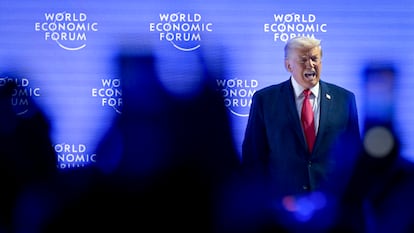

U.S. President Donald Trump announced on Wednesday at the World Economic Forum in Davos that he will not use force to seize Greenland, an ambition that has kept the world on edge. “People thought I would use force. I don’t have to use force. I don’t want to use force. I won’t use force,” he said.
In his address at Davos, however, Trump made it clear that he wants control of Greenland for national and international security reasons. He claimed he would pursue negotiations — but left Europeans with a thinly veiled warning: “You can say yes, and we’ll be very appreciative, or you can say no and we will remember.”
Trump had previously threatened to annex Greenland by any means necessary, causing the greatest transatlantic crisis in decades. Time will provide perspective and clarify the dynamics, but it is worth noting that this shift comes amid market turbulence and clear opposition from European countries and Canada. The events form a pattern not identical, but similar to, the trade and technology standoff with China: an onslaught, resistance, market turbulence, and retreat. “The military’s not on the table,” Trump reiterated after the speech, in statements reported by Reuters.
Renouncing the use of force was the only, extremely significant, bright spot in a gloomy speech to the audience at the conference in the Swiss Alpine town. More than an hour of remarks sketched the essential contours of the Trumpist vision of the world, one in which Europe is a derailed continent, more a burden than an ally. It was a speech full of threats — as described — lies, resentment, insults, humiliations, distortions, and racist undertones.
Lies such as NATO never doing anything for the U.S., when allies invoked Article 5 of mutual defense after 9/11 and fought in Afghanistan side by side with U.S. Forces, or that the 2020 elections, which Trump lost, were fraudulent. In this regard, the U.S. President announced forthcoming criminal measures.
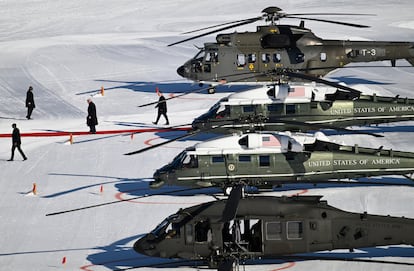
There was resentment, as seen in Trump’s recurring complaints that other countries have supposedly taken advantage of the U.S. For decades through a free-trade system in which, nonetheless, the American superpower was able to prosper and strengthen its hegemony.
Insults, such as when he called Jerome Powell, head of the Federal Reserve, “stupid,” or targeted anyone involved in building wind energy systems.
Humiliations, like his boastful accounts of phone calls with other presidents — for example, with Macron — describing in a cutting tone alleged political capitulations during negotiations, in this case over pharmaceuticals. The Élysée responded that Trump’s claims were “fake news,” that Macron does not set drug prices, and that prices have not changed.
Distortions, such as claiming investment figures in the U.S. That are theoretical, misrepresenting crime rates, and presenting the Trump administration as a miraculous cure for social problems.
Racist undertones, as shown in his comments on Somalis: “They turned out to be higher I.Q. Than we thought,” said Trump, linking the correction of this perception to alleged criminal abilities.
With these ingredients, Trump presented his vision of the world to an audience filled with top business and political figures — a vision in which Europe is not a respected ally.
Europe ”is not heading in the right direction,” Trump said, addressing many Europeans in the audience. Without mentioning it explicitly, he embraced the “great replacement” theory, which holds that immigrants of different ethnic origins will replace native populations. He said there are places that are unrecognizable, that decades of what he considers mistaken policies on immigration, are leading to the death of a civilization, as noted in the National Security Strategy published last November.
But the focal point was Greenland, the source of the biggest crisis among transatlantic allies possibly since the alliance formed in World War II.
From Davos, Trump began by saying that “every NATO ally has an obligation to be able to defend their own territory.” He then put forward an argument for why he believes he should control Greenland, the semi-autonomous island that is part of the Kingdom of Denmark: “The fact is no nation or group of nations is in any position to be able to secure Greenland other than U.S.”
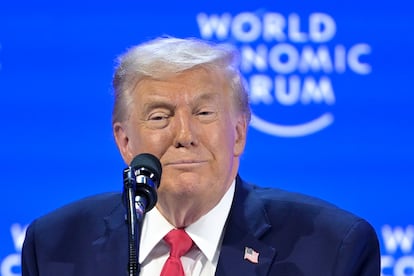
“All the United States is asking for is a place called Greenland,” said Trump. “What I’m just asking for is a piece of ice. […] It’s a very small ask, compared to what we have given them for many, many decades,” he concluded, without specifying the terms of the negotiation by which he would acquire the territory.
After recalling that the gigantic Arctic island is located in a key strategic position “between Russia and China,” he insisted on his idea, arguing that the U.S. Needs Greenland for “strategic national security and international security,” and dismissing the idea that his interest is linked to Greenland’s mineral resources.
After the speech, there was anticipation in Davos about negotiations with European leaders present at the conference. Trump publicly praised NATO Secretary General Mark Rutte, who has taken an extremely accommodating stance toward the U.S. Leader, while taking digs at Mark Carney of Canada and Emmanuel Macron of France, who have criticized him.
“They should be grateful to the U.S., Canada. Canada lives because of the United States. Remember that, Mark, the next time you make your statements,” Trump said. Of Macron, he said he liked him personally but mocked the sunglasses Macron had to wear while giving his speech due to an eye problem.
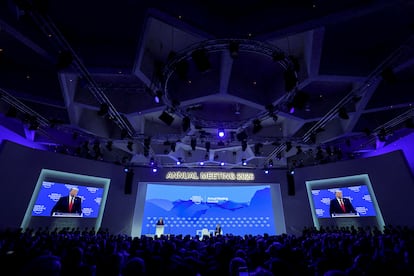
On Tuesday, Canadian Prime Minister Mark Carney led the resistance to the Trumpist onslaught, with a speech of moral and geopolitical stature. French President Emmanuel Macron was also explicit in rejecting U.S. Maneuvers. The president of the European Commission, Ursula von der Leyen, also spoke, expressing opposition to U.S. Annexationist ambitions over Greenland and to the threat of new tariffs on European countries that defend their sovereignty, though in a less forceful tone.
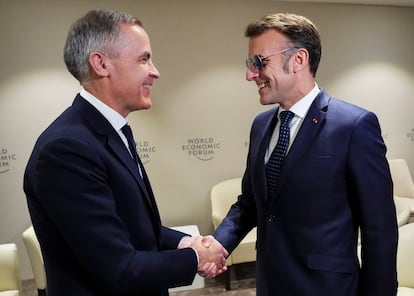
Indeed, Von der Leyen, along with Mark Rutte, are emerging as key figures in diplomatic efforts to defuse the crisis over Greenland. It’s a crisis with far-reaching geopolitical implications, including for Ukraine.
The Greenland crisis is casting a long shadow over other regions.
In Ukraine, where U.S. Support remains a crucial factor in the balance of power. Although Trump has made a dramatic shift away from Joe Biden’s strong backing, Washington is still supplying weapons — selling them rather than providing them as aid — and sharing some intelligence. Tensions with Europe threaten this residual support, as well as negotiations aimed at halting hostilities and sustaining Ukraine’s reconstruction.
The crisis is also affecting the dire situation in the Gaza Strip, with Trump determined to set up a Board of Peace, which many former Western allies are unwilling to join, both because of its structure and because of Trump’s increasingly heavy-handed foreign policy. Even his former ally Italian Prime Minister Giorgia Meloni has announced that, for now, she does not wish to join the Board of Peace.
Sign up for our weekly newsletter to get more English-language news coverage from EL PAÍS USA Edition
Tu suscripción se está usando en otro dispositivo
¿Quieres añadir otro usuario a tu suscripción?
Si continúas leyendo en este dispositivo, no se podrá leer en el otro.
FlechaTu suscripción se está usando en otro dispositivo y solo puedes acceder a EL PAÍS desde un dispositivo a la vez.
Si quieres compartir tu cuenta, cambia tu suscripción a la modalidad Premium, así podrás añadir otro usuario. Cada uno accederá con su propia cuenta de email, lo que os permitirá personalizar vuestra experiencia en EL PAÍS.
¿Tienes una suscripción de empresa? Accede aquí para contratar más cuentas.
En el caso de no saber quién está usando tu cuenta, te recomendamos cambiar tu contraseña aquí.
Si decides continuar compartiendo tu cuenta, este mensaje se mostrará en tu dispositivo y en el de la otra persona que está usando tu cuenta de forma indefinida, afectando a tu experiencia de lectura. Puedes consultar aquí los términos y condiciones de la suscripción digital.