Trump’s plans to alter election rules sound alarm bells ahead of the November midterms
The Republican, who still refuses to admit his defeat in 2020, is urging his supporters to wrest control of the elections from the states in time for the midterms, when control of Congress is at stake
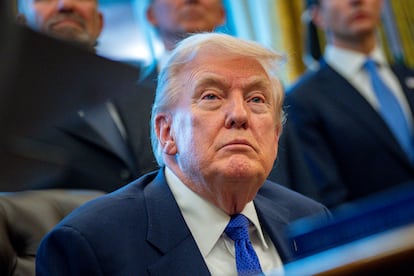

Donald Trump took another step in his undisguised authoritarian rhetoric on Monday, urging the Republican Party to strip states of their powers in order to “nationalize” U.S. Elections in time to influence the November midterm vote. The Republicans risk losing control of both houses of Congress, and for Trump the success or failure of the second half of his term is in the balance.
This appeal to Republicans has raised alarms in Washington about Trump’s true intentions regarding the legislative elections, which he has previously said “should not be held.”
The remarks were made on a podcast hosted by Dan Bongino, a prominent figure in the so-called manosphere and the MAGA movement, who, after serving as deputy director of the FBI for just under a year, recently returned to his former position. The president was in the middle of one of his lengthy monologues, dedicated to the topic of immigration, when he stated: “The Republicans should say, ‘We want to take over.’ We should take over the voting, the voting in at least many — 15 places. The Republicans ought to nationalize the voting.”
The suggestion, in which Trump did not specify which places he was referring to, amounts to an invitation to contradict the Constitution, given that it establishes in Section IV of Article I that in the United States, state laws govern elections, conceived as a decentralized process for which officials of both parties are responsible in the thousands of districts into which the vast map of the country is divided. Trump’s statements must be understood within the context of his obsession — and that of the MAGA movement — with the falsehood that elections in the United States are corrupted by widespread fraud.
The “big lie”
Over five years later Trump continues to claim, without evidence, that the Democrats stole the 2020 election from him, in which he clearly lost to Joe Biden. His insistence on what became known as the “big lie” culminated in the storming of the Capitol by a mob that believed the claims Trump and his allies repeated endlessly at the time.
In his crusade to change the rules of elections, the U.S. President signed an executive order last March requiring voter ID nationwide (currently, 14 states do not impose it) and seeking to prevent mail-in ballots arriving after election day from being counted, even if postmarked before that date. This order has met with resistance from federal judges across the country.
“When you confront a Democrat about voter ID, like in a debate or something… They’re very embarrassed when they say we want voter ID,” Trump said Tuesday during a press conference in the Oval Office. “The only reason somebody doesn’t want that is because they want to cheat. Our elections are crooked as hell,” he added.
FBI agents raided a Fulton County election counting center last week with a search warrant. Fulton County includes Atlanta, Georgia’s most populous city. This district was key to Biden’s victory and, along with Arizona and Wisconsin, was one of the epicenters of Trump’s attempts to manipulate the election results. The agents seized thousands of ballots. The idea that voter fraud occurred in Georgia at that time remains alive thanks to the persistent efforts of local MAGA activists, who have filed dozens of lawsuits that have yet to yield any positive results.

Following that unprecedented operation, in which Director of National Intelligence Tulsi Gabbard personally intervened, it was revealed, through an exclusive report by The New York Times, that Trump had personally called the agents to thank them for their work.
His administration has asked states to share their voter registration data. At least 24 states that have refused to comply with that order, citing Article I of the Constitution, are now awaiting the White House’s legal challenges. Last week, Attorney General Pam Bondi demanded that authorities in Minnesota — the scene of a brutal anti-immigration operation in recent weeks in which two Americans have died at the hands of federal officers — share that information as an essential step toward ending the deployment of 3,000 agents.
Another obsession of the MAGA movement is that undocumented immigrants vote overwhelmingly for the Democratic Party. Beyond the fact that recent arrivals typically lack involvement in political affairs and that it seems unlikely an undocumented immigrant would risk committing an electoral crime that could lead to deportation, an official investigation concluded that in Georgia, of the eight million votes cast in the last election, only 20 were from people without citizenship status.
Despite the evidence from the statistics, Trump insisted in his interview with Bongino on linking the urgency of launching the “largest deportation in history” to the health of the electoral process in the United States. “These people [undocumented immigrants] were brought to our country to vote, and they vote illegally,” he said on the podcast. “Amazing that the Republicans aren’t tougher on it. If Republicans don’t get them out, you will never win another election as a Republican.”
Trump’s latest statements echo others made recently. In an interview with The New York Times, he lamented not using the National Guard to seize ballot boxes in 2020 so that loyal officials could count the votes. Then, in a conversation with Reuters, he asserted that “When you think of it, we shouldn’t even have an election” in November (according to White House spokeswoman Karoline Leavitt, Trump was “simply joking”).
He has also promised legal consequences for those who oversaw the 2020 election, as part of the revenge he has been plotting against his enemies since returning to power. And he has amplified conspiracy theories about the involvement of China, the CIA, the FBI, Italy, Dubai, and Switzerland in the alleged fraud that cost him the presidency.
Sign up for our weekly newsletter to get more English-language news coverage from EL PAÍS USA Edition
Tu suscripción se está usando en otro dispositivo
¿Quieres añadir otro usuario a tu suscripción?
Si continúas leyendo en este dispositivo, no se podrá leer en el otro.
FlechaTu suscripción se está usando en otro dispositivo y solo puedes acceder a EL PAÍS desde un dispositivo a la vez.
Si quieres compartir tu cuenta, cambia tu suscripción a la modalidad Premium, así podrás añadir otro usuario. Cada uno accederá con su propia cuenta de email, lo que os permitirá personalizar vuestra experiencia en EL PAÍS.
¿Tienes una suscripción de empresa? Accede aquí para contratar más cuentas.
En el caso de no saber quién está usando tu cuenta, te recomendamos cambiar tu contraseña aquí.
Si decides continuar compartiendo tu cuenta, este mensaje se mostrará en tu dispositivo y en el de la otra persona que está usando tu cuenta de forma indefinida, afectando a tu experiencia de lectura. Puedes consultar aquí los términos y condiciones de la suscripción digital.