Group of House Democrats demands end to Monroe Doctrine and to Trump’s renewed interventionism in Latin America
Nydia Velázquez, a representative for New York, is introducing a resolution co-sponsored by Alexandria Ocasio-Cortez and other progressive congressmembers
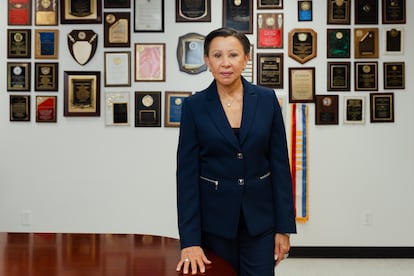

In December 2023, Nydia Velázquez, a Democratic congresswoman representing New York’s 7th District, introduced a resolution in the Capitol demanding that the State Department abandon the Monroe Doctrine, inaugurated exactly two centuries earlier by a speech by the fifth U.S. President, James Monroe, which unilaterally placed Latin America within the sphere of influence of its northern neighbor. This Tuesday, Velázquez is reintroducing the resolution in the House of Representatives, given that this framework for Washington’s relationship with the continent has not only not been abandoned, but, under the presidency of Donald Trump and with Marco Rubio as Secretary of State, it has returned with a force unseen in decades.
The resolution, which EL PAÍS has obtained, proposes an alternative—“a ‘New Good Neighbor’ policy, designed to foster improved relations and deepen more effective cooperation with all the countries of the Western Hemisphere”—to replace the Monroe Doctrine. This doctrine arose from the United States’ opposition to European powers’ interference in countries that were undergoing a process of emancipation, but in practice it marked the beginning of decades of invasions, military interventions, and CIA-orchestrated overthrows of legitimate governments.
Trump’s return to the White House revived it last year and added a corollary to turn it into the Don-roe doctrine.
Velázquez’s proposal—co-sponsored by, among others, the Democratic Representatives Delia Ramírez (Illinois), Alexandria Ocasio-Cortez (New York), Greg Casar (Texas), Rashida Tlaib (Michigan), Adelita Grijalva (Arizona), Pramila Jayapal (Washington), and Ilhan Omar (Minnesota)—adds the most recent events to its review of some of the darkest points in U.S. Foreign policy: From the “banana wars” of the early 20th century to the coup against Jacobo Arbenz in Guatemala, the embargo against Cuba, the overthrows of Salvador Allende in Chile and Joao Goulart in Brazil, support for Operation Condor between 1975 and 1980, the death squads in El Salvador, the Contras in Nicaragua, the invasion of Grenada, the financing of the 1991 coup in Haiti, and the IMF’s austerity policies.
To that list of accusations, the text adds several more, all referencing Trump. Included are the U.S. President’s interference in the Honduran elections, threatening to withdraw economic support if voters did not choose the right-wing candidate, Nasry Asfura; the pardon of former Honduran President Juan Orlando Hernández, who had served 45 years in prison for drug trafficking, and threats to seize control of the Panama Canal; and the pressure exerted on Brazil, through tariffs and intimidation of Supreme Court justices, to benefit the far-right politician Jair Bolsonaro.
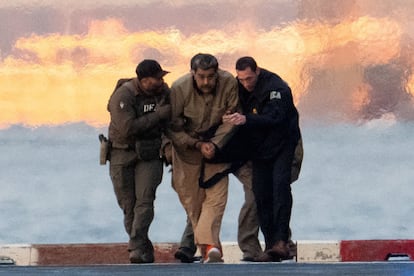
There is also the “illegal” deportation of hundreds of people to Nayib Bukele’s prison in El Salvador; the campaign of extrajudicial executions of alleged drug traffickers in Caribbean waters; and the “unauthorized military attack” to arrest Venezuelan autocrat Nicolás Maduro and his current custody in a New York jail, where he awaits trial for narcoterrorism.
New corollary
The resolution also alludes to the “Trump corollary,” which was defined in the National Security Strategy document, published last December, as American preeminence in the Western Hemisphere, access to key geographies throughout the region, and the use of the American military presence in the hemisphere to establish or expand access to strategically important locations.
The text, which is being introduced on Tuesday and has an uncertain future in the Republican-controlled House, proposes ending all unilateral economic sanctions, including the embargo on Cuba; strengthening the role of Congress, sidelined after Trump’s return to power, in foreign policy; declassifying all U.S. Government files related to coups; and collaborating with Latin American countries on a profound reform of the Organization of American States (OAS).
“This administration’s aggressive stance toward Latin America makes this resolution crucial,” Velázquez explained to EL PAÍS. “The ‘Donroe Doctrine’ is really just a more grotesque version of the same policy that has failed us for over two centuries. The United States and Latin America face shared challenges in drug trafficking, migration, and climate change. We can only solve them through genuine partnership, not coercion.”
Velázquez, who is of Puerto Rican descent, is one of the congressmembers most involved in Latin American affairs on Capitol Hill. Her initiative follows previous attempts to overcome the Monroe Doctrine, to which President Teddy Roosevelt added his own corollary in 1904, according to which Washington reserved the right to intervene in the internal affairs of any country guilty of “chronic wrongdoing, or an impotence which results in a general loosening of the ties of civilized society.”
In 2013, under the Obama administration, Secretary of State John Kerry declared that era over in a speech before the OAS. Six years later, John Bolton, National Security Advisor during Donald Trump’s first presidency, proudly proclaimed that the doctrine was “alive and well.”
Senator Bernie Sanders lamented in an interview with EL PAÍS published last weekend that “for many years, the United States dominated Latin America” “[Washington] overthrew one government after another. That is not what the American people want. The countries of Latin America have the right to determine their own futures in partnership with the United States, not dominated by the U.S. We will do everything we can to resist the United States government using its power to determine governance in Latin America,” Sanders stated.
Sign up for our weekly newsletter to get more English-language news coverage from EL PAÍS USA Edition
Tu suscripción se está usando en otro dispositivo
¿Quieres añadir otro usuario a tu suscripción?
Si continúas leyendo en este dispositivo, no se podrá leer en el otro.
FlechaTu suscripción se está usando en otro dispositivo y solo puedes acceder a EL PAÍS desde un dispositivo a la vez.
Si quieres compartir tu cuenta, cambia tu suscripción a la modalidad Premium, así podrás añadir otro usuario. Cada uno accederá con su propia cuenta de email, lo que os permitirá personalizar vuestra experiencia en EL PAÍS.
¿Tienes una suscripción de empresa? Accede aquí para contratar más cuentas.
En el caso de no saber quién está usando tu cuenta, te recomendamos cambiar tu contraseña aquí.
Si decides continuar compartiendo tu cuenta, este mensaje se mostrará en tu dispositivo y en el de la otra persona que está usando tu cuenta de forma indefinida, afectando a tu experiencia de lectura. Puedes consultar aquí los términos y condiciones de la suscripción digital.