These are the (many) countries that stand to gain from the Supreme Court ruling overturning Trump’s tariffs
The US president responds with a global tariff of 10%, considerably lower than the one currently in place for partners such as Mexico, Canada, or the EU
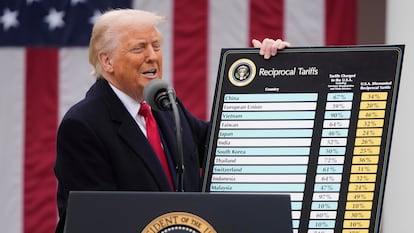

If anything has defined Donald Trump’s aggressive tariff policy since his return to the White House, it has been its volatility and the difficulty for the trading partners punished with those levies — which the President of the United States called “reciprocal” — to know what to expect. This Friday, the Supreme Court ruled in a decision that dealt a near-fatal blow to Washington’s trade agenda by determining that those indiscriminate rates are unconstitutional and therefore cannot continue to be collected. The Republican responded as he usually does: by refusing to admit defeat and going on the offensive.
That offensive was quite like a tantrum. Or a patch. Trump, after years of saying that “tariff” is the “most beautiful” word in the dictionary, celebrated a ruling that, he argued, “clarifies things” and announced a global 10% tariff applicable to all countries. This time, however, it was not based on the law he had previously relied on (a 1977 emergency powers statute known as IEEPA) but on a different one.
This provision allows tariffs to be imposed for 150 days, during which time Congress must agree to approve them. It is a measure set out in Section 122 of the Trade Act of 1974 to address a balance-of-payments issue, and, once again, it does not appear to guarantee stability: if Congress refuses to act, the Administration could, at least in theory, allow the tariffs to expire, declare a new balance-of-payments emergency, and restart the process. The maneuver would raise serious concerns about the separation of powers, but nothing in the statute clearly prohibits it.
The President of the United States took it for granted that in its ruling the Supreme Court was giving him permission to seek out new avenues to continue his mission of rewriting the rules of globalization, when in reality the decision warns him that, while he may try, it is far from certain that his new ideas will not be challenged in the courts — and possibly struck down, as happened this Friday.
That same destination, the courts, also appears to await the disputes that the implementation of the high court’s ruling — unclear on how to proceed with the roughly $150 billion already collected by the Treasury Department — is likely to generate.
Beyond the uncertainties that this temporary measure adds, one thing was clear at the end of a dizzying day in Washington: many countries will wake up this Saturday subject to lower tariffs than those Trump imposed on them during 2025, after a process marked by threats, doubts, and back-and-forths.
China, among the biggest beneficiaries
There are many beneficiaries. Among the biggest is China, the archrival power, which, after months of back-and-forth, had been subject to a 34% export tax to the United States. Then there is Canada, the old friend turned betrayer in Trump’s narrative, which he hit with a 35% tariff amid recent threats to further harden the terms of the relationship between two countries that share a border and a free trade agreement with Mexico. Both neighbors welcomed the relief the Supreme Court’s decision brought to their bottom lines, although the celebration was incomplete: the ruling does not strike down the sector-specific tariffs on steel, aluminum, copper, or cars — all industries that are crucial within the North American economic space.
The European Union, the other major trading partner, will see a 50% reduction in the rate on its imports (from 15% to 10%), while other important countries will see a significant improvement in their respective trade balances with the world’s leading power: from India (25%) to Taiwan and Vietnam (20%) and Thailand (19%). Japan and South Korea (15%).
Among the remaining capitals, many are staying as they are — from London to Canberra, and from Buenos Aires to Quito or Bogotá. After Trump’s mood swings, they had been left with a 10% tariff and will continue to face a 10% levy, at least for 150 days, while waiting to see what other weapons the Republican president may unveil, having announced that he has no intention of letting up in the trade war with which he has upended the global order forged decades ago by the United States.
Tu suscripción se está usando en otro dispositivo
¿Quieres añadir otro usuario a tu suscripción?
Si continúas leyendo en este dispositivo, no se podrá leer en el otro.
FlechaTu suscripción se está usando en otro dispositivo y solo puedes acceder a EL PAÍS desde un dispositivo a la vez.
Si quieres compartir tu cuenta, cambia tu suscripción a la modalidad Premium, así podrás añadir otro usuario. Cada uno accederá con su propia cuenta de email, lo que os permitirá personalizar vuestra experiencia en EL PAÍS.
¿Tienes una suscripción de empresa? Accede aquí para contratar más cuentas.
En el caso de no saber quién está usando tu cuenta, te recomendamos cambiar tu contraseña aquí.
Si decides continuar compartiendo tu cuenta, este mensaje se mostrará en tu dispositivo y en el de la otra persona que está usando tu cuenta de forma indefinida, afectando a tu experiencia de lectura. Puedes consultar aquí los términos y condiciones de la suscripción digital.