Douglas Hanahan, biologist: ‘We don’t necessarily need a cure, what we really need is cancer without disease’
The scientist is author of one of the most influential works in the history of tumor research
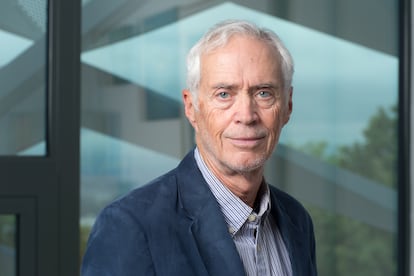

In 2000, Douglas Hanahan (Seattle, United States, 74 years old) co-authored The Hallmarks of Cancer with Robert Weinberg, one of the most influential works in the history of research on the disease. The two met at a conference in Hawaii and agreed on the need to embark on a monumental task: make sense of the overwhelming complexity of the hundreds of illnesses we refer to using a single word.
“There just seemed to be so much complexity and no clarity, variable responses to therapy and just the deluge of Big Data describing the hallmarks of different tumors,” says Hanahan in a conversation with EL PAÍS that took place over a video call from Lausanne, France, where he is the director emeritus of the Swiss Institute of Experimental Cancer Research at the École Polytechnique Fédérale’s School of Life Sciences. “And so we just started with the idea that maybe there’s some underlying principles that explain this dodging diversity,” he says.
In their first attempt, which has since been updated (most recently in Cell magazine), Hanahan and Weinberg described groups of outlaw cells with no respect for the exquisite rules that preserve harmony among millions of the body’s cells, and that evade its security systems meant to maintain order. They found six distinctive hallmarks between these rule-defying cells related to when they divide, when they stop dividing, when they die and how they cooperate with others so that the body continues to function.
The first of these hallmarks is that, in contrast to normal cells that only divide when the body requests it, carcinogenic cells proliferate whenever they want, and endlessly. The second is that they are able to evade molecular barriers that halt proliferation when there is no longer space to grow or fuel with which to do so. The third is that they resist programmed cellular death that normally forces damaged cells to commit suicide. Their fourth superpower is that they are practically immortal. Normal cells have a limited number of divisions, but carcinogenic ones can divide infinitely, keeping their chromosomes young. The fifth hallmark is their ability to access the body’s blood vessels and create new paths to accessing oxygen and the necessary nutrients to sustain their unrestrained growth. Finally, they have the capacity to travel to other tissues and colonize them, with no regard for the part of the body they belong to, a limiting factor for healthy cells.
In a 2011 revision, the duo added other hallmarks, like evasion of the immune system. That article was published the same year that the first immunotherapy drugs appeared, which have revolutionized cancer treatment, as well as that of enabling factors like chronic inflammation. In 2022, they added still more hallmarks, like the cells’ ability to change their identity to adapt to medications, or to recruit and reprogram normal cells, converting them into accomplices.
Question. The complexity of cancer you looked to address in your first article, has it become more approachable in the last 25 years or has the information that we’ve accumulated during that time made understanding even more difficult?
Answer. What [the concept of the different hallmarks] has provided is really a way of rationalizing the complexity of cancer, and realizing that there’s a series of barriers and roadblocks that the organism sets up to prevent things like cancer from happening. What we see in symptomatic cancers is outlaw organs that have learned how to evade all these protective mechanisms. I think that’s been very valuable. It does not explain, however, the underlying complexity of why different tumors use such different mechanisms and have such different hallmarks.
Q. Overall, there are many distinctive abilities of tumors, but I suppose that the weight of each hallmark is different in every kind, and as you describe in your articles, those capacities are activated at different parts of the process, and will be different in each individual. Is there a way of knowing the weight that should be given to each distinctive hallmark, in every moment of the disease’s evolution and in each individual, to fine-tune treatment?
A. That’s a big question for the future. It’s very clear that, even if you need these different capabilities, they can come up at differing times during the development and progression of an individual tumor, even within patients with exactly the same tumor type. It’s not all strictly linear. But continuous proliferation is really the underlying hallmark of cancer, as opposed to neurodegenerative diseases that don’t have that proliferative expansion.
Beyond that, the question is: which hallmarks do you acquire when, how important are they at different stages of tumor development and tumor progression and responses to therapy?
Q. Is that understanding already being used when it comes to patients in hospitals?
A. The sequential acquisition of these hallmark capabilities is a point we have made since the beginning, and there are drugs being developed against virtually all of these capabilities. But the decision of which drug to use or when is still empirical.
Q. Have you seen that some hallmarks have been more easily targetable than others?
A. In 2011, we pointed out that virtually all of them could be targeted. But about half of them are clinically validated drugs. Others are drugs that have been tested in model systems and the like, but have yet to reach clinical validations and being approved for treating patients.
Q. For this challenge, do you think that, for example, artificial intelligence or other new technologies are a good way to use your framework to bring this information to the clinic?
A. We need to be able to interrogate individual patients to see which hallmarks are the most important ones at that particular stage in time, and therefore could maybe be the best ones to treat with drugs. I do make the suggestion that so-called digital pathology — which involves analyzing biopsies of patients using machine learning and artificial intelligence algorithms — is going to provide a lot of new insights into which hallmarks are at work in each tumor.
I think this is a big opportunity for the future, both using [traditional tissue] biopsies, and also so-called liquid biopsies, where they collect blood or other bodily fluids and analyze them for signs of cancers. These techniques could be used to identify which hallmarks are most important in individual cases.
Also, game-imaging technologies, MRIs and ultrasounds are becoming more and more sophisticated and mechanism-based, which allows for the extraction of information that is functional, not just anatomical.
So, I think there’s going to be a possibility in the future to identify this heterogeneity and therefore say, this patient is highly dependent on a particular hallmark capability, and therefore we should target it and use a drug that disrupts it.
Q. You are a physicist by training, and physicists have been very successful in creating models to understand complexity. But I don’t know if the kind of complexity that we are talking about is the same as that which is used to make models for biological systems.
A. We raised that question in 2000, saying perhaps in 25 years it will become a completely logical system. But I think we’re still a long way off.
Q. Do you think that your idea has been useful in the development of treatments?
A. My hypothesis, for which there are some signs of light but not yet really dramatic results, is that if these hallmark capabilities are truly independent, it’s just like an automobile engine. It’s got an electrical system, it’s got a fuel system, and it’s got a system to guide it. And clearly the idea is that, if you separately disrupt those things, it may be harder for the tumor to adapt.
The analogy I make is the notion in conventional warfare that you come in by air, by land, and by sea. The commonality for virtually all cancer therapies for most patients is that they develop adaptive resistance. The drugs work for a while, sometimes patients are cured, but most of the time, the tumors develop resistance and there’s a relapse and progression of the disease. But the logic is, if you are co-targeting different hallmark capabilities, that maybe that would be harder for the tumor to resist, but we have yet to see many studies that have proven the effectiveness of therapeutic combinations.
Q. There is this idea that cancer is also a distorted version of our normal selves, and many of the processes that are associated to hallmarks of cancer are things that are needed by our biology. Does that make it especially difficult to get to this air, land, and sea approach?
A. Right, but many of the hallmarks are not operative in most cells most of the time. Clearly, you’ve got the issue of therapeutic window. But for example, wound healing involves five or six of the nine hallmark capabilities — but the key thing is that wound healing is transitory. You get a wound, many of these activities are activated, and then they go away. Not so with cancer. I think that attacking these different hallmarks is going to be feasible, because processes such as new blood vessel growth and immune attack are not things that are going on all the time.
In fact, with the immune system, one of the hallmarks is to enable it to attack and kill tumors. One of the reasons that it does not is because the immune system tries to avoid autoimmunity. But it’s clear with these Nobel Prize-winning immune check-point inhibitors that it is possible to target tumors, even if you have some side effects that you have to deal with. Of course, this will be the challenge of any sort of monotherapies, but also any combination therapy including hallmark co-targeting: adjusting the drugs and the scheduling and the design to not cause toxicity.
Q. There are those who say that new technological developments will make it possible to cure cancer in the next two decades. Do you think that is realistic?
A. We are already getting cures in a few patients. The key is going to be to have all these new technologies for interrogating tumors, ideally with liquid biopsies, with real biopsies, with non-invasive imaging, so that we can see not only how a tumor looks before treatment, but how it’s behaving on treatment. If we see that adaptive resistance is kicking in and we can identify the kind of adaptive resistance, then you would get another drug that blocks the adaptive resistance mechanism.
Because the reality is — and this has often been stated — what we really need is cancer without disease. We don’t necessarily need a cure, or a “cure-cure.” And the analogy for this is that most men in their 70s and 80s have prostate carcinomas. There are a lot of histologists who look at their prostate and say, “This is a cancer.” But it’s contained by all sorts of checks and balances in the prostate, it only erupts and escapes in a fraction of individuals. And so the rest of these men live normal lives and die with “indolent prostate cancer.”
I think it may be that, with these abilities to monitor how tumors are responding to therapy with increasingly sophisticated technologies, we’ll be able to keep cancer in check to allow people to live normal lives.
I’m not convinced that AI by itself is going to magically cure cancer, but machine learning and AI and digital pathology and noninvasive imaging technologies will really be able to interrogate tumors at various phases of their progression and adaptation of therapy.
Sign up for our weekly newsletter to get more English-language news coverage from EL PAÍS USA Edition
Tu suscripción se está usando en otro dispositivo
¿Quieres añadir otro usuario a tu suscripción?
Si continúas leyendo en este dispositivo, no se podrá leer en el otro.
FlechaTu suscripción se está usando en otro dispositivo y solo puedes acceder a EL PAÍS desde un dispositivo a la vez.
Si quieres compartir tu cuenta, cambia tu suscripción a la modalidad Premium, así podrás añadir otro usuario. Cada uno accederá con su propia cuenta de email, lo que os permitirá personalizar vuestra experiencia en EL PAÍS.
¿Tienes una suscripción de empresa? Accede aquí para contratar más cuentas.
En el caso de no saber quién está usando tu cuenta, te recomendamos cambiar tu contraseña aquí.
Si decides continuar compartiendo tu cuenta, este mensaje se mostrará en tu dispositivo y en el de la otra persona que está usando tu cuenta de forma indefinida, afectando a tu experiencia de lectura. Puedes consultar aquí los términos y condiciones de la suscripción digital.