The United States and Venezuela agree to resume diplomatic relations
Ties had been severed since 2019. The State Department announced the move as part of ‘a peaceful transition to a democratically elected government’ following Maduro’s capture
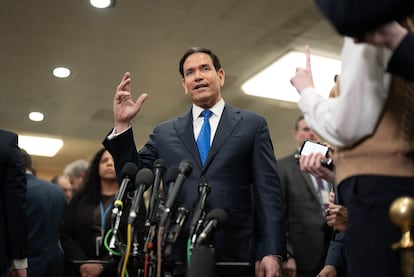

The U.S. State Department announced on Thursday, two months and two days after the capture of Nicolás Maduro in Caracas, that “the United States and Venezuela’s interim authorities have agreed to re-establish diplomatic and consular relations.” “This step,” Washington said in a statement, “will facilitate our joint efforts to promote stability, support economic recovery, and advance political reconciliation in Venezuela.”
“Our engagement is focused on helping the Venezuelan people move forward through a phased process that creates the conditions for a peaceful transition to a democratically elected government,” the text adds. “The United States remains committed to supporting the Venezuelan people and working with partners across the region to advance stability and prosperity.”
The announcement of the resumption of relations will lead to a greater U.S. Diplomatic presence, following the reopening of Washington’s embassy in Caracas in February and the arrival of the head of Venezuela Affairs, Laura Dogu. That same month, Rodríguez appointed one of her closest collaborators, Félix Plasencia, as her representative in the United States. His move to Washington, however, had not materialized until now.
The announcement marks another step in the plan that Trump set in motion with the military intervention to capture Maduro and his wife, Cilia Flores, who are awaiting trial in New York. After the operation, the Republican left Delcy Rodríguez — interim president and a prominent member of Chavismo alongside her brother Jorge — in charge of Venezuela.
Washington’s plan has, during this period, prioritized business —mainly the oil sector — over pressing democratic needs. There is still no set date for calling elections, although conditions have already been created for the return of the main opposition leader, María Corina Machado. She announced last week her intention to return to Venezuela, which she left after spending a year in hiding, to receive the Nobel Peace Prize last December.
On Thursday, Trump said that Venezuela is “stabilized” and again praised the Chavista leadership now in charge in Caracas. “We have a wonderful person as their elected president, Delcy Rodríguez, and she and her staff have been doing a fantastic job working with us.”
The Delcy example
Rodríguez, who previously served as Nicolás Maduro’s vice president, was appointed interim president by Parliament after the U.S. Military intervention. She has never been elected at the polls, but for Trump, she has already become a model.
Without going further, he used her as a reference to hint at what, in his view, should happen in Iran at the end of the war that the United States began last Saturday alongside Israel. In statements to Axios, the president said on Thursday that he is looking for “a Delcy” to replace Supreme Leader Ali Khamenei — killed by Israeli bombs on the first day of the war — because he dislikes the alternatives currently on the table and believes he should have a say in choosing the successor.
Venezuela should elect a new president once the 90‑day period allowed for an interim government — extendable for another 90 days under the Constitution — comes to an end. The Supreme Court, however, classified Maduro’s capture as a “forced absence” and avoided declaring his “permanent absence,” a mechanism that could have opened the door to calling elections more urgently.
“We have 50 million barrels of oil floating right now over to Houston, and we’re working with them really well,” Trump added on Thursday at a White House event honoring the Inter Miami soccer team.
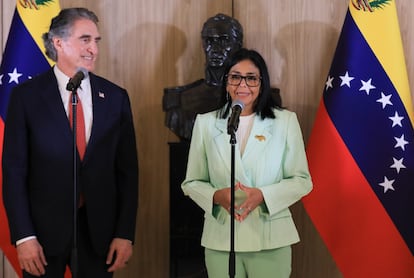
The rapprochement with Venezuela has included a two‑day visit by U.S. Interior Secretary Doug Burgum. During that trip, the first contract under the new hydrocarbons law was finalized between Shell and a private Venezuelan company, which has not yet been identified. The law has opened the energy sector — previously controlled by the government — to private companies, offering them substantial profits and the possibility of international arbitration in case of disputes. Following the signing of these agreements, Shell will resume operations in the country.
“We invited him to the signing of the agreements with Shell, which has been here since 1914, in the gas and oil sector. We are giving life and implementation to the new hydrocarbons law, and we have witnessed the signing of contracts between Shell and a private Venezuelan company,” Rodríguez told Burgum. “Please convey to President Trump our full willingness to continue building this diplomatic and cooperation agenda between our countries.”
Burgum is the fifth high-ranking U.S. Official to visit Venezuela since the January 3 military attack. He also chairs the U.S. National Energy Dominance Council, which oversees mining as well. In the joint statement delivered at the Miraflores Palace, he praised the work carried out by Rodríguez and her brother, the head of Parliament, in approving the new law, and predicted prosperity thanks to the renewed relations between governments that, until last year, were adversaries. He also highlighted the presence of Venezuelan talent in U.S. Oil companies, where many PDVSA technicians found work after emigrating due to the crisis in the national industry and the persecution by Chavismo following the 2002 oil strike.
No details have been presented regarding the joint mining plans for the south of the country, an area that contains major deposits of gold and strategic minerals. Ten years ago, Nicolás Maduro, through the creation of the Orinoco Mining Arc, opened a vast region — covering nearly 12% of the national territory — to indiscriminate exploitation.
In this area, resources are currently extracted by Chinese and Turkish companies, the Venezuelan government, and illegal miners. Much of the territory is controlled by irregular armed groups and criminal networks that have caused severe environmental degradation and human rights abuses, documented in several United Nations reports. Entering this dangerous region will be an enormous challenge for any international company. As he was leaving the country, before boarding his plane, Burgum avoided journalists’ questions about this situation.
Sign up for our weekly newsletter to get more English-language news coverage from EL PAÍS USA Edition
Tu suscripción se está usando en otro dispositivo
¿Quieres añadir otro usuario a tu suscripción?
Si continúas leyendo en este dispositivo, no se podrá leer en el otro.
FlechaTu suscripción se está usando en otro dispositivo y solo puedes acceder a EL PAÍS desde un dispositivo a la vez.
Si quieres compartir tu cuenta, cambia tu suscripción a la modalidad Premium, así podrás añadir otro usuario. Cada uno accederá con su propia cuenta de email, lo que os permitirá personalizar vuestra experiencia en EL PAÍS.
¿Tienes una suscripción de empresa? Accede aquí para contratar más cuentas.
En el caso de no saber quién está usando tu cuenta, te recomendamos cambiar tu contraseña aquí.
Si decides continuar compartiendo tu cuenta, este mensaje se mostrará en tu dispositivo y en el de la otra persona que está usando tu cuenta de forma indefinida, afectando a tu experiencia de lectura. Puedes consultar aquí los términos y condiciones de la suscripción digital.