Juan Pablo Guanipa: ‘I have no doubt: Venezuela is heading towards elections’
The opposition leader, who is close to María Corina Machado, maintains that a political transition is already underway and that Chavismo has lost its ability to impose conditions
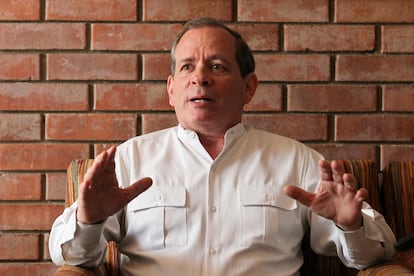
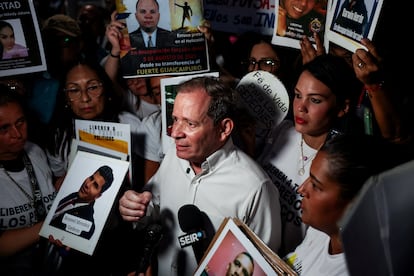
Juan Pablo Guanipa, one of the dissidents who has been most intensely persecuted by the Chavista regime, recounts that of the 260 days he spent in jail, the first 21 were particularly hellish. He was held in a 3x3 meter cell at the headquarters of the Bolivarian National Police in Maripérez, north of Caracas. He remembers it as a filthy prison: scorching hot by day, freezing cold by night, without a toilet or running water, and infested with mosquitoes. They gave him a uniform, and he went 21 days without bathing.
After that period, he says, the prison director agreed to improve his conditions of confinement. He was allowed to receive food from his family, books, and go out to the yard to get some sun. In prison, Guanipa imposed a routine on himself to organize his time in every corner of his cell, with a schedule of tasks that led him to do anaerobic exercises for the first time in his life.
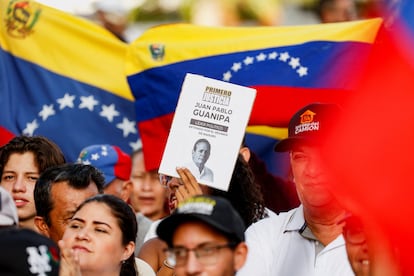
A lawyer and graduate of the University of Zulia, the 61-year-old is a politician steeped in Christian humanism and currently one of the national leaders of Primero Justicia. He is often praised for his firmness and composure in the face of Chavismo. In recent years he has found common ground with María Corina Machado, and since 2022 has been one of her closest collaborators.
Question. Do you feel that the country is moving towards a political transition or, once again, is the opposition counting its chickens before they hatch?
Answer. I think we are in a transition process. It’s happening in stages. Sometimes we don’t see that certain preconditions must be met for this electoral process to take place. The United States, which has become a key player in domestic politics, has said so. Marco Rubio confirmed it in his meeting with the Caribbean countries: we are heading towards an electoral consultation.
Q. Isn’t the military world still too aligned with the objectives of Chavismo?
A. Edmundo González won in all the polling stations designated for police and military personnel in the July 2024 presidential elections. The desire for change is widespread across all sectors of the country. There is a High Command committed to the regime, that’s true: they will have to go. I sense enormous weariness within the military regarding everything that has happened. The United States has economic and political priorities with respect to Venezuela. Up to this point, economic priorities may have carried more weight, as a stabilization mechanism. But we are undoubtedly moving toward a political agenda.
Q. Did you ever imagine that you would spend many years in prison?
A. Always. I thought a lot about my family. I have five children and a granddaughter. We’ve been through some difficult times lately; my wife recently passed away from cancer. This year my twin sons, who are 16, graduated from school. I hadn’t seen them in a while, and now they’re so grown up, I hardly recognized them. Before I was arrested, I spent 10 months in hiding, under very harsh conditions. In those kinds of situations, you never know when you’re going to get out.
Q. What is your opinion of the amnesty law and the political opening that Chavismo is attempting?
A. If they had already released hundreds of people before passing the amnesty law, that means the law wasn’t necessary to do so. What’s needed is political will, a willingness to act. They drafted a law that establishes limits and exceptions. There are civilians and military personnel who won’t benefit. Nor will people in exile. It’s an incomplete law.
Q. What do you think of Donald Trump’s invitation to Enrique Márquez to attend the State of the Union address?
A. Trump needed to show the United States the scope and benefits of the incursion into Venezuela. To that end, he invited a political prisoner, an important figure who was a presidential candidate and even challenged Nicolás Maduro in the Supreme Court. It’s logical that he did so, and I think it’s perfectly fine.
Q. Some speculate that this is a message about how the United States is interpreting a political transition.
A. I don’t think so. We, the democratic parties, can lead this process. The procedure we must follow is the one outlined in the Constitution: the position is declared vacant and elections are called. In my opinion, the process that began on October 22, 2023, which led to the primary elections and resulted in María Corina Machado’s victory, has not yet concluded. It is perfectly legitimate for her to be the standard-bearer of the democratic movement. This will be resolved through elections. Marco Rubio has made that clear.
Q. For Chavismo, the possibility of María Corina Machado being a presidential candidate is ruled out.
A. They are no longer in a position to make demands. Things have changed. They oppressed this country and imposed their will by force, but now there are stronger actors than them. That is the reality.
Q. Aren’t you worried that the country’s sovereignty will be trapped in this way by a foreign power?
A. I see it as something temporary. The United States, which in my opinion took a risk by intervening in Venezuela and ousting Maduro, has something to say about this problem. They will leave when the situation stabilizes, and after the elections, we will have a normal and fluid relationship with them. Just as we should have with the West, which is Venezuela’s natural cultural space—the democratic West.
Q. What is your opinion of the work of the opposition sectors that have decided to participate in elections organized by the regime?
A. They haven’t shown the stature required by such a delicate moment. If we claim to be democrats and a massive citizen consultation is organized in 2023, in which María Corina Machado wins with 90% of the vote, why don’t we abide by the popular will? Some say so openly: that it’s essential to stabilize the economy and postpone the elections until 2030. It seems they believe that, for their own survival, it’s better to keep Delcy Rodríguez in power.
Q. Would you be willing to be part of a national reconciliation agenda?
A. I am willing to reconcile with anyone, but only with the truth. Don’t give me that line about both sides making mistakes and hurting each other equally. No, sir. Here we have a powerful, minority group entrenched in the State that has repressed an entire country and governs illegally.
Q. Have you discussed these issues with your brother Tomás Guanipa, who is politically close to Henrique Capriles?
A. No. We last saw each other the day my brother Pedro, who was also imprisoned, was released. Tomás and his wife brought me food and books in jail, they looked out for me, they were supportive. We have many political differences. I’m not opposed to having talks: if we want to unite the country, we have to start by uniting the family.
Q. Aren’t you afraid of being imprisoned again?
A. The way they arrested me to take me to house arrest, after I had been released from prison, was humiliating and unacceptable. I thought I might die. Of course, it could happen again: they still control the police forces. I have been very clear in defending my rights. One has rights, and one has the right to defend them.
Sign up for our weekly newsletter to get more English-language news coverage from EL PAÍS USA Edition
Tu suscripción se está usando en otro dispositivo
¿Quieres añadir otro usuario a tu suscripción?
Si continúas leyendo en este dispositivo, no se podrá leer en el otro.
FlechaTu suscripción se está usando en otro dispositivo y solo puedes acceder a EL PAÍS desde un dispositivo a la vez.
Si quieres compartir tu cuenta, cambia tu suscripción a la modalidad Premium, así podrás añadir otro usuario. Cada uno accederá con su propia cuenta de email, lo que os permitirá personalizar vuestra experiencia en EL PAÍS.
¿Tienes una suscripción de empresa? Accede aquí para contratar más cuentas.
En el caso de no saber quién está usando tu cuenta, te recomendamos cambiar tu contraseña aquí.
Si decides continuar compartiendo tu cuenta, este mensaje se mostrará en tu dispositivo y en el de la otra persona que está usando tu cuenta de forma indefinida, afectando a tu experiencia de lectura. Puedes consultar aquí los términos y condiciones de la suscripción digital.