Chapter 15: Trump, the president of the elite
The Republican president has tightened the relationship between the elites and the White House, and this has affected communication and the free flow of information

In February 2017, just a few days after Donald Trump first arrived at the White House, The Washington Post unveiled a combative motto: “Democracy dies in darkness.” The phrase became the emblem of a particularly critical journalistic approach. With that focus, the newspaper won a Pulitzer for an investigation into the president’s finances and kept a systematic record of his false statements, which totaled 30,573 in four years.
At that time, Jeff Bezos, Amazon’s CEO, had been the owner of the newspaper for less than four years. During that period, he allowed the paper’s editorial independence to remain intact and sparked hope that a new generation of philanthropic billionaires might become journalism’s lifeline amid the digital storm. Nothing could have been further from the truth.
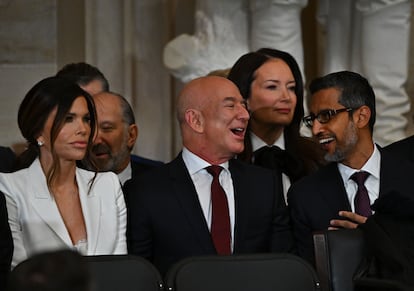
Of that Washington Post, only the combative slogan remains today. On January 20, 2025, Bezos watched Trump’s inauguration from the front row alongside other billionaires such as Elon Musk and Mark Zuckerberg. Trump was beginning his second term, but also taking on a role he had not held during his first: president of the U.S. Economic elite.
What has happened with the Post is a small example of how the magnates have aligned themselves. In February 2026, more than 2,000 journalists were laid off, and Bezos took on a much more active role in the newspaper’s editorial line. For example, he completely restructured the opinion section so that articles focused solely on free markets and personal freedom. No more counting falsehoods or criticizing corruption.
Bezos has thus adapted to Trump’s new strategy for dealing with the economic elite — one that appears to follow a carrot‑and‑stick logic: if you’re with me, I will help you grow and enrich yourself; if you’re not, I will put up every possible obstacle in your way. Financially, things have gone well for Amazon’s CEO. Over the past year, his fortune has risen from $245 billion to $261 billion.
In this chapter of the Trump Observatory, we analyze several elements that show how the relationship between the elites and the president has tightened, and how this affects communication and the free flow of information.
1. A Cabinet of millionaires
According to an estimate by Forbes, Donald Trump’s current Cabinet is the wealthiest in the history of the United States. Two secretaries have fortunes exceeding $1 billion, and three others have more than $100 million. Altogether, they hold over $7.5 billion — twice as much as Trump’s first team and roughly 68 times more than the combined wealth of Joe Biden’s Cabinet. Trump himself, whose net worth is estimated to have risen to $7.3 billion in 2026, has almost as much money as all his ministers combined.

2. With me or against me
Not every business deal with the Trump administration turns out well for companies. Those that comply with its demands receive major benefits, but those that do not risk becoming targets of its anger. The recent case of Anthropic is the clearest example.
When the AI company refused to give the Pentagon full control over its Claude model — which would have meant removing safeguards that limit citizen surveillance and autonomous military actions — the government retaliated by placing the company on a blacklist that prevents any federal office from working with them. That punishment had previously been imposed only on foreign companies such as Huawei.
It’s not an isolated case. The administration keeps a detailed record of the behavior of 553 companies to assess whether their support has been strong, moderate, or weak, and this is taken into account when making decisions.

3. Control of media and social networks
Larry Ellison, co‑founder of Oracle, is the sixth-richest man in the world, according to the latest Forbes ranking. His son is David Ellison, CEO of Paramount Skydance and a figure with growing influence in the media industry. Both are using their closeness to Trump and the Republican Party to build a powerful media empire that would help position the MAGA message across multiple platforms.
The father paid $14 billion to take control of TikTok in the United States, while the son has launched an offensive to acquire CBS and Warner — the company that controls CNN — which accepted a purchase offer after Netflix withdrew its own following a visit by its CEO to the White House. This transaction still needs approval from regulatory authorities, but it does not appear likely to face obstacles.

4. The business of donations
During the election campaign, Trump was already the candidate most supported by major fortunes. But since arriving at the White House, his fundraising power among the elite has continued to grow significantly, and it is estimated that he has received $2 billion for various projects, both partisan and institutional.
According to an NBC study, many of the donors who have given him the most money in the past year had never made political donations before — or at least not in such large amounts. Many of them have concrete interests tied to federal government contracts or because their companies could be vulnerable to public regulation. Notable examples include Greg Brockman, president of OpenAI, who donated $12.5 million, and Alexander Karp, CEO of Palantir, a tech company that uses artificial intelligence for large‑scale data analysis.
One of the projects that has generated the most fundraising is the renovation of the White House. Thirty‑seven donors have already contributed, including several tech companies, banks, cryptocurrency magnates, and businesses from the gambling and betting industries.

5. Lower taxes, greater wealth
The Big Beautiful Bill, as Trump called his budget law last year, included some of the largest tax cuts in U.S. History. Households with the highest incomes are the main beneficiaries, according to an analysis by the Congressional Budget Office and the Joint Committee on Taxation. It is estimated that the richest 10% of citizens will save an average of $14,700 per year, while the top 1% will receive relief of more than $50,000 annually. The law reduces taxes on wealth, on various business sectors, on international transactions for many companies, and lowers the overall tax burden paid by the wealthiest individuals.

6. The business of pardons
In addition to executive orders, Trump has also broken records in the indiscriminate use of another presidential power: the granting of pardons. Through this, he has been able to benefit many millionaires with whom he or his family have done business.
One striking example is Changpeng Zhao, an executive in a cryptocurrency company who was released shortly after Trump arrived at the White House, following investments of $2 billion secured for World Liberty Financial, the cryptocurrency venture run by the president’s sons.
In many cases, these pardons exempt these millionaires from paying outstanding tax debts and compensation owed to the victims of their crimes. According to an estimate by the governor of California, nearly $2 billion will not reach their legitimate recipients for this reason.

To learn more about this topic
Books:
- Andrea Bernstein: American Oligarchs: The Kushners, the Trumps, and the Marriage of Money and Power
- Eoin Higgins: Owned: How Tech Billionaires on the Right Bought the Loudest Voices on the Left
Articles:
- Dan Greenberg: President Trump’s Pardons: An Embarrassment of Riches
- Dan Pfiffer: A Pro-Trump Billionaire Is About to Own CNN
Videos and podcasts:
- Derek Thompson / Plain English: American Democracy as We Know It Might Not Survive This Technology
- Offline: How Peter Thiel Mentored JD Vance and Turned Silicon Valley Towards Trumpism
Tu suscripción se está usando en otro dispositivo
¿Quieres añadir otro usuario a tu suscripción?
Si continúas leyendo en este dispositivo, no se podrá leer en el otro.
FlechaTu suscripción se está usando en otro dispositivo y solo puedes acceder a EL PAÍS desde un dispositivo a la vez.
Si quieres compartir tu cuenta, cambia tu suscripción a la modalidad Premium, así podrás añadir otro usuario. Cada uno accederá con su propia cuenta de email, lo que os permitirá personalizar vuestra experiencia en EL PAÍS.
¿Tienes una suscripción de empresa? Accede aquí para contratar más cuentas.
En el caso de no saber quién está usando tu cuenta, te recomendamos cambiar tu contraseña aquí.
Si decides continuar compartiendo tu cuenta, este mensaje se mostrará en tu dispositivo y en el de la otra persona que está usando tu cuenta de forma indefinida, afectando a tu experiencia de lectura. Puedes consultar aquí los términos y condiciones de la suscripción digital.