The Persian Gulf, a booming business for the Trump family
The US president and his children maintain a thriving relationship with entities and authorities in the Middle East, where they have expanded their activities since the Republican’s return to the White House
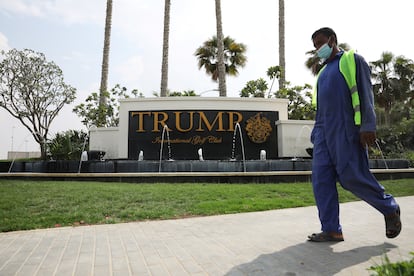

Donald, the son of Fred, a prosperous developer who in the mid-20th century built apartment blocks for the middle class in Brooklyn and Queens, wanted to be richer than his father, and ended up becoming the king of New York real estate and president of the United States. Donald Trump built an empire on the foundations of the family business. He learned to do business in an extreme and aggressive way. “To me it’s very simple: if you’re going to be thinking anyway, you might as well think big,” the current occupant of the Oval Office wrote in The Art of the Deal, an autobiographical book written with journalist Tony Schwartz in 1987, when Donald Trump was already a prominent figure in the Big Apple. By then, Trump Tower was already rising golden toward the sky, reshaping the New York skyline.
Nearly 40 years later, Trump’s fortune has multiplied. It is currently estimated at between $6.5 billion and $7.5 billion, according to calculations by Forbes and The New York Times. Because his company is not publicly traded, it is not easy to quantify his wealth, which is distributed across numerous real estate properties.
His business no longer stems solely from luxury skyscrapers, casinos, and golf courses. His empire has been bolstered by ties to the monarchies of the Persian Gulf, where his fortune has grown exponentially thanks to sheikhs and the cryptocurrency industry. This is the same region where Washington has now unleashed a war, in alliance with Israel, and where he plans to rebuild the Gaza Strip—destroyed by Israel—into a luxury resort. “I keep a lot of balls in the air, because most deals fall out, no matter how promising they seem at first,” the Republican wrote in his manual from the 1980s.
For President Trump, everything is business. And, although during his first term (2017-2021) he asserted that his companies would not sign new trade agreements abroad to avoid mixing his business activities with his role as president, he seems to have changed his mind in this second term. “I found out nobody cared, and I’m allowed to,” he told The New York Times in an interview.
The Trump family’s business ties with the Persian Gulf countries have multiplied since his first term in the White House. The president’s private business activities are not regulated by law. His critics warn of potential conflicts of interest, since, unlike what other U.S. Presidents have done, his companies are indeed capitalizing on the influence of having the president sitting in the most important office of the world’s leading power.
Trump is projected to earn enormous and unprecedented income from his overseas real estate projects during his second term, estimated to exceed $400 million, according to an analysis by Citizens for Responsibility and Ethics in Washington (CREW). This projected income would represent a huge annual increase over past earnings, including the more than $140 million Trump earned from overseas projects during his first term, the analysis adds.
Trump has turned his name into a franchise for luxury hotels, golf resorts, and digital assets. Entrepreneurs and governments in Saudi Arabia, Qatar, and the United Arab Emirates (UAE), among others, pay him hefty sums of money to lend his name to their properties as a synonym for luxury and distinction, even though that word doesn’t have the same meaning for everyone.
The relationship between the Trump empire and the petro-monarchies is so close that the Qatari royal family gifted him a Boeing 747 equipped with every imaginable luxury to replace Air Force One. The aircraft is valued at approximately $400 million. “I think it’s frankly ridiculous that any one in this room would even suggest that President Trump is doing anything for his own benefit,” White House Press Secretary Karoline Leavitt remarked a few months ago when asked about the potential conflict of interest.
The children take the reins
Since Trump first took office in January 2017, his sons Donald Jr. And Eric have assumed control of the Trump Organization, the heart of the family’s business empire, which has extended its reach to Dubai, Abu Dhabi, Doha, Riyadh and Jeddah, among other capitals. In the past year, his companies have signed a dozen agreements with government entities in the United Arab Emirates (UAE) worth more than $500 million, according to information compiled by Forbes.
The family is doing well with the patriarch in the White House. The New York Times estimates that his net worth has increased by $1.4 billion in the last year, and The New Yorker puts that figure at $4 billion, mostly from digital and cryptocurrency businesses.
The Trump Organization’s website announces upcoming projects to build residential complexes and golf courses in Riyadh; another residential and hotel project in Dubai (UAE); new luxury housing and golf investments in Doha (Qatar) and the latest residential, golf and hotel project in Wadi Safar (Saudi Arabia).
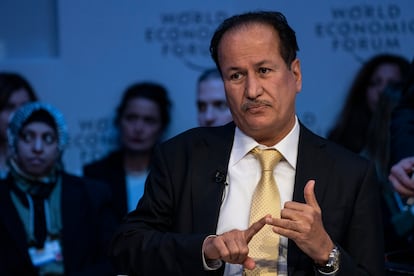
“The Trump Organization does not conduct business with any government entities,” family group spokeswoman Kimberly Benza told CNN. But the truth is, it’s difficult to unravel who is behind the companies in a tangled web of corporations that ultimately have interests with the Gulf monarchies.
The region is not new to Trump. He first dabbled in the Middle East at the beginning of the century. Dubai, the capital of the United Arab Emirates, was in the midst of a frenzied race to build resorts on artificial islands along the Palm Jumeirah coastline, home to the Burj Khalifa, the tallest skyscraper in the world. Nakheel Properties, a real estate developer with ties to the Emirati government, quickly contacted Trump about developing a colossal skyscraper in the new resort complex. Although the project fell through, Trump made other contacts with Dubai businessmen, which would prove to be the seed of his investments in the Middle East.
One of them was Hussain Sajwani, owner of Damac Properties, one of Dubai’s largest real estate developers. In 2013, the two magnates signed an agreement to build the first Trump-branded golf course in the Middle East. Their business dealings have expanded in recent years. A week before taking office for his second term in January 2025, Trump hosted Sajwani at Mar-a-Lago, his Florida estate. There, he announced that the Arab businessman would invest $20 billion in the United States in artificial intelligence data center projects. A few weeks later, Trump launched Project Stargate, through which he plans to mobilize $500 billion to accelerate the AI race.
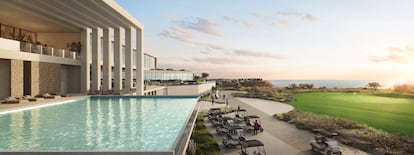
In 2022, the Trump Organization licensed a golf course in Muscat, Oman, thanks to Ziad El Chaar, another of the contacts the magnate had made in Dubai years earlier. El Chaar had moved to Saudi Arabia, where he acted as an intermediary for Dar Al Arkan, a company with close ties to the Saudi government. In the summer of 2024, when polls predicted Trump’s victory, Dar Al Arkan announced several agreements with the Trump Organization for projects in Saudi Arabia and Dubai. Shortly afterward, they also agreed to investments in Qatar. Trump’s licensing revenue—the use of his name in hotels, luxury facilities, or golf courses in exchange for a fee—increased sevenfold between 2023 and 2024, according to The New York Times.
Trump’s first departure from the White House was tumultuous. On January 6, 2021, he cheered on the mob that attempted to storm the Capitol. Many companies blacklisted him. Others welcomed him. “I would love the opportunity to expand our relationship,” said Sajwani, his longtime friend at DAMAC Properties, a week after the January 6 insurrection.
The PGA tournament at Trump’s New Jersey golf course was canceled by its organizers, and he subsequently partnered with LIV, the new professional tour sponsored by Saudi Arabia. Since then, this golf league has organized several tournaments on Trump properties.
The Trump children have seen the burgeoning world of cryptocurrencies, asset tokenization (digital proof of ownership of an asset), and data centers as a fast, secure, and convenient way to expand the family business, and they have found generous allies in Gulf businessmen and officials. Just after returning to the White House, Donald Jr. And Eric invested in American Bitcoin, a bitcoin mining company, along with other investors. The company is expanding in Saudi Arabia and has held talks with entities linked to the Abu Dhabi government following the U.S. President’s tour of the Middle East last summer, during which he secured over $2 billion in investments from the three Gulf states for projects in the United States.
“When the American people elect a president, they expect that person to work for them, not for profit,” Robert Weissman, co-chair of the NGO Public Citizen, told CNN.
Eric and Donald Jr. Also created World Liberty Financial, a financial platform that has USD1, a cryptocurrency pegged to the dollar. MGX, the company linked to high-ranking officials in Abu Dhabi, used the Trumps’ cryptocurrency to make a $2 billion investment in Binance, the cryptocurrency trading platform.
Pardon for the money launderer
Binance founder Changpeng Zhao was pardoned by Trump in October. He had been in jail after pleading guilty to facilitating money laundering that allowed terrorists, drug traffickers, and other criminals to transfer money through the platform.
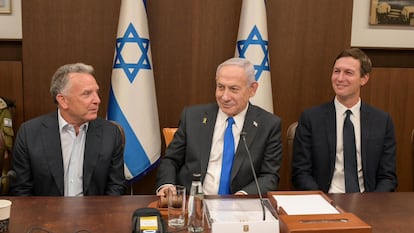
The Trumps are allied in the cryptocurrency business with the sons of Steve Witkoff, a longtime friend of Trump’s with whom he shares business interests. The president appointed him Special Envoy to the Middle East. He, along with Jared Kushner, Trump’s son-in-law, led the negotiations to achieve a peace agreement in Gaza, and both are at the forefront of talks to try to end the war in Ukraine.
Kushner owns an investment firm, Affinity Partners, whose shareholders are primarily prominent figures from the Gulf countries, among whom he has raised more than $5 billion. The largest investor in Kushner’s fund is PIF, Saudi Arabia’s public investment fund.
Sign up for our weekly newsletter to get more English-language news coverage from EL PAÍS USA Edition
Tu suscripción se está usando en otro dispositivo
¿Quieres añadir otro usuario a tu suscripción?
Si continúas leyendo en este dispositivo, no se podrá leer en el otro.
FlechaTu suscripción se está usando en otro dispositivo y solo puedes acceder a EL PAÍS desde un dispositivo a la vez.
Si quieres compartir tu cuenta, cambia tu suscripción a la modalidad Premium, así podrás añadir otro usuario. Cada uno accederá con su propia cuenta de email, lo que os permitirá personalizar vuestra experiencia en EL PAÍS.
¿Tienes una suscripción de empresa? Accede aquí para contratar más cuentas.
En el caso de no saber quién está usando tu cuenta, te recomendamos cambiar tu contraseña aquí.
Si decides continuar compartiendo tu cuenta, este mensaje se mostrará en tu dispositivo y en el de la otra persona que está usando tu cuenta de forma indefinida, afectando a tu experiencia de lectura. Puedes consultar aquí los términos y condiciones de la suscripción digital.