Trump says he will be ‘having the honor of taking Cuba’
US negotiators want President Miguel Díaz-Canel to step down as a condition for a deal with the island, according to The New York Times
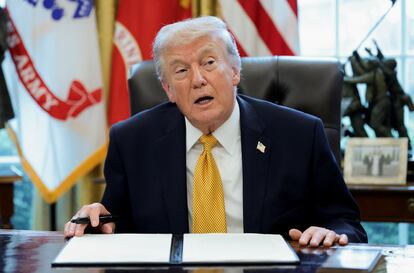
U.S. President Donald Trump stated on Monday at a news conference in the White House that “I do believe I will be having the honor of taking Cuba.” The remarks come amid the escalating war against Iran and tensions with Havana over the energy blockade against the island, which has not received a single drop of fuel for three months. “I think I can do anything I want with it,” he said. “They’re a very weakened nation right now.”
Trump’s remarks come on top of his statements in recent weeks, in which he has been outlining—though not always clearly—his plans for the island. So far, he has repeatedly said that Cuba is a “failed state,” promised to exploit its dependence on Venezuelan fuel—the flow of which has been cut off following Nicolás Maduro’s capture in January—and predicted that it is on the verge of collapse while encouraging economic reforms. He has toyed with the idea of “taking it over in a friendly manner.”
Following last Friday’s confirmation by island authorities that talks with Washington regarding its future are underway, it remains unclear what the outcome of these discussions might be. The New York Times reported on Monday, shortly after the White House occupant’s latest intentions became known, that negotiators sent by Washington have demanded that Cuban President Miguel Díaz-Canel leave power. From there, according to four anonymous sources cited by the newspaper, it would be up to the island’s leaders to decide the next steps.
For Trump, only one thing seems clear: those steps must be taken in the right direction for Washington’s interests. Asked by one of the reporters on Monday which model he had in mind, Iran’s or Venezuela’s—Trump, seated at his desk, responded: “It’s a failed state. They have no money, they have no oil, they have nothing. They have good land. They have beautiful views. It’s a beautiful island. I think they have great people, you know?”
Blackout
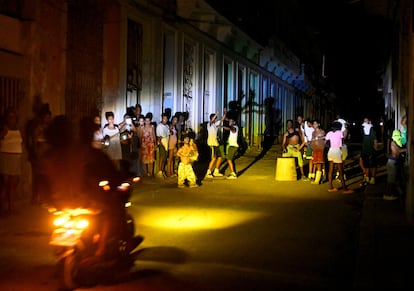
Trump’s latest escalation coincides with a nationwide blackout in Cuba, which lost power on Monday following a total collapse of its power generation system, according to the state-owned Unión Eléctrica (UNE). Since Trump declared a national emergency for the island on January 29, threatening to impose tariffs on countries that supply it with oil, no ships carrying fuel from abroad have entered the country.
Daily power outages lasting more than 20 hours, combined with food shortages, a lack of transportation and widespread frustration, have led Cubans to bang pots and pans in protest for over a week now. On Friday, however, discontent escalated to such an extent that a group of young people set fire to the Communist Party headquarters in Morón, in the center of the country, an act that was immediately labeled by the government as “vandalism.”
Cubans were also hoping that their government would officially announce the strategy it appears to be pursuing to address the historic crisis, after Díaz-Canel finally acknowledged that they are sitting at the negotiating table with the United States. The country, which for years has restricted its diaspora, will now be open to allowing Cuban residents abroad—especially those in the United States—to invest in the private sector and own businesses, one of the economic reforms they will push forward amid pressure from the Trump administration.
The New York Times exclusive discusses political objectives, in addition to purely economic ones. One of the sources cited in the article suggests that Trump could use Díaz-Canel’s downfall as proof to the American public that he is the one who has brought about change on the island after nearly seven decades of Castroism, much like what was attempted in Venezuela. But unlike Maduro, who is awaiting trial alongside his wife, Cilia Flores, in New York, the Cuban president has no pending legal issues with the U.S. Justice system.
It is unclear whether this leadership change will satisfy the more conservative Cuban exile community, which has for decades demanded the complete overthrow of the Castro regime and would not approve of simply removing Díaz-Canel while leaving the Castros—the family that continues to pull the strings—in place. USA Today reported on that possibility last week. It is with the grandson of the 90-year-old Raúl Castro, Raúl Guillermo Rodríguez Castro, aka El Cangrejo, that Secretary of State Marco Rubio is sitting down at the table, according to sources familiar with the negotiations.
The exile community is urging that the “Venezuela model” not be repeated: removing Díaz-Canel while allowing the Castro regime to continue. Cuban-American members of Congress, who wield their own influence on Capitol Hill, have also indicated that they expect more from their government.
Sign up for our weekly newsletter to get more English-language news coverage from EL PAÍS USA Edition
Tu suscripción se está usando en otro dispositivo
¿Quieres añadir otro usuario a tu suscripción?
Si continúas leyendo en este dispositivo, no se podrá leer en el otro.
FlechaTu suscripción se está usando en otro dispositivo y solo puedes acceder a EL PAÍS desde un dispositivo a la vez.
Si quieres compartir tu cuenta, cambia tu suscripción a la modalidad Premium, así podrás añadir otro usuario. Cada uno accederá con su propia cuenta de email, lo que os permitirá personalizar vuestra experiencia en EL PAÍS.
¿Tienes una suscripción de empresa? Accede aquí para contratar más cuentas.
En el caso de no saber quién está usando tu cuenta, te recomendamos cambiar tu contraseña aquí.
Si decides continuar compartiendo tu cuenta, este mensaje se mostrará en tu dispositivo y en el de la otra persona que está usando tu cuenta de forma indefinida, afectando a tu experiencia de lectura. Puedes consultar aquí los términos y condiciones de la suscripción digital.