Cuba’s collapse in the age of influencers: ‘Staying here should be a source of pride, not a sacrifice’
A handful of young content creators on the island have found a degree of freedom online. In the digital world, the narrative about the guerrillas who won the heart of the Latin American left has run its course
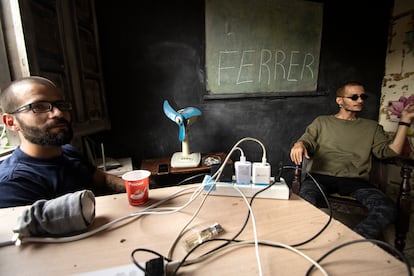

They were born when the Revolution had nothing left to offer them. Some are between 20 and 22 years old and have found less freedom on the streets than in 60-second-long Instagram reels. They dropped out of university or quit their professions, in order to seize the opportunities that YouTube offers. They learned to record themselves during blackouts, to edit in the silent early morning hours, and to have the patience to upload a 40-second, 60-megabyte video to the internet over the course of three or four hours.
They could talk about music, but they don’t. They could record themselves on the Malecón, driving in a 1950s American Chevrolet… but they don’t want to. Instead, they create political content. And today, amidst Cuba’s most severe collapse in almost seven decades, they’re the newest face of dissent within the country.
In the middle of last year, Anna Sofía Benítez Silvente – or Anna Bensi – was asking her Facebook followers whether they preferred curly or straight hair. She also sang songs in English while strumming her guitar. However, by October, the 21-year-old – speaking from her home in Havana, her face much more serious – took to the microphone. She explained that she was facing bureaucratic hurdles in obtaining her degree to qualify as a senior technician in dental prosthetics. And, even with the diploma, it would be difficult to survive on a monthly salary of 3,000 pesos (about $6). In Cuba, she said, “you have to be a magician to survive the nonexistent transportation, the inflation, the corruption, [or] the fact that the country is operating with a currency that not everyone can access (the U.S. Dollar). [You have to be a magician to] survive the meager state salary and survive the high internet rates.” Then, she added: “And what about surviving the food shortages?”
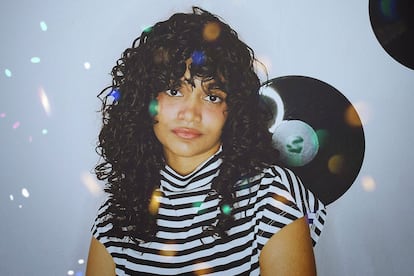
Anna Bensi probably didn’t realize then that there would be no turning back: dissent is irreversible. Her video garnered over 80,000 likes, countless reactions and was shared across various platforms. It didn’t say anything that Cubans didn’t already know, but as a young woman educated in state schools – a face (until that moment) unconnected to any opposition or exile group – she offered a fresh critique of the regime.
So, what exactly happened to Anna Bensi?
“Definitely, at the end of 2025, the situation in Cuba worsened to such an extent that I felt a great need to express some of what I felt and still feel,” she explains. “The mental and physical exhaustion reached its limit of silence: I decided to raise my voice and [describe] what most Cubans experience on the island on a daily basis.”
At that point, the United States hadn’t yet restricted Venezuelan fuel shipments to Cuba. But the country was already experiencing long blackouts, a significant devaluation of its currency, soaring food prices and, in general, a precarious quality of life, with no end in sight.
Anna continued sharing political content, talking about the lack of electricity, the shortages and the corruption. And she couldn’t stop. “Incorporating this topic into my content was completely spontaneous,” she says. Each of Anna’s videos sparked euphoria among her followers.
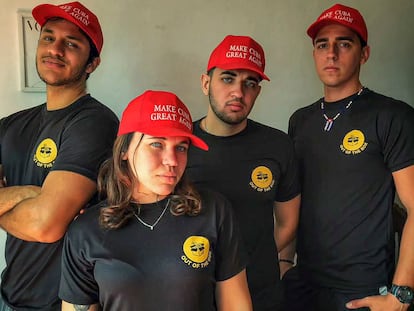
In January of this year, four other young people also launched their project, titled Fuera de la Caja (Outside the Box), on social media. Mauro Reigosa Pérez, Amanda Beatriz Andrés Navarro, Karel Hernández Bosques and Abel Alejandro Andrés Navarro appeared from a location in Havana wearing red caps, adapting Donald Trump’s MAGA slogan (Make America Great Again) to “Make Cuba Great Again.” This has generated considerable criticism.
Almost all of them have dropped out of school. They say that they’re influenced by a wide range of individuals, including Cuban poet and national hero José Martí, Chilean libertarian Axel Kaiser, as well as American economist Milton Friedman.
They define themselves as “libertarian liberals” and identify more with Trump’s rhetoric than with that of the Castro regime. “On the political spectrum, we’re often associated with the right. But, above all, we identify as young people who want to give back Cuban identity and freedom to new generations,” Mauro explains. “Our slogan is ours… and no one can take it away from us. We don’t glorify any politician. We welcome anyone, from any country, so long as they want to accelerate change in Cuba without harming people.”
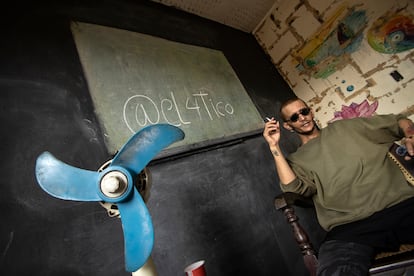
Around the beginning of this year, in Holguín, a city in eastern Cuba, Kamil Zayas Pérez and Ernesto Ricardo Medina were arrested. A year earlier, they had transformed a small online space, El4tico, into a major platform for denouncing the hardships of living in Cuba, reaching over 3,800 YouTube subscribers and 143,000 Instagram followers.
In one of their last videos, posted in February 2026, when the Trump administration was already hinting that Havana was its next target after targeting Caracas, the creators of El4tico told their audience: “The days of this dictatorship are over. We may not like the [arrangement] that comes about, but we understand that change won’t come through the sacrifice of the Cuban people, but rather through the intervention of a third party. So, we have to accept the consequences.” Their message resonated with over 68,600 Instagram followers. Four days later, Cuban State Security agents were shutting down the online channel and arresting Ernesto and Kamil.
Dissent in Cuba has changed, just as the country has changed. At one time, artists, journalists, activists and intellectuals were the regime’s most vocal critics. Today, however, content creators have also joined the fight. Cuba, a country built on the rhetoric of the guerrillas who won the heart of the Latin American left, may be witnessing the end of its narrative in the age of influencers.
The challenge of content creation in Cuba
The internet changed everything. It brought about the rise of independent media. It allowed Cubans – who, for years, had been deprived of fluid contact with their families abroad – not only to communicate with them, but also to learn firsthand what life was like beyond the confines of the island. It was through the internet that the mass protest that broke out on July 11, 2021 – the largest recorded since the Revolution came to power in 1959 – was replicated throughout the country. It was through the internet that university students brought the education system to a standstill last year, when the government tried to raise connectivity costs and, therefore, deprive them of their access to information.
“Before, it was very different. Things happened in Cuba that no one ever knew about,” Anna notes. “The internet has been one of the most widely-used tools to denounce the dictatorship and its injustices. It’s a small freedom that came to us, giving us a space for debate.”
Anna belongs to the generation that prefers creating content for social media instead of working for a state-owned company, in a country with an average salary of around 6,649 Cuban pesos a month (or just $15). “Knowledge is something that no one can take away from us… but these days, having a university degree in Cuba guarantees you absolutely nothing,” she sighs. “There are so many Cuban degrees gathering dust. It’s absurd to earn 3,000 pesos a month (less than $6) when daily transportation costs between 500 and 600 pesos (almost $1).”
Anna is from a different era. She’s able to turn down a government job in order to be an influencer, even though internet access remains prohibitively expensive. Creating content in Cuba is very different from how it’s done by the more than 200 million people who, by 2030, will be driving a $376.6 billion industry worldwide, according to an analysis conducted by WPP Media.
Anna keeps a notebook where she jots down ideas that she later shares with her audience. She starts her work whenever there’s electricity. “Most of the time, I film myself in the early morning.” Her sister, living abroad, helps her with the cost of internet access. “But, even then, good service isn’t guaranteed. It’s terrible; the connection is incredibly slow. Creating content in Cuba is a challenge.”
As is the case worldwide, influencers have proliferated in Cuba showcasing their new clothing hauls, featuring the heirs of K-pop in the Caribbean, or teaching followers how to stay fit in a country plagued by shortages. But those who use their platforms to denounce the country’s ongoing situation remain few and far between. According to Mauro, political content creators face several challenges: from the island, they cannot monetize their work, and they are limited in their ability to collaborate with local businesses due to the nature of their content.
“No one wants to associate their business with our image, for fear of state reprisals,” the young man says. He dropped out of the Electrical Engineering program at José Antonio Echeverría Technological University, a public university in Havana. “Few of us dare to speak out publicly. All young people want change, but fear paralyzes many of them. We hope our project inspires others; that’s our primary objective.” However, there’s one more concern that political content creators have that the rest don’t: “You never know when they can knock on your door and make you disappear,” Mauro says.
Repression amid a crisis
Nine days after Donald Trump threatened to impose tariffs on those who supply the island with oil – declaring a national emergency with respect to Cuba – authorities were using what little fuel they had left to equip their police patrol cars and motorcycles, in order to suppress any acts of subversion. On February 6, in an operation by State Security, officers entered El4tico: they confiscated computers, phones and recording equipment, while also arresting Kamil and Ernesto for the crime of creating political content.
“They use what little fuel they have left to mobilize cars and police to repress and monitor; they’re experts at that,” Yanet Rodríguez Sánchez says. Several officers prevented her from leaving her home in Holguín when she was on her way to attend the trial of the influencers, who now stand accused of committing acts of “propaganda against the constitutional order.”
Anna, for her part, has also experienced harassment over the course of several months. She has received online threats and has been intimidated: surveillance was posted outside her house. “Now they’ve opted to escalate the intimidation even further, by investigating [me and] my mother, [while] applying old techniques of psychological destabilization to harass me,” she describes.
The young people behind Fuera de la Caja (“Outside the Box”) have also been learning the consequences that come with being an influencer who’s opposed to the regime. “State Security started making visits to keep track of us and make us feel threatened,” they explain.
They’re aware that they could end up in prison, but they’ve decided to take the risk. As the country has embraced digitalization, the state’s repressive power has also prepared itself to maintain control over the internet. In 2018, the government approved Decree-Law 370, which provides them with a legal framework to punish the dissemination of information that’s “contrary to the public interest” on public networks. In 2021 – a month after the massive protests broke out on July 11 (some Cubans who broadcast live from their cell phones are serving long prison sentences) – the regime enacted Decree-Law 35 to punish any expression against the government on social media.
Even so, Anna and the young people from Fuera de la Caja continue to talk about corruption, dictatorship, the fear of speaking out, the lack of food or electricity, censorship, control and people’s desire to leave Cuba. Some of them, however, don’t want to leave the country that has experienced the exodus of almost two million Cubans over the last three years. “We wouldn’t want to leave our country; we’re certain that, this year, we’ll be free,” Mauro declares.
It’s a hope that they’ve begun to nurture more strongly in recent weeks, given the pressure coming from Washington, but also because of the irresistible pull of life in Cuba. Mauro and his group share a single desire: “We want Cuba to be the freest country in the world, where the Constitution protects the individual from the state – not the other way around, as it is today. We want living in Cuba to be a source of pride, not a sacrifice,” the young man affirms.
In the long run, Anna’s aspirations are quite simple: “I just want to live in a country where I can work and have the peace of mind that my salary will cover my basic needs and more. [I want] to have electricity all day, [as well as] drinking water. [I want] a place where I can express myself freely, lead a normal life and never stop doing God’s will. That’s precisely the minimum I want Cuba to guarantee us: a normal life. Not a life that revolves around surviving day to day, reducing existence to five hours of electricity, or where eating is no small feat.”
Sign up for our weekly newsletter to get more English-language news coverage from EL PAÍS USA Edition
Tu suscripción se está usando en otro dispositivo
¿Quieres añadir otro usuario a tu suscripción?
Si continúas leyendo en este dispositivo, no se podrá leer en el otro.
FlechaTu suscripción se está usando en otro dispositivo y solo puedes acceder a EL PAÍS desde un dispositivo a la vez.
Si quieres compartir tu cuenta, cambia tu suscripción a la modalidad Premium, así podrás añadir otro usuario. Cada uno accederá con su propia cuenta de email, lo que os permitirá personalizar vuestra experiencia en EL PAÍS.
¿Tienes una suscripción de empresa? Accede aquí para contratar más cuentas.
En el caso de no saber quién está usando tu cuenta, te recomendamos cambiar tu contraseña aquí.
Si decides continuar compartiendo tu cuenta, este mensaje se mostrará en tu dispositivo y en el de la otra persona que está usando tu cuenta de forma indefinida, afectando a tu experiencia de lectura. Puedes consultar aquí los términos y condiciones de la suscripción digital.