Oil, the crisis crushing Cuba and giving Trump new leverage
Fuel shortages are paralyzing the economy, while the United States is incentivizing the island’s private sector
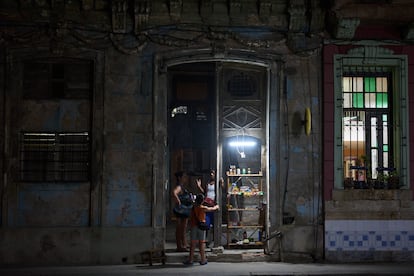

No one knows who did it, because it happened in the middle of a blackout — and if the blackout has one defining trait, it’s that your neighbor could just as easily be you, leveling everyone under the same terrible veil of darkness. The truth is that someone in the Poey neighborhood of Havana set fire to a utility pole in an act of rebellion and exhaustion, like someone who would rather remain in darkness forever than have the electricity gradually restored. Cubans have stopped counting the hours they’re without power and have started measuring the time by how long it will take for power to come back for good.
“Life slips away, and you feel like you can’t see clearly beyond a single step,” says Cuban editor and psychologist Juliette Isabel Fernández. “The lack of electricity not only plunges physical spaces into darkness, but it also dulls the mind.” Life has been scaled back as much as possible: you can hear children shouting as they play in the street now that schools are closed; adults no longer get up to go to work; people walk for miles because there is no transportation; and business owners ask one another how much fuel they still have stored. That is, in fact, the central question now that a country’s survival is measured in drops of oil.
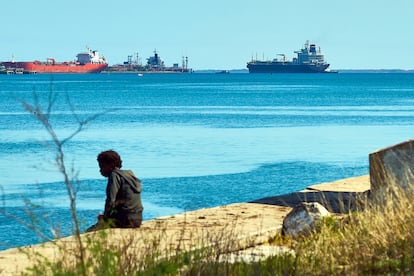
Every day at 7 a.m., Jorge Piñón, an energy expert leading a team at the University of Texas that tracks Cuban oil, grabs his coffee, sits down at his computer, and opens one of the satellite tracking systems. “For now, there are no tankers at sea heading toward Cuba, except for the Sea Horse,” he says.
The Sea Horse is a Russian tanker carrying 200,000 barrels of diesel that is apparently on its way to the island now that the more than 30,000 barrels of Venezuelan crude that used to arrive daily — and the more than 17,000 that came from Mexico — are no longer reaching Cuba.
On the Marine Traffic tracking platform, the Sea Horse — which set sail almost two weeks ago and is moving very slowly — appears to be about 1,400 nautical miles off the coast of Matanzas province in the Atlantic Ocean. The researchers, who are monitoring its every move, are unsure whether the ship will be able to enter a Cuban port. “The questions are: Will the Sea Horse arrive? And if it does, will the U.S. Coast Guard intercept it?” Says Piñón.
When the Trump administration declared a national emergency over Cuba on January 29, threatening to impose tariffs on the products of any country that supplies fuel to the Havana government, some claimed that Cuba had perhaps three weeks left before its total collapse. After more than a month, that hasn’t happened. The country has been drawing on its reserves and, according to Piñón, “has been squeezing out its last drops to survive January and February.” The team of experts, however, has issued an ultimatum: “If by the end of March we don’t see the smokestack of a tanker on the horizon, Cuba will have reached zero hour.”
No one — not even researchers — knows what this could mean or how the situation might unfold. “I have never seen or studied a country where 100% of the fuel disappears,” says Piñón. In any case, Cuba’s zero hour won’t arrive overnight; it has already begun. The sugar harvest didn’t start this year; there is barely any gas left for cooking; some hotel chains have shut down and sent their workers home; and several airlines have halted their flights due to a lack of fuel.
“Without energy, there can be no economy, no education, no healthcare, no food production,” says Piñón. “If you don’t have that engine, the rest of the country collapses. Without energy, there is no country.”
And that’s something the Trump administration knows firsthand: that if you remove a single piece from the already weakened machinery of the Cuban government, the whole structure can come down. Washington’s strategy toward Cuba appears to be different — not a war like the one unleashed in Iran, a country with the world’s third‑largest fuel reserves; nor an attack like the one carried out in Venezuela, which sits atop the world’s largest reserves and has roughly 2,000 times more oil than Cuba. The approach for the island is one of suffocation, like taking the respirator away from a patient on life support.
Cuba is also a far easier territory to manage: today it has, at most, around eight million inhabitants, exhausted after years of scarcity, living on nearly 42,500 square miles, and governed by people who, at this stage of the shipwreck, have not even managed to keep the narrative of the Cuban Revolution afloat. After nearly 70 years of Castroism, what Cuba offers its citizens is a depressed economy, inflation above 12%, ridiculously low wages, and a life reduced to figuring out how to secure the next plate of food.
For that reason, the United States — contrary to what politicians in South Florida and the most conservative wing of Miami may have expected — has said that before any political change, what Cuba needs is an economic one.
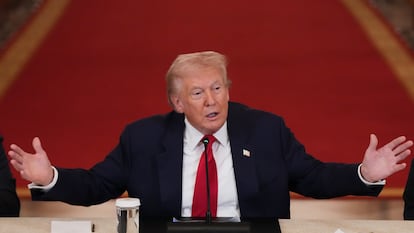
“Put aside for a moment the fact that it has no freedom of expression, no democracy, no respect for human rights,” said U.S. Secretary of State Marco Rubio, in a shift that caught many off guard. While a senator from Florida, the Cuban-American politician criticized any rapprochement with the Cuban government that did not prioritize regime change. Now, as Trump’s right-hand man, Rubio argued that “Cuba’s fundamental problem is that it has no economy.”
The Cuban side acknowledged that it is willing to engage in dialogue, but not to discuss its “constitutional system.” Trump, who has insisted that Cuba has very little time left, said that for now his priority is Iran. But in a sense, his administration has already begun taking its first steps — not only through the economic tightening around the island, but also by placing in the hands of Cuban entrepreneurs responsibilities that the state can no longer assume. The definitive end of Cuba’s narrative appears to have already begun.
The energy problem
Around midday on Wednesday, March 4, the Cuban Electric Union (UNE) confirmed a nationwide blackout following a failure at the Antonio Guiteras thermoelectric plant in Matanzas. This caused the disconnection of the National Electric System (SEN) from Camagüey to Pinar del Río, leaving more than six million people without power. At that time, the SEN’s available capacity was approximately 1,180 MW, compared to a demand of 2,250 MW. However, the problem of electricity shortages in Cuba did not begin this year, nor with Trump’s economic clampdown. The country had already been sinking into its own decline.
Cuba has seven thermoelectric plants, in addition to the Guiteras plant: the Máximo Gómez plant in Mariel; the Diez de Octubre plant in Nuevitas; the Carlos Manuel de Céspedes plant in Cienfuegos; the Lidio Ramón Pérez plant in Felton; the Antonio Maceo plant in Santiago de Cuba; and the Ernesto Guevara plant in Santa Cruz del Norte. They all share a common problem: “These thermoelectric plants use Cuban crude oil,” says Piñón. The expert explains that the Guiteras plant suffered a leak in one of its boilers due to corrosion of its walls caused by the use of that type of crude.
With a demand of over 100,000 barrels of fuel per day, Cuba currently faces a deficit of 60,000 barrels. This fuel used to come from Venezuela or Mexico, and the government paid for it with loans or by exchanging doctors, teachers, sports professionals, or military intelligence agents. This is the diesel that Cuba now does not have for transportation, agriculture, and even for supplying the pumping equipment needed to provide water to its population. The remaining 40,000 barrels of demand are produced by Cuba itself. This is a heavy crude oil, with a high sulfur and other metal content, highly corrosive, and used exclusively in thermoelectric power plants.
Because of the decades-long U.S. Trade embargo, Cuba is not allowed to export crude oil for processing in refineries with a “high conversion rate,” the expert says. The three refineries it has on national territory — Ñico López in Havana, Camilo Cienfuegos in Cienfuegos, and Hermanos Díaz in Santiago de Cuba — cannot process such heavy and viscous crude, only lighter types.
Specialists have warned that the biggest problem facing Cuba’s thermoelectric plants, after more than 40 years of service, is the lack of major maintenance these “old, outdated” structures receive, says Piñón. Experts estimate that Cuba would need between $8 billion and $10 billion over a decade to recapitalize its electricity sector.
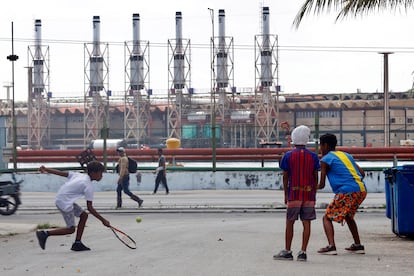
After thermoelectric plants, the second-largest source of energy in the country is the so-called generator sets, which Fidel Castro promoted in 2006 as part of what he called the Energy Revolution. Today, most of them are idle because they don’t have the diesel fuel needed to operate. The third-largest source of electricity on the island comes from renewable energy sources, such as wind, biomass, and solar. Two years ago, China committed to installing seven 5 MW photovoltaic parks in six Cuban provinces. The Cuban government also stated that by 2028 they planned to install 92 photovoltaic parks, totaling 2,000 MW of capacity. Currently, the country is constructing approximately 50 solar parks, each with a capacity of 21.8 MW.
However, according to Piñón, for these structures to function, “you first need baseload power.” “If you don’t have batteries to store solar energy, it’s complicated.” Another energy source could be the sugar industry, which the expert calls “the sleeping giant.” “Sugarcane is sugar, but also alcohol, ethanol as fuel for vehicles, and bagasse to generate electricity. The mills are old, and nobody works the fields. Last year, only 15 of the 56 mills that are supposedly active were operational, and none of them were able to reach their production targets.” Cuba, which was once the world’s leading sugar exporter, had to import approximately $36.6 million worth of sugar in 2023.
The combination of the total lack of fuel and an already‑broken system — strained even further by Trump’s measures — has led to the reality Cubans face today: a paralyzed country, with fewer and fewer tourists, blackouts lasting more than 20 hours a day, where drivers pay up to $1.30 per liter at state-run gas stations after waiting for up to 24 hours to refuel, or pay up to 5,000 Cuban pesos (almost $10) on the black market per liter, a price that only months ago was 400 pesos (about 70 cents).
Faced with this situation, Rubio announced that the United States would pave the way to alleviate the Cuban people’s suffering. This time, he allowed private businesses on the island to import unlimited fuel from the United States for their own use. According to the U.S. Treasury Department, these operations will only support “the Cuban people” — the transactions will not pass through the state. But the new measure does not even begin to alleviate Cuba’s fuel shortage.
Cuba, in the hands of its private sector
On March 2, Aldo Álvarez, the owner of Mercatoria, a company that produces and distributes hygiene, cleaning, food, and beverage products in Cuba, had to send his more than 100 employees home, with their salaries guaranteed until further notice. Due to fuel shortages, Álvarez temporarily closed the company, which he opened in 2021 when the government announced the opening of micro, small, and medium-sized enterprises (MSMEs) — a move that took place during the crisis that culminated in the July 11 popular protests of that year.
In 2025, there were approximately 9,900 private businesses on the island, employing more than 30% of the population. Although their prices are sometimes beyond the reach of the average Cuban, these businesses have become the primary source of food and other basic goods in a country plagued by shortages. After Trump’s emergency decree, many began to close or slow down sales. According to a study by Oniel Díaz Castellanos, director of the consulting firm AUGE, 78% of MSMEs reported a drop in sales during the first month of this year.
However, by the end of February, Mercatoria was operating again, following the announcement that Cuban private businesses could begin importing their own fuel. “If this measure hadn’t happened, we would all be closed,” says Álvarez. “The administration has recognized us as a useful and necessary ally, but this measure is only the first step; we have to take others to get where we need to be.”
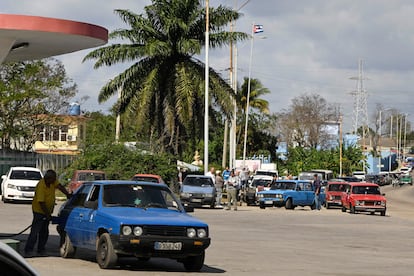
Advertisements for gasoline at $1.89 per liter and diesel at $1.98 per liter, shipped from Miami or Texas, have already begun circulating on social media and WhatsApp groups. The fuel would arrive in 25,000-liter tanks at the port of Mariel. Payment for the containers must be made via bank transfer through banks in non-Cuban countries. Once the business owner registers with a state-run import company and makes the purchase, the fuel is dispensed at gas stations in Cuba where the owner has a service contract. The first shipments have already begun arriving in Cuba.
However, a study by AUGE warns that 70% of Cuban MSMEs cannot import fuel on their own. “Making these imports to meet their consumption levels would be a big financial and operational undertaking that wouldn’t have a real impact,” says engineer Yulieta Hernández Díaz, CEO of the Pilares Construction Group, which provides services on the island. “If authorization is limited only to large imports for those who can afford it, this leaves many private businesses in a critical situation. We are one of those businesses that doesn’t see the viability of importing fuel.”
During the early years of the Cuban Revolution, the country’s leadership nationalized companies, effectively seizing all types of property from foreigners and private individuals, thus declaring the socialist state enterprise the main player in the Cuban economy. Over time, although reluctant to fully embrace private ownership, the country had to make some concessions to cope with the economic crisis.
“The Cuban government has always viewed the private sector as a necessary evil. They need it; they realize that private companies are much more agile in resolving issues or making decisions, but in practice, they always see it as a threat. If you have an actor that builds up money and resources and gains influence, that actor can eventually begin to challenge you politically,” says the economist Ricardo Torres, former researcher at the Center for the Study of the Cuban Economy and professor at American University in Washington. Just a few days ago, Cuba announced, for the first time in almost 70 years, permits for the creation of public-private partnerships.
That is the sector to which the Donald Trump administration —after Barack Obama took the first steps during the restoration of diplomatic relations with Havana — is speaking, and to which it is handing the fuel so that the island does not reach total collapse.
For many, it is a strategy as part of a negotiation that, even today, is not clear to many people. “What Trump is doing is reducing the state’s presence in the economy,” says Torres. Although it may seem that nothing is changing, many things appear to be shifting.
Sign up for our weekly newsletter to get more English-language news coverage from EL PAÍS USA Edition
Tu suscripción se está usando en otro dispositivo
¿Quieres añadir otro usuario a tu suscripción?
Si continúas leyendo en este dispositivo, no se podrá leer en el otro.
FlechaTu suscripción se está usando en otro dispositivo y solo puedes acceder a EL PAÍS desde un dispositivo a la vez.
Si quieres compartir tu cuenta, cambia tu suscripción a la modalidad Premium, así podrás añadir otro usuario. Cada uno accederá con su propia cuenta de email, lo que os permitirá personalizar vuestra experiencia en EL PAÍS.
¿Tienes una suscripción de empresa? Accede aquí para contratar más cuentas.
En el caso de no saber quién está usando tu cuenta, te recomendamos cambiar tu contraseña aquí.
Si decides continuar compartiendo tu cuenta, este mensaje se mostrará en tu dispositivo y en el de la otra persona que está usando tu cuenta de forma indefinida, afectando a tu experiencia de lectura. Puedes consultar aquí los términos y condiciones de la suscripción digital.