Sheridan Gorman, the latest case Trump is using to defend the expulsion of migrants
The 18-year-old student died after being shot by a Venezuelan migrant who had previously been arrested for theft, renewing criticism that immigration authorities are not prioritizing criminals
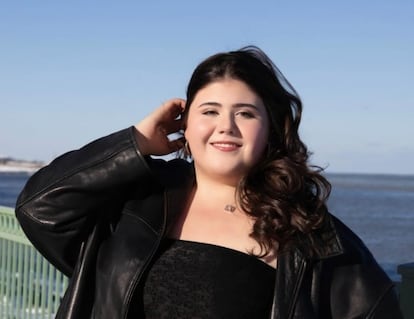

Traces of the flowers and candles that friends, family, and classmates brought as a farewell to the Tobey Prinz Beach pier in the Rogers Park neighborhood, north of Chicago, still remain. On Thursday, March 20, at around 2 a.m., Sheridan Gorman, an 18-year-old student at Loyola University, was walking there with friends, all young people like herself. They wanted to see the Northern Lights, Gorman’s parents later said in a statement. Gorman was “walking with friends, close to home, in an area where she had every right to feel safe,” when someone shot and killed her. Her case has gained national attention after the Trump administration revealed that the man accused of her murder was an undocumented immigrant, making her the latest figure being used by the White House to unleash a wave of xenophobia and justify the mass deportation of undocumented immigrants.
To the list that includes nursing student Laken Riley, Illinois youngster Katie Abraham, and 12-year-old Jocelyn Nungaray, we can now add Gorman. These are the names the Department of Homeland Security (DHS) clings to in order to justify Trump’s policy of detentions and deportations, accusing those responsible for their deaths — and by extension all foreigners — of threatening the safety and security of Americans. All four died at the hands of, or in incidents involving, migrants of Latin American origin, and in every case, Trump pointed to his predecessor Joe Biden’s immigration policy as the root cause. But in Gorman’s case, the fact that the accused had previously been arrested for theft renews and reinforces criticism that immigration authorities are not prioritizing criminals, as they have repeatedly stated.
Gorman, originally from Westchester County, New York, loved “traveling, listening to music, cooking, reading, going to concerts, and meeting new people.” Friends remember her as “kind, generous, cheerful, and a lot of fun.” In fact, her Instagram posts show an enthusiastic young woman surrounded by friends on outings and at parties. Her last photos, however, have become a kind of memorial where people come to leave messages of condolence. “Rest in peace, beautiful soul,” “my deepest condolences to her family and friends,” and “I hope there is more love where you are than here” are some of the comments.
There are others trying to understand why someone who shouldn’t be in the obituaries of newspapers across the country died. And they’ve found the answer in the identity of her killer. “This is a completely preventable murder by another illegal immigrant,” one commentator writes. He’s referring to José Medina, a 25-year-old Venezuelan who, according to authorities, shot Gorman. According to the Chicago Police Department, Medina was arrested last Friday and has now been charged with first-degree murder and attempted first-degree murder.
The police report details that security camera footage shows Medina, dressed in black and masked, approaching the group of friends, pulling out a gun, and pointing it directly at Gorman as she tried to run away. He then fired, fled, and entered a nearby building.
Authorities revealed that Gorman, who was shot in the back, died instantly. Very little is known about the incident so far, and it hasn’t even been revealed whether Medina had any connection to the young woman or the university campus, but friends who were with the victim at the time told local media that she didn’t appear to be the attacker’s target.
Gorman’s death leaves much in its wake: a completely broken family; a university community stunned by the death of one of its own; and a government that has seized the narrative to validate anti-immigrant policies that for more than a year have kept migrants — both documented and undocumented — in a state of almost permanent terror.
Crime as policy
On Sunday, the DHS offered more details about José Medina: he crossed the border on May 9, 2023, had contact with Border Patrol agents, and was subsequently released. That same year, the Venezuelan was arrested for shoplifting and released on June 19, 2023. Under the so-called Laken Riley Act — which in January 2025 reclassified even minor offenses as valid grounds for deportation, not just major crimes — this officially made him deportable. Critics of Trump’s immigration policy point out that this demonstrates that, in practice, immigration authorities are not prioritizing the capture and deportation of known criminals, although the DHS has shifted the blame to a lack of cooperation from local authorities.
On Monday, Donald Trump was questioned by the press about Gorman’s death and, as he often does in these cases, he blamed the previous administration: “This person came in through the open door policy of Joe Biden and we have others,” the U.S. President said. “We’re taking them out by the tens of thousands. We’re doing a great job, but it’s a shame.”
The DHS, for its part, seized the opportunity to criticize J.B. Pritzker — the Democratic governor of Illinois and one of the most vocal critics of the current immigration crackdown — for his sanctuary policies, which mean that neither the state nor the city of Illinois cooperates with federal immigration authorities. Gorman “was failed by open border policies and sanctuary politicians who released this illegal alien twice before he went on to commit this heinous murder,” said Lauren Bis, acting deputy secretary of the federal agency. She also demanded that state authorities “commit to not releasing this criminal illegal alien from jail back into American neighborhoods.”
In a statement sent to Fox News, after expressing his condolences to Gorman’s family and saying he hopes to see “the alleged perpetrator held accountable to the fullest extent of the law,” Pritzker emphasized that the Trump administration “needs to stop politicizing heinous tragedies” and seek “real solutions, like reinstating federal funds to prevent violence that support our public safety efforts.”
In June 2024, the death of Jocelyn Nungaray — a 12-year-old girl murdered in Texas by two Venezuelan migrants — became a central issue in the Republican’s campaign. “These monsters should never have been in our country,” Trump declared at the time. In January of this year, Katie Abraham, a 20-year-old from Illinois, was killed in a collision with a vehicle driven by a Guatemalan immigrant. When the government deployed hundreds of agents from Immigration and Customs Enforcement (ICE) and other agencies to Chicago last year, they dedicated Operation Midway Blitz, a massive campaign of arrests and deportations, to Abraham’s case.
Although the White House has used these incidents to insist on a supposed link between crime and the arrival of migrants to the country, the truth is that more than one study has proven not only that no such link exists, but also that undocumented migrants are less likely to commit crimes than Americans. A study by the Cato Institute, a Washington think tank, showed that the incarceration rate for U.S. Citizens is double that of undocumented migrants and almost quadruple that of migrants with legal status. While 1,617,197 Americans were arrested in 2023, the number of undocumented migrants detained that year was 67,813, compared to 58,515 legal migrants.
Now, with the recent death of Sheridan Gorman, David J. Bier, director of immigration studies at the Cato Institute, has challenged the Trump administration itself, asserting that they “prioritize racial discrimination over prosecuting criminals.” Bier points to the fact that, of the more than 675,000 people deported up to last December, only between 25% and 35% had criminal records. “They should have been one of the new administration’s primary targets, but they weren’t. As a result, they went unpunished and were able to reoffend,” Bier argues.
Sign up for our weekly newsletter to get more English-language news coverage from EL PAÍS USA Edition
Tu suscripción se está usando en otro dispositivo
¿Quieres añadir otro usuario a tu suscripción?
Si continúas leyendo en este dispositivo, no se podrá leer en el otro.
FlechaTu suscripción se está usando en otro dispositivo y solo puedes acceder a EL PAÍS desde un dispositivo a la vez.
Si quieres compartir tu cuenta, cambia tu suscripción a la modalidad Premium, así podrás añadir otro usuario. Cada uno accederá con su propia cuenta de email, lo que os permitirá personalizar vuestra experiencia en EL PAÍS.
¿Tienes una suscripción de empresa? Accede aquí para contratar más cuentas.
En el caso de no saber quién está usando tu cuenta, te recomendamos cambiar tu contraseña aquí.
Si decides continuar compartiendo tu cuenta, este mensaje se mostrará en tu dispositivo y en el de la otra persona que está usando tu cuenta de forma indefinida, afectando a tu experiencia de lectura. Puedes consultar aquí los términos y condiciones de la suscripción digital.