From saint to raver: Rosalía opens ‘Lux’ world tour by exploring all her incarnations
In Lyon, the singer unveils a show with a theatrical and pop spirit that focuses on her new album without abandoning her flamenco roots or the greatest hits from ‘Motomami’
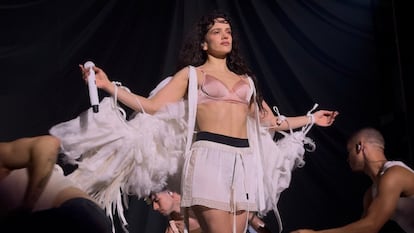

Rosalía kicked off her Lux world tour in Lyon on Monday night with an ambitious, theatrical, and at times dazzling show that confirmed the magnitude of the shift she embarked upon with her latest album. Bringing such a sophisticated and maximalist record to the stage — a work built on a myriad of contrasts, instruments, languages, references, and impulses — was expected to be a challenging undertaking. The Catalan singer met the challenge with authority in an opening show that felt somewhat like a lavish dress rehearsal for a production that was already very solid and well-structured, though still with a few rough edges visible. Rosalía will perform in Spain from the end of March to mid-April, with four concerts in Madrid during Easter week and then another four in Barcelona, before continuing her tour through Europe, the U.S., and Latin America.
Rosalía had promised a very different show from the Motomami tour, one capable of combining “experimentation, rigor, and joy.” That, broadly speaking, is what unfolded at the LDLC Arena in the French city, a multipurpose auditorium adjacent to the stadium of Ligue 1 soccer team Olympique Lyonnais. Lux arrived on stage transformed into a classically inspired pop ceremony, drawing on opera, ballet, and the art world while remaining a grand spectacle for the public. It also alluded to religion, though not in the form of the grand, emphatic liturgy one might have expected. Rosalía administered these symbols with more lightness than anticipated: there were saints, convent-like white, and devotional symbols, but without suffocating the concert with solemnity.
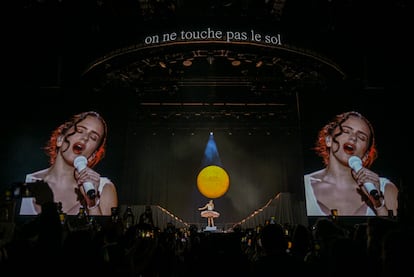
The singer appeared on stage emerging from a box, transformed into a motionless dancer, on a semicircular stage illuminated with theatrical lights, like a Roman-style amphitheater. In the background, the set was the reverse of a painting, as if Rosalía were revealing the inner workings of creation. The singer emerged wearing a white chiffon dress and pink bodice, a playful nod to Madonna, but then underwent multiple metamorphoses throughout the night: pious and saintly, cabaret dancer, artist’s muse, hallucinating raver, Lucifer’s apprentice, and, finally, a celestial creature with angel’s wings.
Lyon — a city unaccustomed to being the starting point for tours of this scale — served as a testing ground. The chosen venue, medium-sized and with a capacity of 13,500 people, allowed for gauging volume and transitions before moving on to larger venues: the next stop will be Paris, where Rosalía will perform on Wednesday and Friday before almost twice the audience. The concert had the typical tension of a first night, with a few very minor technical glitches that didn’t detract from the overall experience. Rosalía moved comfortably in this format, more intimate than a stadium. She was able to get close to the audience, wander among the attendees, and take advantage of a stage design created to eliminate distance.
One of the most striking aspects of the production was the orchestra pit, arranged in the shape of a Latin cross. At the intersection of its axes stood some 30 musicians in a chamber orchestra format, with strings, winds, and percussion adding depth to the ensemble without overwhelming it with a symphonic mass. This visual element reinforced the iconography of Lux, but it also served a pragmatic purpose: facilitating the singer’s movement and creating a more intimate connection between Rosalía, the stage, the musicians, and the audience.
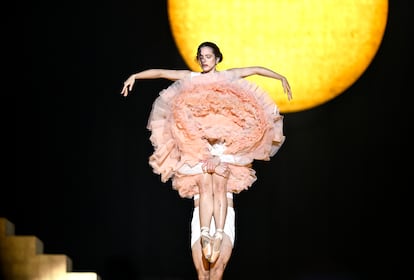
The setlist was one of the biggest unknowns of the night. The concert, lasting just under two hours, focused clearly on Lux, although it did include nods to her previous work. The first part of the concert served to introduce the new album with Sexo, Violencia y Llantas, Reliquia, and Divinize. Porcelana, with Rosalía on her toes and surrounded by the dancers of (LA)HORDE, the French collective responsible for the show’s main choreography, was one of the most powerful images of that initial section. Then came Mio Cristo Piange Diamanti, with Rosalía in her most folkloric form.
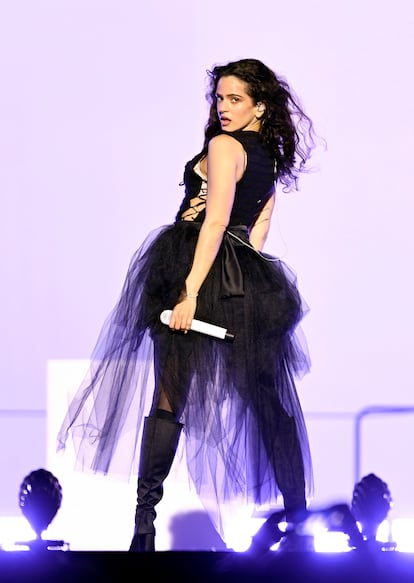
After a brief greeting to the audience in broken French, the concert took a turn. Rosalía shed her white attire and entered the darkness. Dressed in black, with feathered horns and the air of a creature from the underworld, she launched into Berghain, the lead single from Lux, in one of the most powerful sequences of the night, which culminated in a frenzied electronic party, much like her triumphant performance just days before at the Brit Awards. From there, she bridged the gap to Motomami with Saoko, La Fama, La Combi Versace, and De Madrugá. At that moment, it became clear that Lux wasn’t going to erase the previous album, but rather merge with it. El Mal Querer (2018), on the other hand, was conspicuously absent.
The third act began with a flamenco cajón solo while the audience clapped off-beat. This was followed by El Redentor, rescued from her debut album, Los Ángeles; an unexpected version of Can’t Take My Eyes Off You; La Perla, a huge fan favorite and perhaps the best choreographic number; Sauvignon Blanc, performed at the piano with Llorenç Barceló; and a sensational La Yugular. The final stretch brought the show back to direct contact with the audience. During Dios es un Stalker, Rosalía moved among the attendees in a kind of secular procession, microphone in hand, collecting souvenirs and signing autographs. Then came La rumba del perdón and CUUUUuuuuuute, already carrying a sense of finality, before the last stretch recaptured some of the most recognizable hits from her repertoire with La Noche de Anoche (her 2020 duet with Bad Bunny), Bizcochito, and Despechá. The closing track, Magnolias, tempered the party energy, leaving a final, more subdued impression.
The concert confirmed that this tour will offer more than just a simple shift in imagery. Rosalía has found a way to reconcile the ambition of a large-scale production with an unexpected sense of intimacy. Opera with reggaeton, refinement with playfulness, the complete artist with the girl next door. The first night didn’t clear up all the questions, but it did answer the main one: Lux works on stage. And not as a mere literal translation of the album, but as the articulation of her persona within a broader framework, capable of absorbing almost all of her previous incarnations. On the Lux tour, the different Rosalías no longer simply appear one after another: they finally begin to coexist.
Sign up for our weekly newsletter to get more English-language news coverage from EL PAÍS USA Edition
Tu suscripción se está usando en otro dispositivo
¿Quieres añadir otro usuario a tu suscripción?
Si continúas leyendo en este dispositivo, no se podrá leer en el otro.
FlechaTu suscripción se está usando en otro dispositivo y solo puedes acceder a EL PAÍS desde un dispositivo a la vez.
Si quieres compartir tu cuenta, cambia tu suscripción a la modalidad Premium, así podrás añadir otro usuario. Cada uno accederá con su propia cuenta de email, lo que os permitirá personalizar vuestra experiencia en EL PAÍS.
¿Tienes una suscripción de empresa? Accede aquí para contratar más cuentas.
En el caso de no saber quién está usando tu cuenta, te recomendamos cambiar tu contraseña aquí.
Si decides continuar compartiendo tu cuenta, este mensaje se mostrará en tu dispositivo y en el de la otra persona que está usando tu cuenta de forma indefinida, afectando a tu experiencia de lectura. Puedes consultar aquí los términos y condiciones de la suscripción digital.