Kim Gordon, or how to be a rock legend and Trump’s nemesis at age 72
The founder of the legendary New York band Sonic Youth releases ‘Play Me’, her third solo album: ‘I’ve always acted more as a sociologist than an artist’
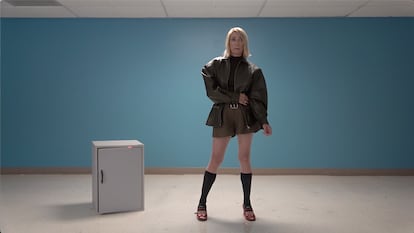

It’s fairly certain that Kim Gordon, 72, has never heard of Francisco Giner de los Ríos, a turn-of-the-century intellectual and educator who in 1876 founded Spain’s prestigious school of higher learning Institución Libre de Enseñanza. But she would wholeheartedly endorse his desire, over the years, to become “more radical and more spotless every day.” At an age when many would choose to retire and live off the fruits of their own legend, the muse of New York’s alternative rock scene and co-founder with Thurston Moore of the band Sonic Youth has released her third solo album.
Play Me contains 12 songs in which the listener recognizes Gordon’s signature sound from the very first chord. They no longer have that raw, dissonant sound of the noisy, nihilistic, and destructive rock of the 1980s and 90s, when the artist became a musical icon everyone wanted to emulate and many women aspired to imitate. Since teaming up with Justin Raisen, the New York-born, California-based music producer specializing in rap and electronic music, her tracks have taken on a hypnotic, industrial cadence and rhythm, aided by Gordon’s voice—half spoken, half sung—which always whispers a vulnerability of someone on the verge of collapse. During her more than two decades with her then-husband, Moore, and fellow guitarist Lee Ranaldo, the artist’s bass sound became the group’s trademark. On the new album, those anarchic and disjointed sounds also resonate as Gordon’s defining characteristic.
When we meet her in the café of a modern luxury hotel in central London, the image of classic elegance and fragility that the singer projects clashes sharply with the content of an album that, with repeated listens, sounds increasingly provocative and critical. Although she returned to California, the land where she grew up and which shaped her character, after the breakup of Sonic Youth and the end of her marriage, Gordon has never stopped creating. “I consider myself a visual artist who makes music,” she explains.
She wears a navy blue knitted jacket with gold buttons and a crest on the side of the breast pocket, almost in a Ralph Lauren style that seems to suggest Gordon has settled down. She orders tea and submits to the conversation with apparent reluctance. She has always cultivated this image of apathy and apparent lack of interest, and of being, unintentionally, the coolest person in the room, although she defends herself against such labels and attributes her attitude to “a shyness and reticence that have always been with me.”
In fact, although her voice is subdued and slow, she doesn’t shy away from any topic of conversation. Donald Trump, Elon Musk, social media, Artificial Intelligence, consumerism, and the renewed attacks against so-called “woke” culture—which, for her, a symbol of a particular feminism of recent decades, represents a series of achievements that must be defended tooth and nail.
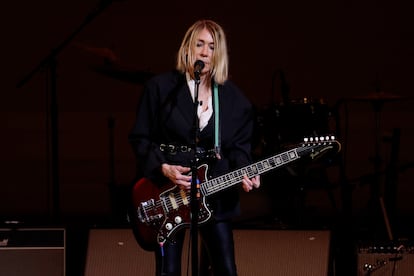
On her previous album, The Collective (2024), she included a track, Bye Bye, whose music video featured her daughter, Coco Gordon Moore. A young woman carries out the rebellious act of running away from home, staying in a motel, and cutting her hair. But it’s the syncopated rhythm with which the singer recites a series of banal, everyday, and also provocative objects and tasks, like an improvised packing list, that makes the song hypnotic. “Pajamas, toothpaste, mascara, lipstick, shampoo, dental floss, call the vet, cigarettes for Keller—Gordon’s brother, who has paranoid schizophrenia, and whose poems the singer published in 2023—… jeans, pajamas, Bella Freud, YSL, vibrator… bye bye,” the lyrics say. It became a TikTok phenomenon. Generation Z rediscovered Gordon, and many girls recorded themselves paraphrasing the list while packing their suitcases.
On the new album, Gordon includes ByeBye25!. It’s the same pounding rhythm, but with the gritty background of a guitar. And this time, the singer recites all those words, concepts, or things that irritate the authoritarian and fanatical hordes that propelled Donald Trump to a second term in the White House. “Electric vehicles, conversion therapy, gay, immigrants… diversity, transgender, Hispanics, women, injustice, opportunities, climate change, elle.”
It’s impossible to elicit an aggressive and direct political discourse from Gordon, but her terse responses clearly reveal her weariness with the direction her country is taking. Her way of combating it is through quiet but persistent provocation, like a pile driver; contempt for everything regressive in Trump’s policies.
“We wanted the album to sound really fast, more focused on the themes, with greater confidence. I wanted to work with a focus on the rhythms, and Justin [Raisen, the producer] understood my voice and my lyrics very well, which stand out more on this album,” explains Gordon, increasingly radical in her criticism of billionaire technocrats like Elon Musk, whom she mocks on the album, and in her denunciation of the anxieties generated by American capitalism. “I’ve always acted more as a sociologist than an artist,” she admits, explaining her obsession with describing the current landscape. This is a legacy from her father, a University of California professor who chronicled the sociology of teenagers in a 1960s book, unaware that his daughter would become a role model for several subsequent generations.
Sign up for our weekly newsletter to get more English-language news coverage from EL PAÍS USA Edition
Tu suscripción se está usando en otro dispositivo
¿Quieres añadir otro usuario a tu suscripción?
Si continúas leyendo en este dispositivo, no se podrá leer en el otro.
FlechaTu suscripción se está usando en otro dispositivo y solo puedes acceder a EL PAÍS desde un dispositivo a la vez.
Si quieres compartir tu cuenta, cambia tu suscripción a la modalidad Premium, así podrás añadir otro usuario. Cada uno accederá con su propia cuenta de email, lo que os permitirá personalizar vuestra experiencia en EL PAÍS.
¿Tienes una suscripción de empresa? Accede aquí para contratar más cuentas.
En el caso de no saber quién está usando tu cuenta, te recomendamos cambiar tu contraseña aquí.
Si decides continuar compartiendo tu cuenta, este mensaje se mostrará en tu dispositivo y en el de la otra persona que está usando tu cuenta de forma indefinida, afectando a tu experiencia de lectura. Puedes consultar aquí los términos y condiciones de la suscripción digital.