It will take the oil market three to five months to return to normal even after a potential ceasefire
Once the Strait of Hormuz reopens, it will be necessary to repair facilities, restart wells, and manage a logistical crisis at sea. Gas and oil prices will continue to reflect geopolitical risks
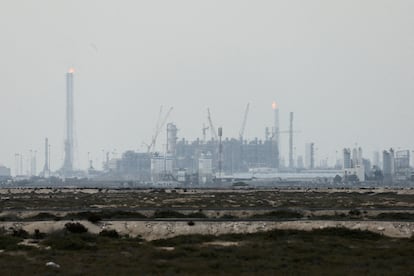

The Strait of Hormuz is neither a curtain nor a barrier that can be easily opened and closed. This strategic enclave, the epicenter of the energy crisis looming over the world, is more like a tube of toothpaste. Traffic came to a sudden standstill when news broke of the U.S. And Israeli attack on Iran, as shipping companies and insurers saw the danger coming even before Iranian retaliation against ships or energy facilities began. Its reopening, however, will be much slower and more complicated, even if the most optimistic forecasts are met. If the war in the Middle East were to end today, it would still take the world months to restore even a modicum of normality to oil supplies.
It will take time to restart the currently idle facilities, repair the damaged ones, and organize the maritime traffic of all the ships—around 2,000—that are currently stranded in the Persian Gulf. And a risk premium will persist in oil and gas prices, reflecting a shock unseen in decades. The industry’s full recovery will not be measured in months, but in years. Just this Tuesday, Qatar invoked force majeure to announce that it will be unable to fulfill its long-term supply contracts with China, South Korea, Italy, and Belgium for a period of five years.
In just three weeks, this upheaval has caused a 45% rise in the price of Brent crude oil and a 70% rise in the price of natural gas. The reopening of this strategic chokepoint is a matter of urgency for the world’s economies, and especially for the United States. Donald Trump, determined to reopen the Strait of Hormuz, faces midterm elections in November and risks triggering a crisis that is already hitting Americans in their wallets, as they pay more for gasoline and diesel.
“First, facilities have been shut down, and it will take time to resume production. They’ll also have to repair infrastructure damaged by the attacks, such as the Ras Laffan gas plant in Qatar. And they’ll need to clear the Persian Gulf of ships that have been anchored there,” explains Jorge León, an analyst at the consulting firm Rystad Energy. Each of these challenges presents daunting figures. The International Energy Agency estimates that more than 40 energy infrastructure sites across nine different countries have suffered “severe or very severe” damage, which will already cause an initial delay in the resumption of supply.
A shortage that will last years
According to energy consultancy Vortexa, the situation has shifted “from a logistical disruption to a structural supply shortage that will last for several years.” In addition, delays in ongoing expansion projects will reduce the projected increase in global liquefied natural gas production capacity for 2028 by 28 million tons per year. It will take Kuwait about four months to recover its production, according to the country’s authorities.
As for oil, traffic through the Strait of Hormuz has averaged just two tankers per day over the past week. Oil flows through the Strait have plummeted by 98%, as has production activity in countries such as Saudi Arabia, Kuwait, Iraq, and the United Arab Emirates, which have now run out of storage capacity. Goldman Sachs notes that the stockpile of oil now floating in tankers stranded in the Persian Gulf has increased by 74 million barrels since February 27, “suggesting that Gulf producers may be approaching the limits of their offshore storage capacity.”
When the Strait of Hormuz reopens, the oil already loaded onto ships will be the first to go on sale, while production operations are restarted and damage is repaired. A VLCC (Very Large Crude Carrier) can transport around two million barrels, and a supertanker, up to four million. A valuable cargo worth $400 million at current prices will rush to leave the Persian Gulf, though not without first navigating a predictable traffic jam of ships. In fact, 2,000 ships and some 20,000 sailors are currently stranded in the Gulf, according to a report last week by Arsenio Domínguez, secretary-general of the International Maritime Organization (IMO), the United Nations agency for maritime affairs.
“It won’t be a matter of just setting off. Coordinated action by the maritime traffic control system will be necessary,” explains Emilio Rodríguez-Díaz, director of the Department of Navigation Sciences and Techniques and Naval Architecture at the University of Cádiz in Spain and a specialist in maritime safety. Thus, just as air traffic controllers manage air traffic, maritime traffic must also be organized—a task handled by Iran and Oman in the Strait of Hormuz. By comparison, about 300 ships pass through the Strait of Gibraltar every day, making it the world’s busiest maritime passage, which is coordinated by control systems of Spain and Morocco. That’s one vessel every five minutes—twice the traffic previously seen in the Strait of Hormuz.
What is already considered the worst oil supply crisis in history has highlighted the vulnerability of the Middle East’s energy infrastructure and the risk posed by the high concentration of crude oil production and storage capacity in the region. “We now expect policymakers to rebuild higher levels of strategic reserves following the reopening of the Strait and for markets to factor in a safety premium in long-term prices,” Goldman Sachs concludes.
Sign up for our weekly newsletter to get more English-language news coverage from EL PAÍS USA Edition
Tu suscripción se está usando en otro dispositivo
¿Quieres añadir otro usuario a tu suscripción?
Si continúas leyendo en este dispositivo, no se podrá leer en el otro.
FlechaTu suscripción se está usando en otro dispositivo y solo puedes acceder a EL PAÍS desde un dispositivo a la vez.
Si quieres compartir tu cuenta, cambia tu suscripción a la modalidad Premium, así podrás añadir otro usuario. Cada uno accederá con su propia cuenta de email, lo que os permitirá personalizar vuestra experiencia en EL PAÍS.
¿Tienes una suscripción de empresa? Accede aquí para contratar más cuentas.
En el caso de no saber quién está usando tu cuenta, te recomendamos cambiar tu contraseña aquí.
Si decides continuar compartiendo tu cuenta, este mensaje se mostrará en tu dispositivo y en el de la otra persona que está usando tu cuenta de forma indefinida, afectando a tu experiencia de lectura. Puedes consultar aquí los términos y condiciones de la suscripción digital.