Marzio G. Mian, journalist: ‘The Arctic is the new Congo’
The Italian reporter has carried out multiple investigations in the region and points out that the Inuit have no allegiance to Europe
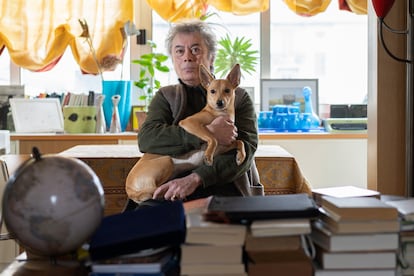

Italian journalist and explorer Marzio G. Mian is one of the world’s greatest experts on the Arctic, where he has been traveling for 30 years. He founded The Arctic Times Project, an association of international journalists for the documentation of climate change in this frozen landscape. He has just returned from Canada and will soon be going to South Korea, to see the ports and shipyards created to serve the Chinese polar route.
We meet at his home in Milan, a place filled with books. He cooks up pasta, believing that people get to know each other better over food. In his suitcase there is always spaghetti, oil, and oregano, and this is how he has gotten to know the Inuit of Greenland — by cooking with them. “They are obsessed with food, with surviving,” he says. He points out that the recent agreement between Trump and NATO chief Mark Rutte proves once again that the Inuit are not being consulted, neocolonial style. “It’s the beginning of Greenland’s entry into the U.S. Sphere,” he says.
Mian is the author of two books that are essential to understanding what is happening near the North Pole: White War. On the Arctic Front of the World Conflict and Arctic. The Battle for the Great North. He will soon publish Volga Blues, a journey along the great Russian river. In 2024, he was nominated for the Pulitzer Prize for another book on Russia.
Question. When did you realize that the world’s geopolitical future was playing out in the Arctic?
Answer. The Arctic is the new Congo. It feels like a new world. But things happened there that were not talked about. In Norway, on the border with Russia, the situation was clear. The USSR liberated them from the Nazis. They had a historic collaboration agreement. The war in Ukraine put an end to that. In 2016, an exclusive deal was made in Greenland — a uranium and rare earth mine in Narsaq with capital from the Chinese Ministry of Defense. That’s when the alarm bells went off. It makes a perfect story: a small place that reflects everything going on in the world. And then there are the Inuits.
Q. What are they making of it?
A. I spent time eating with them, everything but seal, I don’t like seal. Reindeer, whale, walrus are all delicious! What do they think? An Inuit does not say, I think this or that. You can’t ask what they think of Trump. They do not use the first person, they do not use the self. They are part of a whole, of a community. Facebook has killed them: it’s an inconceivable type of narcissism for them. It is the place with the most suicides. They do not feel prepared to deal with this world.
Q. When did you see the possibility of conflict in the Arctic?
A. NATO was carrying out bigger maneuvers than in the Cold War. And in the Russian Arctic, where few journalists enter, I understood what was at stake. Anyone who knows Russia and its paranoia knows that Putin means it when he says, there is no Russia without the Arctic, and there is no Arctic without Russia. The deterrents that worked in the Cold War, such as the atomic bomb, no longer apply. The USSR was an atheist empire; Russia is something else. It has this self-destructive and apocalyptic element — a tendency to take the wrong path in history.
Q. Does Russia sense a threat in the Arctic?
A. They have been there since the 18th century, along 24,000 kilometers of coastline. The Arctic is like the Mediterranean if you look at it from above. That’s how they see it in the United States. They see themselves as an Arctic power, but not a superpower, like Russia, which has 40 or 45 icebreakers while the United States has only two.
Q. They are late to the party.
A. They need to catch up in terms of physical presence. Mainly, they want to install the Golden Dome, an anti-missile shield. During Biden’s presidency, there was already strong intervention in Greenland. They expelled the Chinese in three years. Contracts were awarded, and they had two sulfur mines. Silicon Valley’s Peter Thiel also wanted to turn Greenland into a lawless libertarian utopia. If Trump’s project does not materialize, it will be Trump’s fault alone. The Inuit have no allegiance to Europe. One hundred percent of them want independence from Denmark. And they know that by making a pact with the United States, the Inuit of Alaska have become rich from the profits of mining.
The Arctic was brutally colonized by the United States, Canada, and Denmark with the complicity of the Catholic and Anglican Church, something that is not talked about. On my last trip, I was in Grise Fiord, Canada, the northernmost settlement on the continent. The Inuits were deported there by Canada in 1953, at the height of the Cold War. The U.S. Sent 10,000 troops to Thule (in Greenland), and, in order to exercise its sovereignty, Canada had to send people who could survive. They deported Inuit from Quebec 2,500 kilometers to the north, by lying to them. They died within months. What I have discovered is that they planned to take them even further north, to where there is a radar station: that is where the United States and Canada are engaged in a face-off now. The Northwest Passage has become a priority for the United States. And Canada believes it is theirs.
We are in a war at a level that precedes war, with no shooting. The two world wars started like this
Q. So the tension between Canada and the United States is no small deal.
A. No, the recent agreement between Canada and China is incredible, and challenging for Trump. We are in a war at a level that precedes war, with no shooting. The two world wars started like this. And we see a tendency to present war as inevitable in Europe. NATO should have disappeared with the USSR in 1991. Its mission ended there. That’s the mistake.
Q. Does the key lie in the Arctic’s natural resources and minerals?
A. That and geography. Exploiting the Arctic is expensive. Russia is the only country with experience, but it needs the oil companies that left with the sanctions. The U.S. Wants it too. There is a kind of Yalta in the Arctic. It is not unusual that Putin and Trump’s summit was held in Alaska.
Q. So, in reality, there is a desire for cooperation between Russia and the United States.
A. Exactly. Putin said he was not surprised by America’s ambitions in Greenland — he gave the green light. The alarm was raised when NATO troops were sent there. The relationship between Trump and Putin is stronger than we imagine. Who knows, perhaps they want to break up NATO. Russia also suffers from the alliance with China, its historical enemy. It would not be strange for China to support a weak Russia if need be.
Q. Isn’t big business the best antidote to war?
A. Yes. One of the partners of a Delaware consortium for trade agreements with Greenland is the island’s foreign minister: they want to export iceberg water. The purest water in the world!
Q. And what will happen when the pole melts, estimated to happen in the summer of 2035? It will totally alter the climate in Europe.
A. Russia and Canada are the biggest beneficiaries of climate change. Russia already farms in southern Siberia. In Canada, there are real estate companies that invite funds to invest in unheard of places, such as Yukon, northern Alberta.
Q. Trump is a climate change denier, but he knows it exists in the Arctic.
A. Yes. Putin is not a denier. He has a problem with permafrost; it melts and infrastructures crumble. In Russia there has been an environmental disaster with Arctic mines of nickel and cobalt. These escaped European sanctions; they are used to manufacture electric cars... Non-polluting. There has never been so much hypocrisy as there is today.
Sign up for our weekly newsletter to get more English-language news coverage from EL PAÍS USA Edition
Tu suscripción se está usando en otro dispositivo
¿Quieres añadir otro usuario a tu suscripción?
Si continúas leyendo en este dispositivo, no se podrá leer en el otro.
FlechaTu suscripción se está usando en otro dispositivo y solo puedes acceder a EL PAÍS desde un dispositivo a la vez.
Si quieres compartir tu cuenta, cambia tu suscripción a la modalidad Premium, así podrás añadir otro usuario. Cada uno accederá con su propia cuenta de email, lo que os permitirá personalizar vuestra experiencia en EL PAÍS.
¿Tienes una suscripción de empresa? Accede aquí para contratar más cuentas.
En el caso de no saber quién está usando tu cuenta, te recomendamos cambiar tu contraseña aquí.
Si decides continuar compartiendo tu cuenta, este mensaje se mostrará en tu dispositivo y en el de la otra persona que está usando tu cuenta de forma indefinida, afectando a tu experiencia de lectura. Puedes consultar aquí los términos y condiciones de la suscripción digital.